In yesterday’s posting “The breakfast walk”, one notable feature of that walk was what is now the elegant Nobu Hotel Epiphany, which preserves (from the earlier Casa Olga hotel) the 6-story-tall mosaic mural of El Palo Alto, the coast redwood tree for which the city of Palo Alto is named:
(#1) The Casa Olga mural
(#2) The mural on the much-expanded Nobu Hotel Epihany
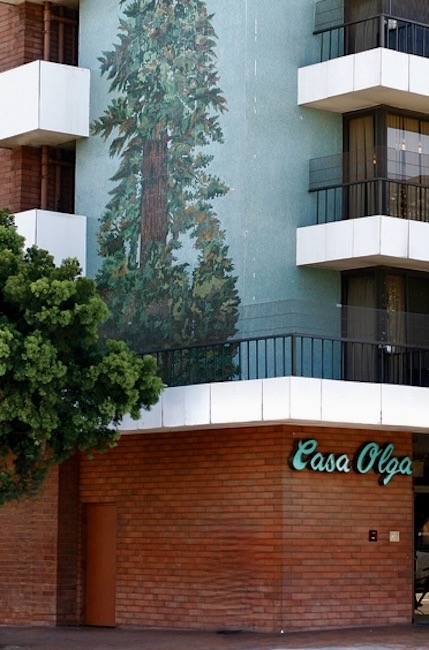

I remind you that this is a short distance from my house, but has just become part of the urban landscape, taken for granted — as indeed we take for granted the many actual coast redwoods growing companionably on our streets (reaching straight into the sky, towering over a hundred feet, easily hundreds of years old). (There’s one such tree only about 50 feet from my front door.)
And I remind you that the tree in #1 and #2 is not an abstract or imagined coast redwood, but a specific Sequoia sempervirens — El Palo Alto — that grows in a little urban forest park, alongside the railroad tracks (originally Southern Pacific, now Caltrain) at the border between Palo Alto (in Santa Clara County) and Menlo Park (in San Mateo County), only abut 7 blocks from my house.
El Palo Alto. From Wikipedia:
El Palo Alto (Spanish: ‘the tall stick’ [or ‘stake’ or ‘pole’, in some contexts even ‘tree’]) is a coast redwood (Sequoia sempervirens) located on the banks of San Francisquito Creek in Palo Alto, California, a city in the San Francisco Bay Area. The namesake of the city and a historical landmark, El Palo Alto is 1085–1086 years old and stands 110 feet (34 m) tall.
Before European arrival, the land around El Palo Alto was home to the Ohlone Native Americans. Local folklore holds that El Palo Alto was a rest stop for the first European expedition that discovered San Francisco Bay, led by Spanish explorer Gaspar de Portolá in 1769. The tree became widely known with the early-1850s establishment of a highway between San Francisco and San Jose, and as a landmark along the San Francisco–San Jose railroad, construction of which passed the tree in 1863. In 1876, Leland Stanford, co-founder of Stanford University along with his wife Jane Lathrop Stanford, purchased land near El Palo Alto.
Early images and accounts indicate that El Palo Alto once had two trunks. It lost one trunk before 1883 — the exact date is unknown — perhaps due to heavy rainfall and erosion of the riverbank. Fearing the tree’s total loss, Leland Stanford directed that the riverbank be reinforced with a wooden bulkhead, which was replaced with concrete abutments in 1904 and again in 1911. Coal soot from steam locomotives passing below the tree suffocated the leaves of the tree’s upper limbs; nearby wells lowered the water table, and by the late 1920s the tree was declared moribund. Although it has decreased in stature by some 50 ft (15 m) since the late 1800s, El Palo Alto was ultimately saved by the continuous preservation efforts of the city, local arborists, Stanford University, and Southern Pacific (the owner of the adjacent railroad); a 1997 appraisal concluded that the tree would “persevere and grow for centuries to come”.
… The tree remains prominent on the City of Palo Alto seal, in the Stanford University seal, and as a mascot in the university’s marching band. [yes, an undergraduate cavorts in a tree costume]
The pal– of Spanish palo is, historically, the pal– of English palisade. From NOAD:
noun palisade: [a] a fence of wooden stakes or iron railings fixed in the ground, forming an enclosure or defense. [b] historical a strong pointed wooden stake fixed deeply in the ground with others in a close row, used as a defense…. ORIGIN early 17th century: from French palissade, from Provençal palissada, from palissa ‘paling’, based on Latin palus ‘stake’.
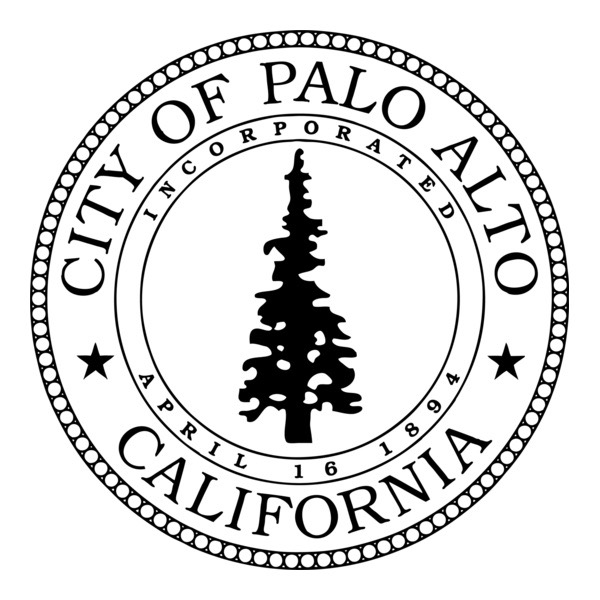
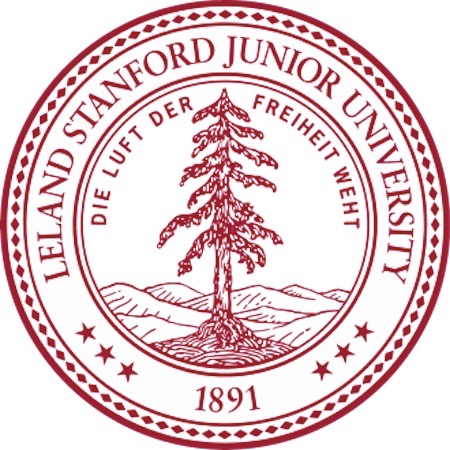
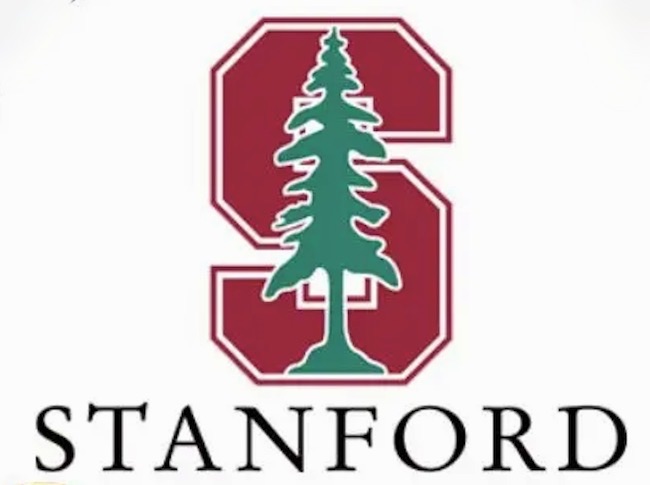
More discussion in my 10/11/13 posting “palisade”, where there’s also a muddy photo of the famous El Palo Alto (muddy because the tree is growing in a stand of coast redwoods, so it’s not easy to distinguish it from its neighbors). Mostly, El Palo Alto comes to us in images abstracted from reality, as a symbol — in the city’s seal, the university’s seal, and the university’s logo:
(#3) The Palo Alto city seal
(#4) The Stanford University seal
(#5) Maximum abstraction: the Stanford logo
Leave a Reply