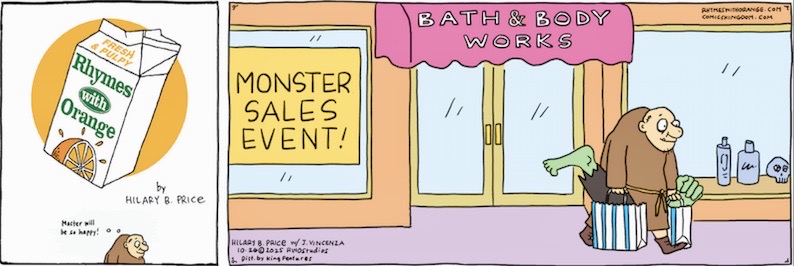
In today’s Rhymes With Orange strip, a sale at Bath and Body World:
A sale of body parts from and/or for monsters — not what comes to mind when you come across the N + N compound monster sale, which is a dauntingly large sale, one that’s (metaphorically) a monster
Now the details.
Background. From NOAD:
noun monster: [a] an imaginary creature that is typically large, ugly, and frightening. [b] an inhumanly cruel or wicked person: he was an unfeeling, treacherous monster. [c] often humorous a person, typically a child, who is rude or badly behaved: Christopher is only a year old, but already he is a little monster [d] a thing or animal that is excessively or dauntingly large: this is a monster of a book, almost 2,000 pages | [as modifier]: a monster 120-mm gun. [e] a congenitally malformed or mutant animal or plant.
Sense d is the one at issue in what follows.
The expected understanding. This is as a Predicative compound monster N2 ‘dauntingy large N2’, as in monster truck (cf. jumbo truck ‘huge truck’), monster abs (cf. killer abs ‘formidably impressive abs’), monster mistake (cf. giant mistake ‘gigantic mistake’); and so monster sale ‘enormous sale’
Note: nouns used predicatively — as monster, jumbo, killer, and giant are in the examples above, and as midget is in midget truck ‘tiny truck’ — are sometimes said to be adjectives (to belong to the syntactic category Adjective) — but most of them are nouns used predicatively, in an adjectival function; they belong to the category Noun, not Adjective (and, among other things, don’t allow degree modification: *very / really / more / less monster truck vs. ✓very / really / more / less monstrous truck).
Note on Note (life is complex): there are some doublets — homophonous items, one an Adjective, the other a Noun, in particular fun, mammoth, and dwarf. Such pairs are likely to develop, because both predicating Adjectives and predicating Nouns can occur as predicate complements (his abs are gigantic / giant).
The cartoon understanding(s). Here, things are still more complex, because the Bath and Body World customer both looks more than vaguely monster-like and is also carrying off bags of what look like body parts of (or perhaps for) a monster. Two possible understandings, then, of what’s on sale:
Object compound N1 sale ‘a sale of / on N1(s)’, as in book sale, kitchenware sale, hardware sale; and so monster sale ‘a sale of monsters’
Use compound N1 sale ‘sale of things for use by N1(s)’ (cf. baby food ‘food for use by a baby’), as in mystery reader sale, novice cook sale, toolsmith sale; and so monster sale ‘a sale of stuff for monsters’
It might well be that Hilary Price intended that we should entertain both understandings at once; a comic strip is, after all, a work of popular art, and artists of all sorts are inclined to invite multiple interpretations in their works.
[Added 1/27: a less tortured interpretation, from Robert Coren in his comment below: the customer is Victor Frankenstein’s servant Igor from the movies.]
October 27, 2025 at 6:32 am |
The character is pretty clearly Dr. Frankenstein’s servant/assistant Igor, purchasing parts that his boss will use in putting together the monster. (I have not actually read Shelley’s book, or for that matter seen any of the classic Frankenstein movies, but I’m aware of “Igor” as being stereotypically associated with the legend.)
October 27, 2025 at 7:45 am |
Ah yes, of course Igor. Thank you.