From Tim Evanson on Facebook yesterday, this cover art by J.C. Leyendecker (1874-1951): The Literary Digest of 6/12/1909:
(#1) Homoerotic soft porn in the style of classical sculpture (complete with a laurel wreath for the author au naturel); the laurel wreath identifies the writer as an incarnation of Apollo, the god of poetry, who is often depicted with a laurel wreath (recalling his desire for Daphne, a nymph who was transformed into a laurel tree to escape the god’s advances); meanwhile, the writer is nude, because he’s a god (the model for this drawing was JCL’s favorite model, also his partner in life, Charles Beach (1881-1954))

I’m a writer (among other things), and I mostly work in my underwear, but I don’t write commando. Well, I’m no Charles Beach, and certainly no Apollo.
One more divine Beach cover by JCL. From my 9/15/24 posting “Speeding into the 20th century”, with this cover of Collier’s magazine from 1/19/1907 (two years before #1), about
an early J.C. Leyendecker work of gay soft porn in the style of classical sculpture (an art form that lets the artist get away with a lot), which is also a hymn to rapid transport in the early 20th century:
(#2) “The Speed God” [Mercury] posed with a stylized caduceus against a hot air balloon, while the messenger of the Roman gods poses his muscular body on the hood of an early automobileAnd then there are Mercury’s truly fabulous winged sandals, which appear to be living creatures in their own right.

Two things now. First, Charles Beach, the model in #1 and #2. Then, more on Apollo and Daphne, the story alluded to in #1.
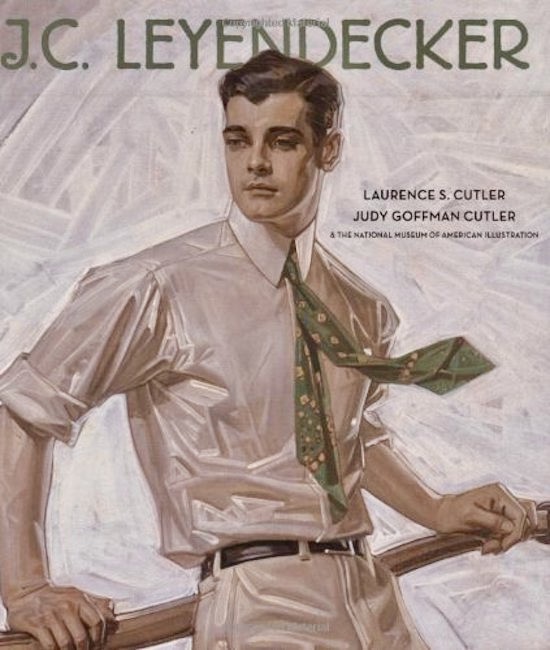
Charles Beach. JCL’s companion for most of his life. From J.C. Leyendecker: American Imagist by Laurence S. Cutler & Judy Goffman Cutler (2008):
Norman Rockwell described Charles Beach as: “tall, powerfully built, and extraordinarily handsome — looked like an athlete from one of the Ivy League colleges. His manners were polished and impeccable… ” He was Joseph Leyendecker’s ideal man.
The cover of the book:
(#3) Not JCL, but Charles Beach, in one of JCL’s ads
From my 7/10/20 posting “Hiding homosexuality: JCL”, in a quote from the Messy Nessy Chic: Cabinet of Curosities site (a Parisian boutique):
… The magnum opus of his work … is “The Arrow Collar Man”, a character created for a shirt company who became one of the early-20th century’s biggest male sex symbols. “[He] had about as large a place in the pantheon of hotness as Rudolph Valentino, Elvis, and the Marlboro man,” explained Vogue’s Laird Borrelli Persson.
… Americans were swooning, as was J.C., and with good reason: the model behind the Arrow Collar Man was none other than the muse and love of his life, Charles Beach
Leyendecker lived with Charles in a splendid house in New Rochelle, New York, where they threw party after party in true Roaring Twenties glory, embodying the decadence of the era and indulging in their own real-life Gatsby fairytale thanks to the artist’s success.
If Leyendecker’s sexuality was understood in the industry, it was kept quiet from the audience. But his work did all the talking, albeit in coded messages; suggestive side staring, a preference male-centric environments like locker rooms, clubhouses and tailoring shops. It’s as if Leyendecker was trying to communicate with a gay audience through secret glances and homoerotic undertones. Wartime was also a good space for homoeroticism to hide in plain sight and J.C. painted numerous recruitment posters for the United States military and the war effort.
Apollo and Daphne, In two works of art, a sculpture from the 17th century and a painting from the 18th.
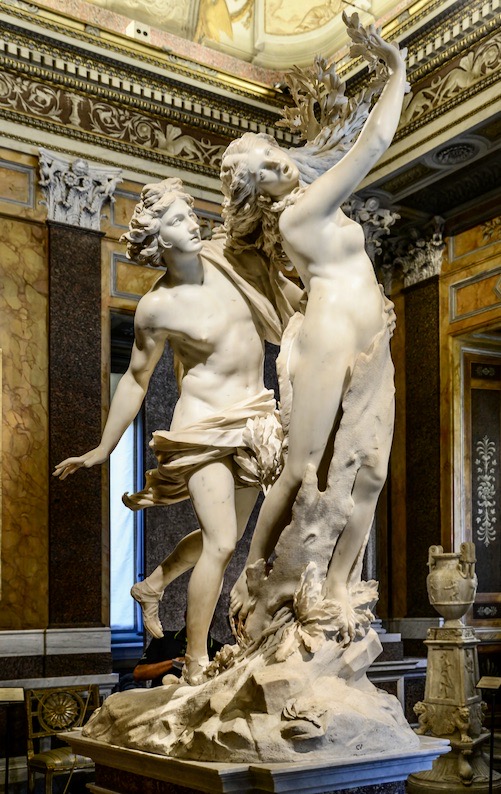
The Bernini. From Wikipedia:
(#4) The statue in the Galleria Borghese in Rome, where it’s housed along with several other examples of the artist’s most important early worksApollo and Daphne is a life-sized marble sculpture by the Italian artist Gian Lorenzo Bernini, which was executed between 1622 and 1625. It is regarded as one of the artistic marvels of the Baroque age … The sculpture depicts the climax of the story of Apollo and Daphne …, as written in Ovid’s Metamorphoses, wherein the nymph Daphne escapes Apollo’s advances by transforming into a laurel tree.
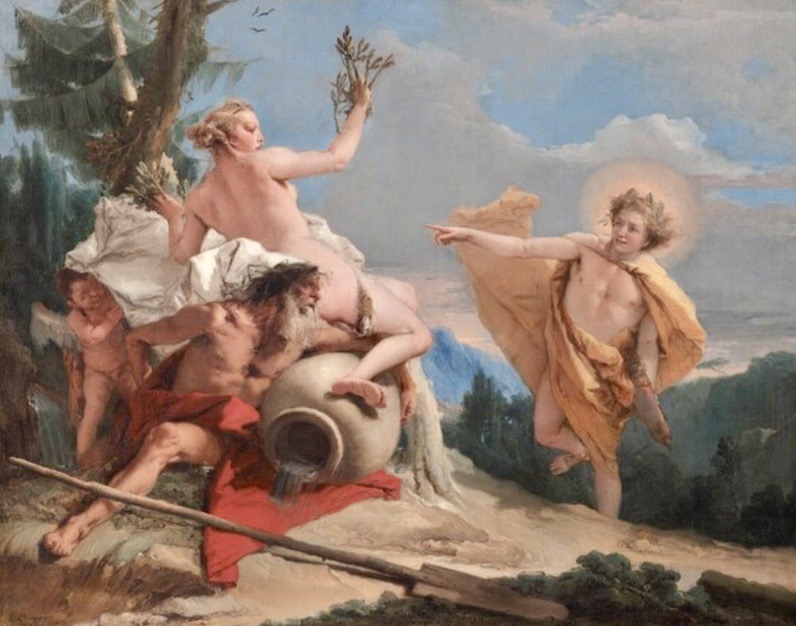
The Tiepolo. The National Gallery of Art (in D.C.) site on Giovanni Battista Tiepolo’s Apollo Pursuing Daphne (c. 1755/1760):
(#5) From left to right: Cupid, Peneus, Daphne (in the midst of turning into a tree), Apollo (in a halo of sunlight); probably not Apollo’s best momentThroughout his career Tiepolo painted small pictures of mythological themes, which proved extremely popular. The subjects of these works came from the best–known episodes from ancient literature, but his conception of the stories was varied and original. His depiction of Apollo and Daphne comes directly from Ovid’s Metamorphoses. Daphne, the beautiful nymph and follower of the chaste goddess Diana, was pursued by the sun god Apollo, who had been struck by Cupid’s golden arrow of love [AZ: Cupid made me do it, was his excuse]. Fleeing Apollo, Daphne reached her father, the river god Peneus, seen here at left. To avoid Apollo’s unwanted advances, she was turned into a laurel tree. The transformation takes place before us as her leg turns into a trunk and her arms sprout branches.
The Apollo Pursuing Daphne is unique among interpretations of the theme. Apollo’s forward thrust seems to propel Daphne backward in a composition of excited movement. Cupid takes cover from the wrath of Apollo that will shortly ensue, and Peneus remains firmly rooted in an effort to stop the ardent pursuer. The off–center composition, typical of Venetian art, was used by Tiepolo elsewhere but never in such a dramatic and emotionally intense manner.
Balked in his intention to descend upon Daphne like the blazing sun, Apollo retired to a life of writing, mostly raunchy poetry, which he set to tunes on his divine lyre. #1 shows him at work on his masterpiece, Sun God Jazz, also known as Ladies of Laurel Canyon.
December 8, 2024 at 3:24 pm |
That final reference to Ladies of Laurel Canyon brings me to the stew of sexual vocabulary and sexual allusion in my 10/16/17 posting “Revisiting 8: Rod Canyon”, about
https://arnoldzwicky.org/2017/10/16/revisiting-8-rod-canyon/