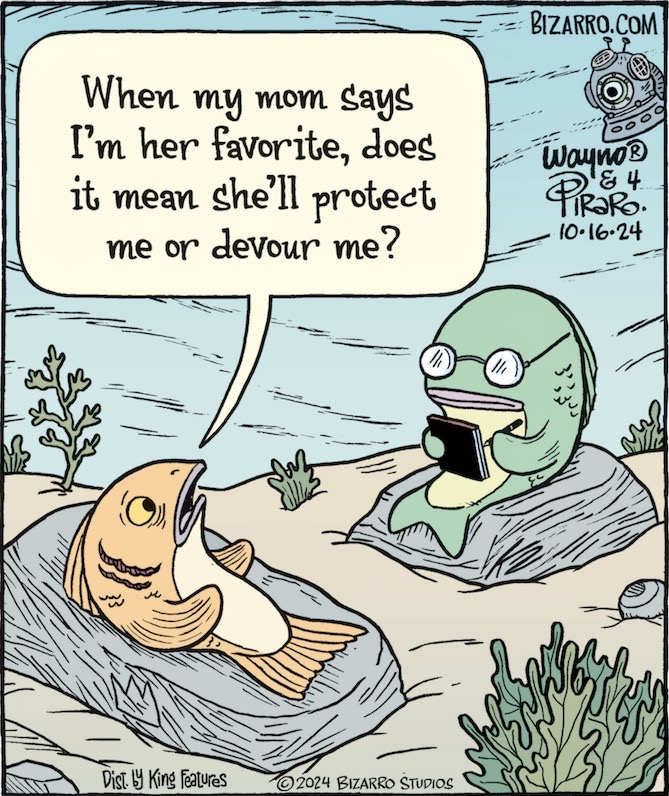
… in yesterday’s (10/16) Bizarro (Wayno’s title: “Subaquatic Psychology Session”):
All about the noun favorite: an implicit superlative, denoting a top-ranking element in some comparison set, but it’s way more complex than that, and the joke turns on one of those complexities (if you’re puzzled by the odd symbols in the cartoon — Wayno says there are 4 in this strip — see this Page)
The relevant complexity becomes clear when you look at some explicit superlatives, in questions like these:
Who is the biggest? What is the best?
These are baffling out of context. Because they are consistent with so many different contexts. But these aren’t differences in what the questions mean; dictionaries wouldn’t have different entries for the many kinds of being the biggest or the best. In technical talk, the questions aren’t many-ways ambiguous, but are instead, neutral, or unspecified, with regard to the different kinds of being biggest or best.
It’s much the same for the implicit superlatives, in questions like:
Who is your favorite? What is my favorite?
There are so many kinds of favorite things (try not to think of The Sound of Music). Favorite places, favorite friends, favorite songs, and on and on. Favorite children and favorite foods, in the case of the cartoon. If your mom tells you you’re her favorite, and you’re a fish (of a race of talking fish, from CartoonWorld), then either of those is a genuine possibility — but of course maybe she’s saying you’re her favorite tennis partner or her favorite artistic swimmer or whatever. Neutrality all the way. (Though the more you know about the context, the narrower the range of understandings becomes.)
The lexical items. From NOAD:
noun favorite: [a] [AZ: ‘a highly favored one, the most favored one’] a person or thing that is especially popular or particularly well liked by someone: the song is still a favorite after 20 years ..
adj. favorite [AZ: the adjing of the noun in sense a]: [attributive [only]] preferred before all others of the same kind: their favorite Italian restaurant.
A different complexity. Favorite is understood as a superlative, but there are two relevant uses of the superlative, denoting either an upper bound (the greatest minds of their generation) or merely a high rank (a most delightful dinner companion ‘a very delightful dinner companion’ — a usage often referred to as the absolute superlative, indicating extreme degree without comparison). As you can see from my bracketed note on the noun favorite, this item has both uses: upper-bound ‘the most favored one’ and absolute ‘a highly favored one’, as in the cite of still a favorite.
A further complexity. Upper-bound superlatives, even in combination with definite determiners (the and possessives like my), don’t necessarily pick out a unique referent, since they can be used with plural head nouns to pick out a set of referents at the upper bound: the greatest minds of their generation, my favorites in the class. Then, automatically, there will be some vagueness in the lower bound of this set. (But though it’s fine to talk about the 3 smartest students, or your 3 favorite students, in a class of 30, it’s odd to talk about 3 out of 5 that way, or 20 out of 30; so there’s some version of the Paradox of the Heap lurking here too.)
And a still further one. Things are fairly well-behaved for adjectives denoting objectively measurable qualities (though imps lurk in measurement too), but not at all in those denoting subjective characteristics, like amusing and favorite, where different people will have different judgments, and where even a single person will have different judgments in different contexts, at different times, for different purposes, and so on. I am notably resistant to answering questions of the form who / what is your favorite X? —
Who is your favorite composer? What is your favorite dish?
maintaining that — given the definite determiner your and the singular number of composer and dish, together signaling uniqueness — the question is unanswerable, though I could list a large number of composers whose works please me greatly, in different ways on different occasions; and a similarly large number of dishes that I like a lot, again in different ways on different occasions.
For another time. Three topics related to these core issues about explicit superlatives and the implicit superlative favorite.
First, the recent innovation of a ‘bookmarked web address’ sense of the noun favorite (and its verbing to favorite (a site)).
Second, a contrast between the cases above, which I argue illustrate neutrality rather than ambiguity, and some cases that I have recently argued illustrate ambiguity rather than neutrality.
And third, a bit of musing on Los Favoritos — Arizona taco shops and an Arcángel song — in American Spanish.
Leave a Reply