In this morning’s comics feed, two linguistic jokes from the Roman Empire (in a Rhymes With Orange and a Bizarro); maybe it’s just something in the air, but on the other hand, September 4th, 476, marks the end of the Western Roman Empire as a political entity and consequently (in some people’s view) the beginning of the Middle Ages. So let’s say goodbye to the boy emperor Romulus, aka Augustulus, and antiquity; and hello to the barbarians and, oh yes, medieval times!
Bye-bye, Imperial times
Took Romulus to the border, to see the Empire die
I’ll get to Augustulus in a while. But first the cartoons.
The Rhymes With Orange. Two Roman legionnaires greeting each other:
(#1) Greeting each other with high fives, in the Roman fashion

From NOAD, on the idiom:
noun high five: informal, mainly North American a gesture of celebration or greeting in which two people slap each other’s open palm with their arms raised: they gave each other an exuberant high five in the middle of the press center. verb high-five: [with object] greet with a high five: the two officers high-fived each other.
Q: Why high five? A: high because the arms are raised; five from the five fingers on one hand.
Then, instead of displaying the five fingers of one hand, the two Roman legionnaires are displaying a V sign, because the Roman numeral for ‘five’ is V. Think of it as a kind of manual pun.
The Bizarro. This one turns on a straightforward, though phonologically imperfect, pun:
(#2) antonym ‘opposite’ as a pun on the Antony of Antony and Cleopatra — as in the Shakespeare play, on the passionate (but doomed) relationship between Cleopatra, the Egyptian queen, and Marcus Antonius (Mark Antony in English), as an agent of the Roman occupation of Egypt

The Shakespeare. From Wikipedia:
Antony and Cleopatra is a tragedy by William Shakespeare. The play was first performed around 1607, by the King’s Men at either the Blackfriars Theatre or the Globe Theatre.
… The plot is based on Thomas North’s 1579 English translation of Plutarch’s Lives (in Ancient Greek) and follows the relationship between Cleopatra and Mark Antony from the time of the Sicilian revolt to Cleopatra’s suicide during the War of Actium.
Other tellings. The story has been re-told many times, in a variety of forms, including several notable films. The most extravagant of which is surely the 1963 Cleopatra; from Wikipedia:
Cleopatra is a 1963 American epic historical drama film directed by Joseph L. Mankiewicz, with a screenplay adapted by Mankiewicz, Ranald MacDougall and Sidney Buchman from the 1957 book The Life and Times of Cleopatra by Carlo Maria Franzero, and from histories by Plutarch, Suetonius, and Appian. The film stars Elizabeth Taylor in the eponymous role, along with Richard Burton, Rex Harrison, Roddy McDowall and Martin Landau. It chronicles the struggles of the young queen Cleopatra VII of Egypt to resist the imperial ambitions of Rome.
From the film:
(#3) Taylor (then 31) and Burton (then 36), in golden times; they fell in love, and lust too, on the set
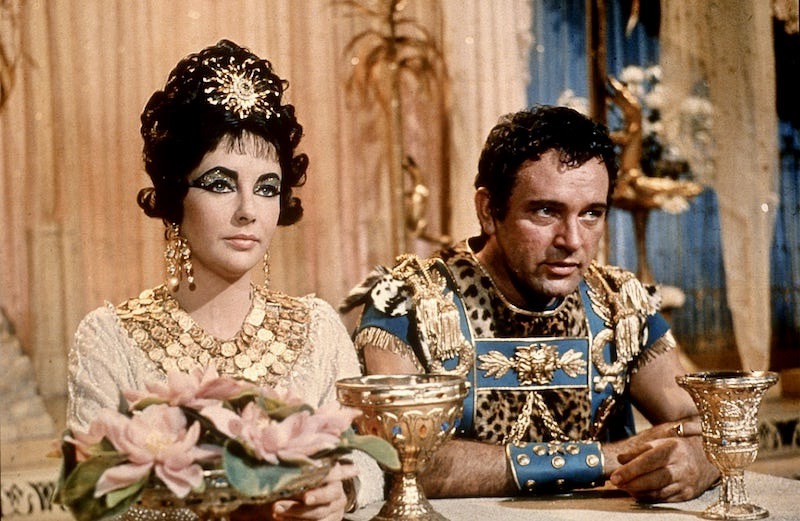
Even the film’s trashy indulgence of glitz and glamor and its absurd length can’t entirely overwhelm the poignant story; and Rex Harrison as Caesar, Roddy McDowell as Octavian, and Richard Burton as Mark Antony stand out for their characterizations (despite an erratic script). Elizabeth Taylor changes her costume every few minutes — I am not making this up — and is way out of her depth as Cleopatra (meanwhile, Burton figuratively reeks of testosterone, which works fine for the Mark Antony character). So in my opinion it’s a long vulgar mess with gems in it, which makes it, in my recollection, immensely enjoyable. I really should watch it again — but four hours would be a gigantic investment of my precious time.
Romulus Augustus Day, September 4th. From Wikipedia:
Romulus Augustus (c. 465 – after 511 [AZ: he was pretty much a cipher before 476, then vanished into obscurity afterwards]), nicknamed Augustulus, was Roman emperor of the West from 31 October 475 until 4 September 476. Romulus was placed on the imperial throne while still a minor by his father Orestes, the magister militum, for whom he served as little more than a figurehead. After a rule of ten months, the barbarian general Odoacer defeated and killed Orestes and deposed Romulus. As Odoacer did not proclaim any successor, Romulus is typically regarded as the last Western Roman emperor, his deposition marking the end of the Western Roman Empire as a political entity. The deposition of Romulus Augustulus is also sometimes used by historians to mark the transition from antiquity to the medieval period.
Remember, remember, the 4th of September
Leave a Reply