Acres, folks, acres. Diamonds and dildos got covered in my 8/26 posting “Acres of dildos”. Then from Wendy Thrash on Facebook the next day, more acres that I probably should have talked about in the first place. WT wrote:
Sorry, but as an old Seattleite this forces me to think of Acres of Clams
and referred to a Folk Music Blog posting, “The Songs of Ivar Haglund” by Jacqui Sandor on 5/28/19. I was just going to post WT’s note as a comment on my posting here, but then it occurred to me that “Acres of Clams” might not be familiar to everyone, and even if you know about the folk song (a text climaxing in acres of clams, set to an old Irish jig tune), the note might not have transported your imagination to Seattle, or, indeed, to Ivar Haglund. It might just have been baffling.
So now I will take you into a gigantic morass of the folk song world — in which, however, shines the canonical “Acres of Clams” text, which ends up being about Puget Sound (where Seattle is located), where clams abound, and where there’s a seafood restaurant founded by folksinger Ivar Haglund named Ivar’s Acres of Clams. You see, it does hang together. (And, despite the previous dildos, the clams in question are — surprise! — not lady-parts, but edible bivalves.)
The morass is a consequence of the fact that an extraordinary number of texts have been set to that same jig tune — possibly more than to any other folk tune — and then both the tune and all those texts have been popularly known by names that are phrases from the texts (you’ll see a small sampling of these names in a moment). Even the canonical clam text (from about 150 years ago) is so popular that virtually every folksinger who performs it alters the text to fit their own interests, passions, aims, and politics.
To set the stage, from the HistoryLink site:
(#1) From “Ivar Haglund opens Ivar’s Acres of Clams at Pier 54 in July 1946” by David Wilma on 6/19/00

The folk song. Briefly, from Wikipedia:
“Old Settler’s Song (Acres of Clams)” is a Northwest United States folk song written by Francis D. Henry around 1874. The lyrics are sung to the tune “Old Rosin the Beau.” The song [text] also goes by the names “Acres of Clams”, “Lay of the Old Settler,” “Old Settler’s Song,” while the melody [AZ the tune, that Irish jig] is known as “Rosin the Beau,” “Old Rosin the Beau,” “Rosin the Bow,” “Mrs. Kenny,” “A Hayseed Like Me,” “My Lodging’s on the Cold, Cold Ground.” The Sacred Harp song “338 Sawyer’s Exit” … uses the tune. The tune was also used for the song “Denver”, which was recorded by The New Christy Minstrels in their 1962 live performance album The New Christy Minstrels – In Person.
The first recorded reference to this song [the “Acres of Clams” text + the jig tune] was in the Olympia, Washington newspaper the Washington Standard in April 1877.
… The song achieved prominence decades later when radio-show singer Ivar Haglund used it as the theme song for his Seattle, Washington radio show. Pete Seeger and Woody Guthrie said that they taught the song to Haglund. Haglund went on to name the Seattle restaurant “Ivar’s Acres of Clams” after the last line from the ballad
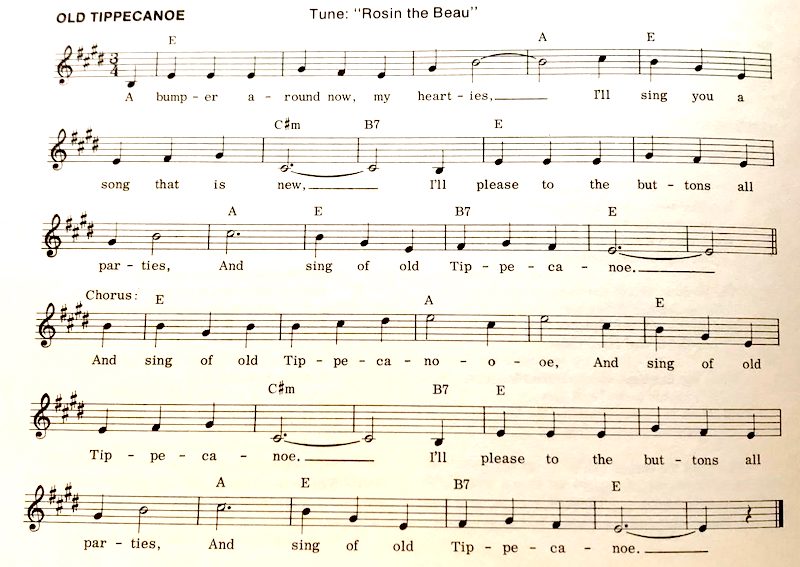
Two non-clam uses of the tune. One political, one religious. First, the political:
(#2) Circa 1840, “Old Tippecanoe” is a campaign song for William Henry Harrison sung to the tune of “Rosin the Bow”, as printed in Songs America Voted By (Silber 1971)
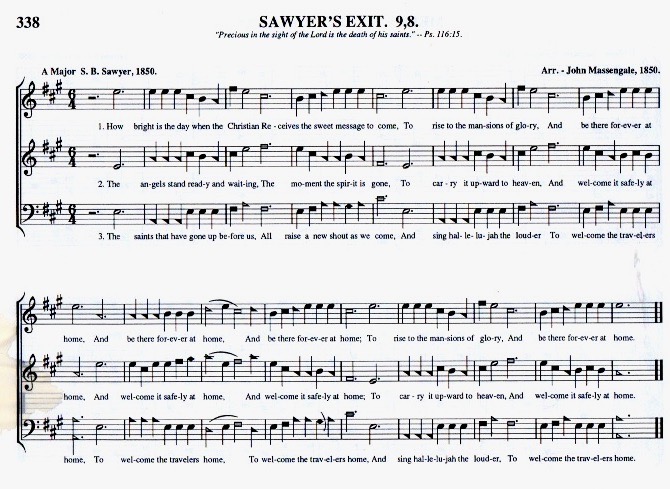
Then, the religious: Sacred Harp 338, Sawyer’s Exit (from the 1991 Denson Revision):
(#3) Shapenote music written for treble, tenor, and bass, without an alto line; the melody is in the tenor line
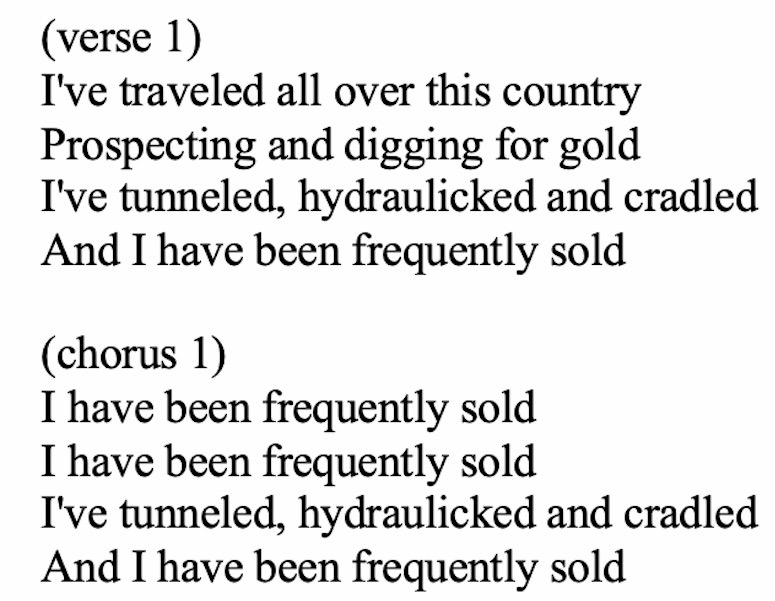
The canonical clam text. Nine verses, each with its own chorus (riffing on the last line of the verse). Here’s the first:
(#4) The prospector’s lament
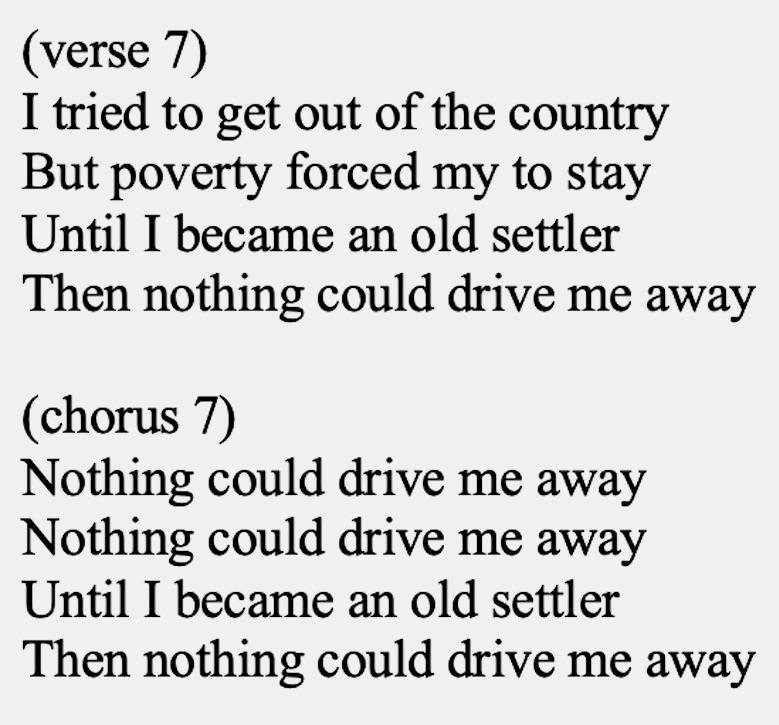
The story unfolds over five verses, until in verse 7 he’s obliged to settle down:
(#5) He becomes an old settler
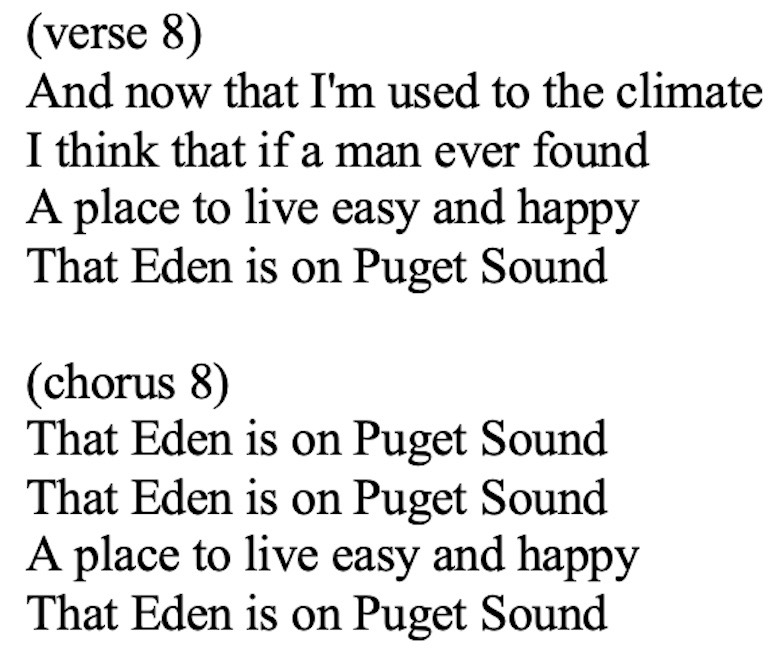
And finds happiness:
(#6) Happiness on Puget Sound
(#7) Amidst the acres of clams

August 28, 2024 at 9:41 am |
A personal note about Wendy Thrash, who I met originally on the Usenet newsgroup soc.motss decades ago, and then got to visit in Seattle a few years ago when I was in town for a friend’s wedding.
She was a software engineer at AMD from 2005 to 2017; she retired in 2017, describes herself now on LinkedIn as “reading, drinking, carousing, and sleeping a lot” — which is amusingly self-deprecating, but doesn’t begin to do justice to her sharp eye, plain speaking, and wit; she’s married to Donna Henderson, who regularly appears as a character on Wendy’s Facebook page.
She jokes about being old, but she’s 8 years younger than I am, so I think of her as having retired in late middle age.