Going past me yesterday morning, a tv ad for some remedy for, as I heard it, teeth stained by poppies (and other foods).
Yes, coffee. With blueberries, black tea, and red wine, a classic offender against dental whiteness. Granting that I have /a/ (in addition to /ɔ/) as an alternative accented vowel in coffee, poppies is a complex but phonologically unsurprising mishearing; coffee and poppies are in fact excellent half-rhymes / imperfect rhymes:
My morning coffee
By a field of poppies
(with two feature rhymes, both well-attested — (initial) p for k and (medial) p for f — plus a subsequence rhyme, with the final z of poppies against the absence of a final consonant in coffee; for the terminology, see my 1976 Chicago Linguistic Society paper “Well, this rock and roll has got to stop. Junior’s head is hard as a rock.”, available on-line here)
So much for the pronunciation. But why, you wonder, would I have poppies in my mind? It doesn’t seem to make sense.
Here we are up against the exquisite particularity of individual events. Sometimes you just have to have been there to begin to understand why things happened the way they did. (As a result, much of history is inscrutable, literally incomprehensible.)
In this case, I can supply the link. It is very much to the point that
The intense blooming season for the California poppy [Eschscholzia californica, the state flower] usually falls within late winter to early spring, during the months of mid-February through mid-May. (Wikipedia on the Antelope Valley California Poppy Reserve)
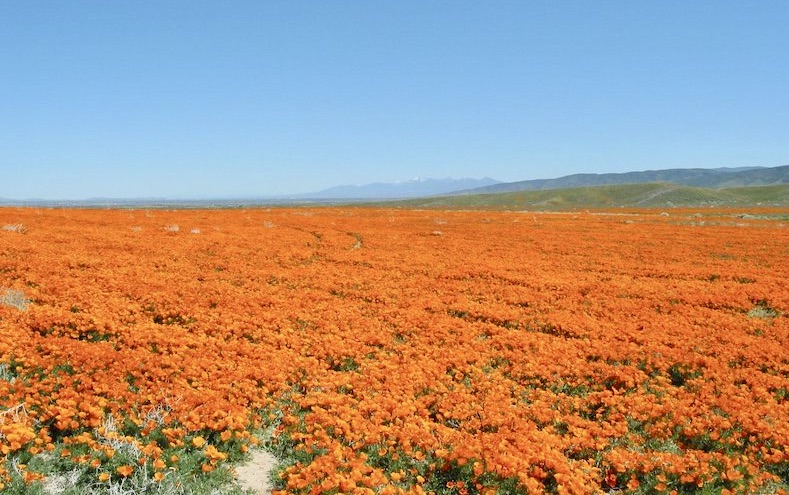
which is to say, now. When you can see spreads like this one:
A field of California Poppies in the Antelope Valley Reserve[from Wikipedia] Antelope Valley California Poppy Reserve is a state-protected reserve of California, … harboring the most consistent blooms of California poppies, the state flower. The reserve is located in the rural west side of Antelope Valley in northern Los Angeles County, 15 miles (24 km) west of Lancaster…. The reserve is at an elevation ranging from 2,600 to 3,000 feet (790 to 910 m) above sea level, in the Mojave Desert climate zone. … Other wildflowers within the reserve include owl’s clover, lupine, goldfields, cream cups and coreopsis.
Meanwhile, California poppies reseed freely, so individual plants appear everywhere. Which means that recently they’ve become a regular feature of walks in my Palo Alto neighborhood with my (Fijian) helper Isaac, for whom they are astonishingly beautiful exotics. So I can fairly be said to have (California) poppies always on my mind.
But there’s no way you could have known that.
March 31, 2026 at 6:05 am |
If I remember correctly, my mother had /a/ in coffee, and my father had /ɔ/ (both were life-long New Yorkers). I seem to have settled on /ɔ/.
March 31, 2026 at 6:48 am |
If I remember correctly, many decades ago in NYC, /ɔ/ in coffee was more working class, /a/ more middle class (also Philadelphia, so relevant for me). But complicatedly variable.
April 1, 2026 at 6:37 am
For what it’s worth, both my parents were middle class, although my father’s family was somewhat more affluent.
April 1, 2026 at 7:25 am
To RC about his parents and class: the patterns for any particular individual will be the result of complex particular life histories (some variants in my own speech can be tied to the influence of *specific people* at specific times in my life); correlations to social variables become detectable only through the statistical analysis of large groups of people; they are large-scale statistical generalizations, with tons of individual variation.
When I know them, I’ll cite the generalizations, because they might shed some light on particular cases. But some individuals will be in the tails of the statistical distributions, might even be astonishing outliers; for them, the generalizations won’t be illuminating.