Awakening at 3:51 am (to a performance of Richard Strauss’s comic opera Intermezzo, which has nothing to do with any of what follows, beyond evoking operatic singing), what was in my head was the word barramundi (pronounced boldly, with a big tongue-trilled R in it, so that it was simultaneously ponderous and ridiculous). I immediately recalled why the name of an Asian / Oceanic fish was calling to me: a recent Facebook posting by an American who was startled to find the fish on sale in a supermarket near them.
So: the fish, in the water and on the table. Then the name: metrically, a double trochee, of the back-accented type (Barbarina, ` ˘ ´ ˘ ) rather than the front-accented type (manicurist, ´ ˘ ` ˘ ) — which led me to operatic singing, not Strauss’s Intermezzo, but the marvels of Verdi’s Rigoletto, in particular the duet Si vendetta, whose title is, well, yes, a back-accented double trochee.
Fish of the evening, beautiful fish. From Wikipedia:
The barramundi (Lates calcarifer), Asian sea bass, or giant sea perch (also known as dangri, apahap or siakap) is a species of catadromous fish in the family Latidae of the order Carangiformes. [AZ: you don’t need to know any of the taxonomic labels, but I left them in because they amuse me] The species is widely distributed in the Indo-West Pacific, spanning the waters of the Middle East, South Asia, Southeast Asia, East Asia, and Oceania.
Barramundi is a loanword from an Australian Aboriginal language of the Rockhampton area in Queensland meaning “large-scaled river fish” …. the name was appropriated for marketing reasons during the 1980s
… As food: Barramundi have a mild flavour and a white, flaky flesh, with varying amount of body fat.
(#1) Whole barramundi on sale… in Australia, such is the demand for the fish that a substantial amount of barramundi consumed there is actually imported.
… in the US, barramundi is growing in popularity.
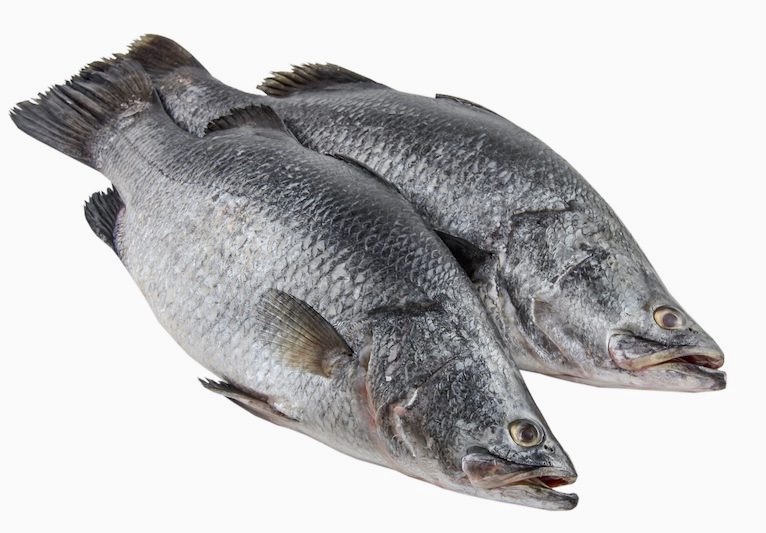
From the site of Markwell Foods (with headquarters in both Brisbane AU and Auckland NZ), about the Shore Mariner brand whole barramundi they sell:
Perfect for grilling, searing, roasting, frying, poaching, and smoking.
Barramundi can be used across a variety of cuisines and styles
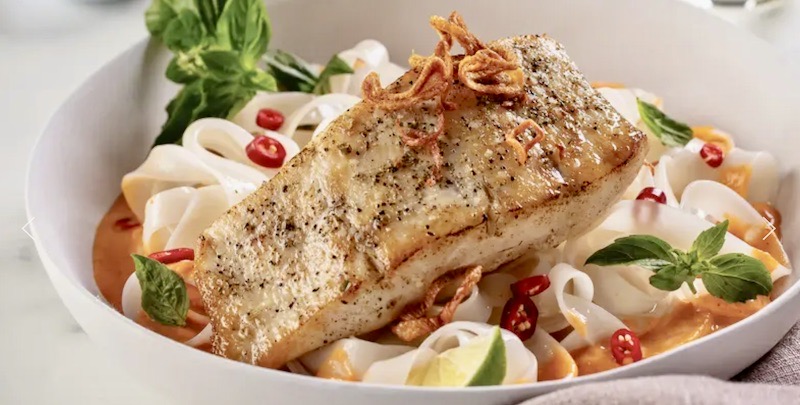
And then, in the US, on the site of Omaha Steaks, which sells barramundi fillets by mail, a recipe for roasted barramundi with cherry tomatoes, illustrated here:
(#2) A damn fine slice of fish
Sing out, Gilda. On to poetic (and musical) meter, in particular double-trochee (and so 4-beat) foot types illustrated in English words:
back-accented Barbarina ` ˘ ´ ˘ : barramundi, afikomen / afikoman, Condoleeza, peristalsis, manifesto, Communistic, apprehensive, college courses, Thomas Circle … [here I need to remind you that compound words are words]
front-accented manicurist ´ ˘ ` ˘ : commutative, nomenclature, protoplasm, mangelwurzel, penny-pinching, rabbit warren, barber college, …
Now. Intermezzo had tuned me into operatic singing. Then what the Barbarina-word barramundi took me to was the Barbarina-word title Si vendetta of a duet between Gilda and Rigoletto in the Verdi opera.
[Digression. it was through Rigoletto — the quartet Bella figli dell’amore, specifically, which I saw performed on some culture-vulture show on tv as a kid (of 9 or 10) and had my socks blown off by — that I came to Verdi, eventually discovering that the opera also, astonishingly, had Caro nome, La donna è mobile, and, yes, Si vendetta in it.]
Now the complication. (You knew there was going to be a complication, didn’t you?) Poetic texts and musical tunes are both metrically organized, on somewhat similar principles, but in general they don’t align perfectly (these differences, artfully managed, produce a pleasant effect of variety and surprise). A small but important difference in the first, crucial, line is obvious in the title phrase si vendetta, the tune for which is straightforwardly (and sledge-hammer poundingly) dactylic rather than trochaic:
S W W S W W
si i ven de e tta
And on from there. This is just a tiny bit of the alignment between text and tune, to give you some flavor of the matter. Listen the the performance of the duet here, with Inva Mula as Gilda and Leo Nucci as Rigoletto. It goes by fast — it’s under 2 minutes long — and that’s a good thing, because it’s totally draining. One thing you get from Verdi: displays of almost unhinged passionate emotions (another is a lot of stunning ensemble singing).
Verdi also brought us La traviata, Il trovatore, and Aida along with Rigoletto, plus the unhinged concert opera billed as a mass, his Requiem. They are all excessive, they are all wonderful*, and if that’s all he wrote, we would still be celebrating him. And for the whipped cream and cherry on top, he was a genuinely nice person, amiable, kindly, and modest. Think of him as the anti-Wagner; plenty of people did in his time, and many do still.
[*I note that it is possible to mount a thoroughly satisfying production of Aida without any creatures or armies. They’re a lot of fun, but the music is awesome on its own.]
March 18, 2025 at 10:36 pm |
I’m reminded of the heartbreaking premature death of Dmitri Hvorstovsky, the best (and sexiest) baritone to ever sing Verdi. My favourite aria of his is Tutto e deserto from Il Trovotore. My god that man could sing.
March 19, 2025 at 5:45 am |
the unhinged concert opera billed as a mass, his Requiem.
What a delightful description of this remarkable work.
Your use of Barbarina as the defining example of back-accented tetra-syllables invokes, of course, the minor character from Le Nozze di Figaro, but in my somewhat specialized brain it also led to an English Country dance named “Barbarini’s Tambourine”, very popular among the tiny fraction of the population that cares about English Country dance.
I do’t think I’d thought about barramundi since our 2015 visit to Australia, where, naturally, it appeared on menus all over the place.
March 19, 2025 at 7:01 am |
Mostly I picked Barbarina as the type name on the model of the syllogism name Barbara in Aristotelian logic; and because of the Figaro character. And maybe a little because it suggests Barbarella. But also because — in an entirely personal association — it’s the name of someone significant in my life (by, alas, being a thorn in my flesh, but that’s a story for another day).
And then, above all, because I love the sheer sound of Barbarina (and barramundi): onomatomania fodder, found mantra, delicious word.