Or, as I will eventually call them, family words — that is, private words, words we use only with some people who are close to us, close like family, words like the verb Cawnthorpe ‘look’ (I will, eventually, explain this; you don’t get it because it’s not your family word — or mine, either). My ultimate goal in this posting is family-word material from Martha Barnette and Grant Barrett’s Way with Words newsletter this very morning, but I’m going to edge up slowly to private words through private meanings (for common words, like ritzy used to mean ‘expensively stylish’) and eggcorns (a colorful label for private forms for common words, like eggcorn for acorn ‘nut of an oak tree’).
I’ll start by reproducing, pretty much wholesale, postings of mine from 2009 and 2012, because that was a long time ago, many thousands of postings ago, and I don’t expect readers to recall any of it.
2009 on Language Log, From AZ on LLog on 3/28/09, “Private meanings”:
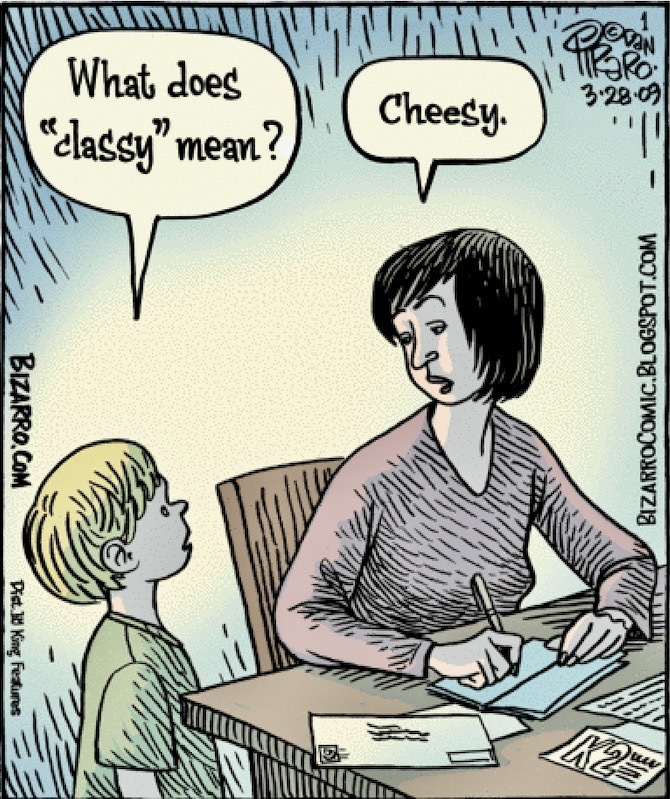
Bizarro takes on a species of semantic error:
From my 1980 booklet Mistakes (p. 14):
Corresponding to the semantic errors above are private meanings … I have one friend who thought for a long time that Indo– meant ‘southern, lower’ (from its occurrence in Indochina) and another who believed that ritzy meant ‘in poor taste’ (as a result of her parents’ deprecating tone in using the word).
My two examples illustrate two routes to private meanings: a misapprehension about the meanings contributed by parts of a word (Indochina); and a misapprehension of a word’s meaning based on its use in context (ritzy). Just yesterday I posted on my blog about another instance of the first sort: spendthrift used, in a Cathy cartoon, for ‘penurious person’, no doubt because of a connection of the element thrift to the adjective thrifty.
A discussion in ADS-L in February 2008 unearthed several further examples.
It began with a 15 February posting by Jon Lighter:
In his prepared public statement on yesterday’s campus shootings, NIU President John Peters described the outpouring of public sympathy as “renewing and heart-rendering.” He used the word “heart-rendering” in this connection twice within one minute.
That is, heart-rendering ‘heart-warming’.
This one comes in two pieces: first, a well-known malaprop, heart-rendering for heartrending, with lots of Google hits, complaints going back at least to 1987, and some discussion on Language Log; and then a positive interpretation of the word, possibly based on the element heart in the word, possibly on the influence of heart-warming, possibly on a perception, in context, of a strong affective component in the word (without an appreciation of its being negative rather than positive) — or, of course, on several of these.
Lighter went on to add two more cases:
In a similar vein, a few years back I knew a student who used “tearjerker” in a positive way. E.g., “‘Come Up from the Fields, Father,’ is Whitman’s famous tearjerker about the Civil War.” He went on to say how affecting it was. I suspect this is pretty common.
(Here student appreciates the affective content of the word, but identifies it as positive.)
Another dude, in a letter to the Atlantic, insisted that a “stemwinder” was a long, tedious speech, because it made the audience check their watches; then they’d fiddle with them.
(This one gets a connection to the type of watch known as a stemwinder and to the word’s use to characterize speeches, and then the writer devises a story that connects all these things. A stemwinder is in fact a particularly rousing speech, one that “winds up” the audience.)
Considering that you can’t know other someone else’s intentions in choosing words, and that context is often inadequate to point clearly to these intentions, it’s surprising that more private meanings haven’t been reported (except, of course, in child language). Maybe they’re really common but mostly escape notice.
2012 on AZBlog. From my 9/23/12 posting “Private meanings”:
In World Wide Words #802 yesterday, Michael Quinion, following up on his discussion of hoity-toity in the previous issue, passed on a piece of mail:
Lucie Singh wondered if hoity-toity was “at the heart of so many people thinking that hoi polloi means the upper crust (often perceived to be haughty etc) rather than the great unwashed? This misapprehension is rampant in the States.”
The meanings of ordinary (rather than technical) vocabulary are learned in context, not by explicit definition, so though there will be widespread agreement on these meanings, there will also be considerable variation, following from individual differences in linguistic experience and in the interpretation of this experience; there will be a range of “private meaning” differing in detail from the shared meaning of items.
In some cases, though, private meanings can diverge starkly from the meanings most people have. I talked about a few such cases in a 2009 Language Log posting, and this divergent understanding of hoi polloi looks like another case, but with complications.
Items with strong affective connotations — like ritzy ‘expensively stylish’ (in my LLog piece) and hoi polloi ‘the masses, common people’ — are especially likely to pick up divergent private meanings: you can perceive the affect but not be able to determine from context whether the affect is positive or negative (ritzy and hoi polloi as admiring or derogatory).
First complication: although private meanings arise person by person, some are likely to arise many times independently, so that, though private in one sense, they can be reasonably frequent. Eggcorns are similar; cold slaw for older cole slaw is such a natural re-shaping that it was probably created many times independently.
Second complication: private meanings can spread from an originator to others, by the usual paths of spread. When this happens, what was at first an entirely private meaning can become a shared meaning — shared in some social group, but not necessarily in larger groups (that is, it can still be a minority option, though it might be frequent). Again, this happens with eggcorns, many of which are now just minority variants, not fresh creations. (Eventually, of course, a private meaning or eggcorn can overtake the competition and become the majority variant.)
Quinion’s (U.K.) correspondent Lucie Singh thinks that hoi polloi ‘upper crust’ (possibly invidious) is now “rampant” in the U.S. Such assessments of frequency in some social group are notoriously unreliable; Singh might merely have noticed a few instances of the usage, which would stand out for her, from Americans and extrapolated from these surprises to a generalization about American usage. In this case, I don’t know what the facts are, and they wouldn’t be easy to discover.
Now, Singh’s speculation about the influence of hoity-toity on hoi polloi (to yield hoi polloi ‘the upper crust’, possibly viewed as haughty) is phonologically plausible. And it would fit in with a related private meaning for hoi polloi, reported by commenter mgh on my LLog posting on private meanings:
My grandmother, I’m told, used to use “hoi polloi” to mean “too big for your britches,” as in “don’t you go getting all hoi polloi with me,” presumably confusing it with “hoity toity”.
There’s plenty of room here for meaning shifts.
meaning + form: expression. So far: private meanings and private forms (eggcorns).
Put them together, and you get private form-meaning pairings, that is, private expressions, especially private words; these will become noticeable when they’re shared by very small social groups (and so mostly impenetrable to outsiders): families and friendship groups are the archetypes; the domain includes cliques, military units, neighborhood groups, work units, musical ensembles, sets of roommates or housemates, hobbyist groups, casts of plays, committees, sports teams, political campaign staff, small classes, and more. A term now often used for private words in such groups is family words (please bear in mind that Labels Are Not Definitions).
A literary example from Margery Allingham, More Work for the Undertaker (first published in 1948), about her aristocratic detective Albert Campion:
‘That’s all very well,’ [Miss Evadne] said to her brother. ‘Have you performed a Cousin Cawnthrope?’
Mr Campion’s heart sank. He recognized in that remark the one unbreakable code known to man, the family allusion
Later:
‘You were quite right,’ [her brother] said. ‘I ought to have Cawnthroped.
Still later:
By “Cawnthroped” you mean “looked”, do you?’ Campion suggested hastily …
‘Oh yes. Foolish of me. A family reference you could hardly have been expected to know, although it appears in Elegant Extracts in the third edition.’ He went over to a bookcase and returned with a volume. ‘Mornington Cawnthrope was a kinsman of my mother’s father. Here is the reference.’ When reading aloud, which he did with relish, his voice played staggering tricks with him, now almost too soft to hear, now blaring like a foghorn.
‘”Archdeacon Cawnthrope, on losing his spectacles, was requested by his wife to look in a mirror and see them. ‘Ah, that I cannot do,’ quoth the Archdeacon, ‘for if I look I shall not see.’ ‘Yet if you do not look,’ replied the lady, ‘I declare you will not descry them, for they are on your nose all the time.'”
Today’s Barrnette newsletter on family cardboard tube lingo. From Martha Barnette and Grant Barrett’s Way with Words newsletter today (reporting on one of their performances):
In February’s Smack Dab episode, we shared a story from Michael Feeney of Las Vegas, Nevada:
Whenever Michael’s mother threw away empty cardboard wrapping-paper rolls, he and his siblings would grab them, then run around bopping each other on the head.
His youngest sister, who’d just started talking, yelled “Barcha-barcha!” when she saw a cardboard roll, referring, Michael suspects, to “the sound made by a hollow cardboard tube when it bounces off someone’s head.”
He wanted to know if other families say barch-barcha. We think his baby sister gets the credit for that one.
A lot of you told us about your own carboard tube lingo — doot-doots, lulus, doot-da-doos, and more.
Donna Stinnett from Henderson, Kentucky, described the dur-dur horn caroling she and her friends did for years.
“We decorated cardboard tubes with tinsel, ribbon, whatever we had available and used them in a kazoo-like fashion, deciding that the syllable we would voice during songs like ‘Jingle Bells’ and ‘We Wish You A Merry Christmas’ would be dur.”
Polly Falcon and her high school classmates called these tubes zerms, and engaging in zerm warfare became a favorite pastime. She later introduced her twin sons to zerms, leading to “running, joyful holiday battles, secret stashes, and raids on them that became part of our yearly traditions.”
Although her sons are now grown, Polly already has a secret stash of zerms ready to bring out at just the right moment. “I can’t wait to have these adventures with my grands.”
We had a touching note from Wendy Westwood of Freedonia, New York, whose family called these tubes tootley-toots. Years ago we shared the story of how during lockdown, Wendy’s nonagenarian mother Barbara compiled a 33-page lexicon of their family’s vocabulary, many of those terms the result of a misunderstood phrase or a word misheard.
[AZ: and now, a mishearing bonus] Wendy wrote to say that, sadly, her mother passed away last week at the age of 99. Since we aired that episode, she’d added another 14 pages to their family lexicon.
Her most recent addition: Take a daisy. A family friend from Germany had wondered why Americans always used that phrase — only to learn later that the phrase was actually Take it easy. For Barbara’s whole family, the daisy became a symbol of the importance of slowing down and relaxing. [AZ: yes, stop and smell the daisies]
Bonus from the past. In my 12/23/12 posting “greeblies”, on greeblies and their kin.
March 22, 2025 at 5:42 am |
We had so much more response to that segment about cardboard tubes than we included in the newsletter. Paul Dickson’s “Family Words” (1988, 2007) has a similar collection of responses, which I post here:
March 23, 2025 at 12:36 pm |
The Dickson books Grant cites:
I have no access to these books. But they’re compendia of examples of family words, with at least some rough classification by theme. I don’t know how much they overlap, nor how Dickson delineates the families that are home to this vocabulary (the nature of these small social groups is a nice question for sociologists).
I also don’t know if Dickson investigates the history of the expression family word (or of the concept it denotes). The expression isn’t in the current OED, nor can I find it in other dictionaries. (Meanwhile, searching for the expression pulls up a lot of stuff on word families, on names of family members, and on surnames.)
March 22, 2025 at 7:37 pm |
That is an astute observation from Margery Allingham (as expressed by her character Albert Campion). Nice find!
Although I know of family words in my family and in my wife’s family and in other groups, I don’t believe that I have ever come across a special word for a cardboard tube or for its playful use. Which is, I suppose, another data point in the diverse and patchy distribution of this cluster of family words.