In e-mail on 9/24 from Masayoshi Yamada, Emeritus Professor of Linguistics, Shimane University (author of, inter alia: A Dictionary of Trade Names and A Dictionary of English Taboo and Euphemism), substantially edited:
Recently, I happened to read the newspaper comic strip Zits; on September 23 and 24, the main character Jeremy uses the expression “I had the radish”. One of the few dictionaries which defines it:
have had the radish ‘to be no longer functional or useful; to be dead or about to perish’. Local to the state of Vermont. Primarily heard in US. (Farlex Dictionary of Idioms, 2024) (Free Dictionary link)
However, I don’t have any clue to its etymology: why radish? And is it so local to Vermont? I have no idea which language source the Farlex Dictionary is based on. [AZ: It cites the Free Dictionary, which aggregates information from many sources, so that’s not especially helpful.]
I pointed out to MY that in the strip, Jeremy decides to just invent (make up) some expression, to see if he can get it accepted. And picks had the radish. Presumably in the belief that no one had ever used it as an idiom. The first three strips (in strips to come, Jeremy eventually concedes that his idiom has had the radish):
(#1) 9/23: the first attempt to spread the idiom
(#2) 9/24: a roadblock appears (with Jeremy’s buddies)
(#3) 9/25, today: resistance continues (with Jeremy’s family)
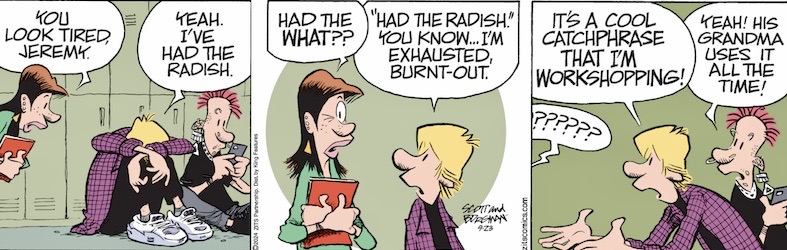
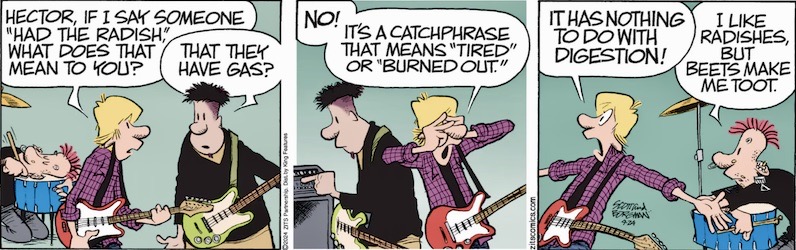
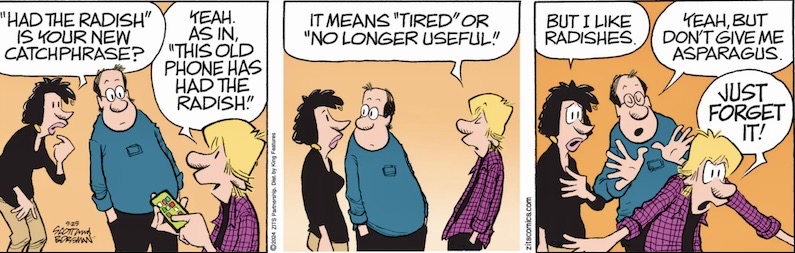
Here I note that these people are in (cartoon) central Ohio. Far from Vermont. Even if it turns out that the idiom is genuinely from Vermont (and that the creators of the cartoon, Jerry Scott and Jim Borgman, had somehow come across it and used it in the comic strip rather than inventing some entirely fresh expression for this meaning, like, say, earn the kaddish), in the cartoon, it’s a Jeremy coining, without any Green Mountain tinge.
However, I suspect I’ve found the Free Dictionary’s source. In my response to MY (somewhat edited), I noted a reputable source, which I now go on to quote from:
The idiom isn’t in the Dictionary of American Regional English, nor in (the three-volume) Green’s Dictionary of Slang. However, there is real evidence that it is in fact used in Vermont in this sense. From the Seven Days website (“an independent weekly newspaper covering Vermont news, politics, food, arts and culture”) WTF column, “What Does the Vermont Expression ‘Had the Radish’ Mean?” by Ken Picard on 12/20/17:
In keeping with this week’s Winter Reading Issue, WTF answers a native Vermonter’s burning lexicological question: “What does the expression ‘had the radish’ mean, and where did it come from?”
OK, perhaps the question isn’t burning so much as smoldering. Still, where there’s smoke, there’s fire — or so might say Wolfgang Mieder, a University of Vermont professor of German and folklore. Mieder is Vermont’s foremost paroemiologist, or scholar of proverbs and proverbial expressions. If you’ve ever wondered about such colorful Vermontisms as “You can’t make a whistle out of a pig’s tail” or “A gallon of sap is worth one day’s labor,” Mieder is your go-to guy for tracing their meanings and origins.
Mieder, 73, is a jovial fellow from Lübeck, Germany, who’s taught at UVM for 46 years. During his tenure, he’s authored or edited more than a dozen books, including A Dictionary of American Proverbs, a compendium of more than 15,000 sayings, maxims and adages commonly used throughout the United States and Canada. As he remarked during a recent interview, “I always thought it was kind of neat that an immigrant did this book.”
Mieder’s enthusiasm for metaphorical language is palpable, and his office walls are lined with shelves of reference books and proverbs written in framed needlepoint. Some are commonplace, such as “An apple a day keeps the doctor away.” Others are less so: “One kind word will warm three winter months.”
Mieder instantly recognized the expression “had the radish” as meaning something that’s in deep trouble, spent or done for, as in: “That old tractor’s finally had the radish.” In fact, he first heard it from his wife, who heard it at Milton High School, where she taught German and Latin for 40 years after the couple moved to Vermont in 1971.
As to the expression’s Vermont roots, however, Mieder couldn’t immediately say. [AZ: and in the end he was still unable to say, though he cited a raft of imaginative speculations]
Meanwhile, back on Zits, you can look forward to had the radish having had the radish. (I have a certain limited ability to see into the comics future.)
September 26, 2024 at 10:57 am |
in the cartoon, it’s a Jeremy coining, without any Green Mountain tinge.
Unless we’re to take Pierce’s remark about Jeremy’s grandma seriously (unlikely, especially since one would expect at least one of his parents to know this), and suppose that she was originally from Vermont.
September 26, 2024 at 11:18 am |
I took Pierce’s comment to be sheer invention, just to back up his buddy’s project. But then these are cartoon characters, and there’s only so much we can know about their inner lives and histories.
September 27, 2024 at 5:36 am
As I hinted above, I think your interpretation is most likely the correct one.
September 26, 2024 at 11:02 am |
Jeremy’s “workshopping” does suggest he is just making up the expression. But OTOH his friend Pierce in the 9/23 strip says “His Grandma uses it all the time!”. If we accept that, it may be that Jeremy’s source for it is not simply invention but involves family transmission.
September 26, 2024 at 11:22 am |
I went with “workshopping”, but, yes, Grandma’s a possibility, though rather distant, I think. See my reply to Robert Coren.
September 27, 2024 at 6:05 am |
Probably the conclusion of their string of strips on this bit.
The Friday 27 September strip:
Panel 1: [Pierce, Jeremy, and Sara seated]
Jeremy: I give up. My “had the radish” catchphrase is a failure.
Panel 2:
Jeremy: Talk about a waste of time!
Sara: I’m sorry.
Panel 3:
Pierce: WAIT — So, “had the radish” has had the radish?
Sara: Mfft! [not in speech bubble]