In my final dream of the night, I was explaining to a group of rapt visitors that “Come, thou fount of every blessing” was the official hymn of Stanford University — an idea no doubt provoked by the fact that my Apple Music was at the time playing a series of performances of this very hymn (most often set in the US to the tune NETTLETON), of which I am very fond. As it turns out, in addition to an official fight song, Stanford does have an official hymn, its alma mater, “Hail, Stanford Hail” (which is rarely played — deservedly so, in my opinion — except that it’s obligatory at Commencement). Meanwhile, though I have hymn resources from three largely separate traditions and have consulted hymn repositories, there appears to be no tune named STANFORD (STAMFORD is something else entirely), despite the fact that the prolific Anglo-Irish composer Charles Villiers Stanford wrote a number of hymn tunes, among them the often-set ENGELBERG.
So there is in fact a Stanford (University) hymn and a number of (C. V.) Stanford hymns, but no STANFORD hymn (tune).
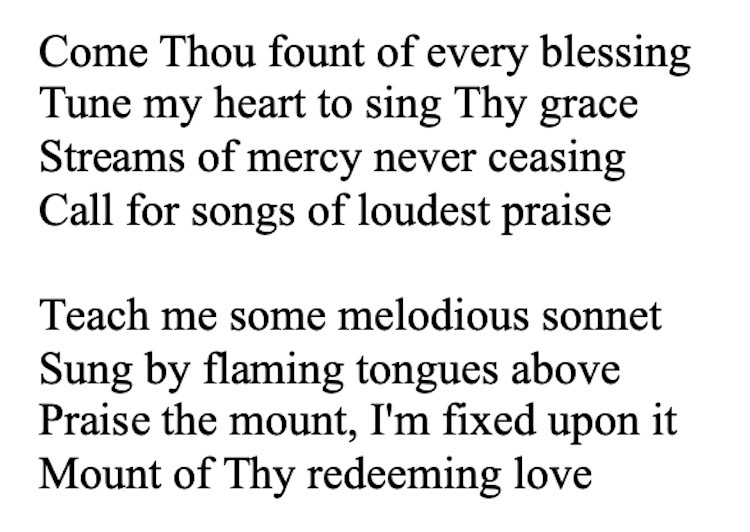
Come Thou fount. Examined in some detail in my 12/23/11 posting “Come Thou Fount”, with its vividly worded text (by Robert Robinson, 1757), beginning:
(#1) In the Sacred Harp (1991 Denson Revision) shapenote hymnbook with four tune settings, none of them the familiar one in the US, NETTLETON; two of them are rousing shouting songs, in accord with the passionate text
Stanford songs. From Wikipedia:
Come Join The Band is the official fight song of Stanford University. The lyrics were written in 1907 by screenwriter and playwright Aurania Rouverol, then a student at Stanford, and are set to the trio from Robert Browne Hall’s New Colonial March. Although Come Join the Band remains Stanford’s official fight song, the Stanford Band nowadays plays All Right Now as their usual fight song at football games.
“Come Join the Band” and “All Right Now” are in some sense the public musical faces of the university. I was aware that Stanford must have an alma mater (song), because that’s what colleges do, but I couldn’t recall having heard it (alma maters are often embarrassing — awkward and mawkish). Then I discovered that Stanford actually does have an official hymn, “Hail, Stanford Hail”, which is also its alma mater. It’s performed as part of the Commencement ritual, but, it seems, rarely on other occasions (though there’s a rap version of some popularity).
In this YouTube video, you can listen to the Stanford Chamber Chorale, under the direction of Stephen M. Sano, in a 2020 distributed performance — it was Covid time — of the university’s alma mater, the Stanford Hymn “Hail, Stanford Hail”. The recording supplies the first verse and the refrain:
VERSE 1
Where the rolling foothills rise
Up t’wards mountains higher,
Where at eve the Coast Range lies,
In the sunset fire,
Flushing deep and paling;
Here we raise our voices hailing
Thee, our Alma Mater.REFRAIN
From the foothills to the bay,
It shall ring,
As we sing;
It shall ring and float away;
Hail, Stanford, Hail!
Hail, Stanford, Hail!
The (mercifully suppressed) other two verses:
VERSE 2
Tender vistas ever new
Through the arches meet the eyes,
Where the red roofs rim the blue
Of the sun-steeped skies
Flecked with cloudlets sailing;
Here we raise our voices hailing
Thee, our Alma Mater.VERSE 3
When the moonlight-bathed arcade
Stands in evening calms,
When the light wind half afraid
Whispers in the palms,
Far off swelling, failing,
Student voices glad are hailing
Thee, our Alma Mater.
Hard to say whether “flecked with cloudlets sailing” or “student voices glad are hailing” is more giggle-inducing; but I would be hard-pressed to sing these lines with a straight face, and apparently very few students attempt it.
Where did this come from? From Wikipedia on Stanford University:
“Hail, Stanford, Hail!” is the Stanford hymn sometimes sung at ceremonies or adapted by the various university singing groups. It was written in 1892 by mechanical engineering professor Albert W. Smith and his wife, Mary Roberts Smith (in 1896 she earned the first Stanford doctorate in economics and later became associate professor of sociology), but was not officially adopted until after a performance on campus in March 1902 by the Mormon Tabernacle Choir.
But enough of HSH. On to CVS.
Charles Villiers Stanford and his songs. From Wikipedia:
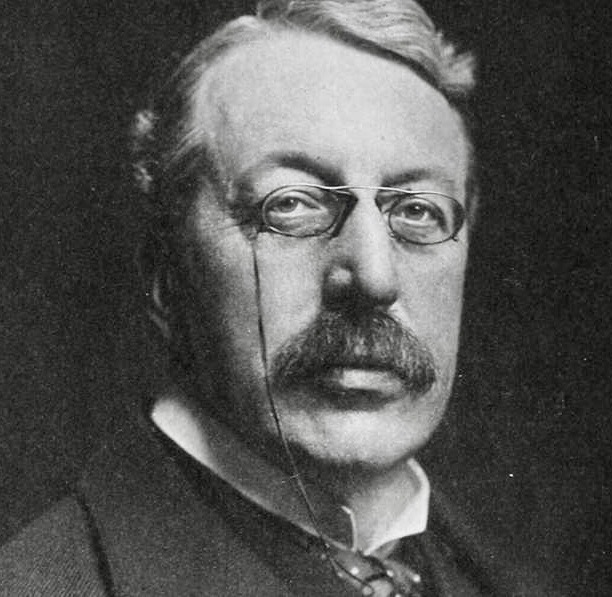
Sir Charles Villiers Stanford (30 September 1852 – 29 March 1924) was an Anglo-Irish composer, music teacher, and conductor of the late Romantic era. Born to a well-off and highly musical family in Dublin, Stanford was educated at the University of Cambridge before studying music in Leipzig and Berlin. He was instrumental in raising the status of the Cambridge University Musical Society, attracting international stars to perform with it.
(#2) CVSWhile still an undergraduate, Stanford was appointed organist of Trinity College, Cambridge. In 1882, aged 29, he was one of the founding professors of the Royal College of Music, where he taught composition for the rest of his life. From 1887 he was also Professor of Music at Cambridge. As a teacher, Stanford was sceptical about modernism, and based his instruction chiefly on classical principles as exemplified in the music of Brahms. Among his pupils were rising composers whose fame went on to surpass his own, such as Gustav Holst and Ralph Vaughan Williams.
From the Hymnary site on the tune ENGELBERG:
Charles V. Stanford composed ENGELBERG as a setting for William W. How’s “For All the Saints” [“For all the Saints who from their labours rest”]. The tune was published in the 1904 edition of Hymns Ancient and Modern with no less than six different musical settings. [now most often associated with Fred Pratt Green’s 1971 text “When in our music God is glorified”]
From what I can see on the Hymnary site, none of CVS’s hymn tunes got named after him, nor were any hymn tunes named in honor or memory of him. In line with this, I have hymnbooks from three largely distinct traditions — the Sacred Harp tradition, the Evangelical Lutheran Church in the US, and the Episcopal / Anglican Church in the US, and none of these has a tune named STANFORD.
Indeed, only the last of these has any tunes by CVS; my 1982 Episcopal hymnal has, in particular, three different settings of ENGELBERG by CVS:
— 296 “We know that Christ is raised and dies no more” (text by John Brownlow Geyer)
— 429 “When in our music God is glorified” (text by F. Pratt Green)
— 477 “All praise to thee, for thou, O King divine” (text by F. Bland Tucker)
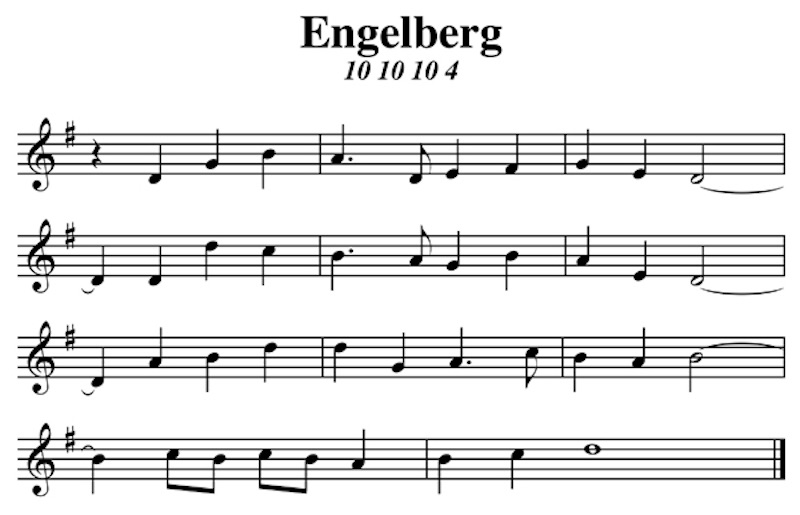
In any case, ENGELBERG is a (C. V. ) Stanford song. Here is ENGELBERG, from the Organ Improvisation site:
(#3)
And with that I join “all the Saints who from their labours rest”.
Leave a Reply