The Wayno / Piraro Bizarro of 5/26:
A Wayno Psychiatrist cartoon, this time with couples therapy in which the couples’s conflicts are referred to the attitudes of their inner children, one of whom is said to be infected with the dreaded cooties of childlore (if you’re puzzled by the odd symbols in the cartoon — Wayno says there are 5 in this strip — see this Page)
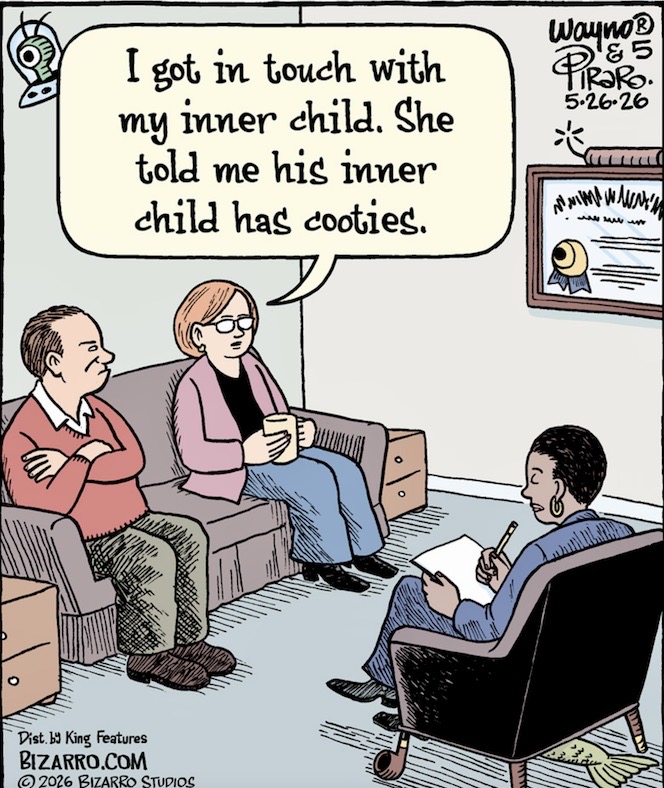
It’s likely that some of my readers will find this one-sentence summary of the cartoon’s content to be simply incomprehensible — because the two central terms in all of this belong to specialized vocabularies — cooties from American childlore; and inner child from pop-psychological therapy-talk.
The short versions, from NOAD:
— noun cootie: … 2 (usually cooties) US a children’s term for an imaginary germ said to have infected a person of the opposite sex or someone considered socially undesirable: he would run around the playground and chase me around and I thought he had cooties | [as modifier]: every grade level had a designated cootie kid.
— nominal inner child: a person’s supposed original or true self, especially when regarded as damaged or concealed by negative childhood experiences: you may still be acting out the pain suffered by your inner child.
At greater length.
— in my 7/17/12 posting “Cooties”, an extended discussion (with another cartoon)
— from the Wikipedia entry on the inner child in pop-psychological therapy-talk:
In some schools of popular psychology and analytical psychology, the inner child is an individual’s childlike aspect. It includes what a person learned as a child before puberty. The inner child is often conceived as a semi-independent subpersonality subordinate to the waking conscious mind. The term has therapeutic applications in counseling and health settings.
The theoretical roots of the inner child trace back to Carl Jung’s divine child archetype, which he saw as both an individual and collective symbol of renewal and transformation.
… The concept became known to a broader audience through books by John Bradshaw and others. Bradshaw [Healing the Shame That Binds You] (2005) emphasised that by acknowledging the inner child, individuals could awaken their true selves and heal past emotional wounds.
Leave a Reply