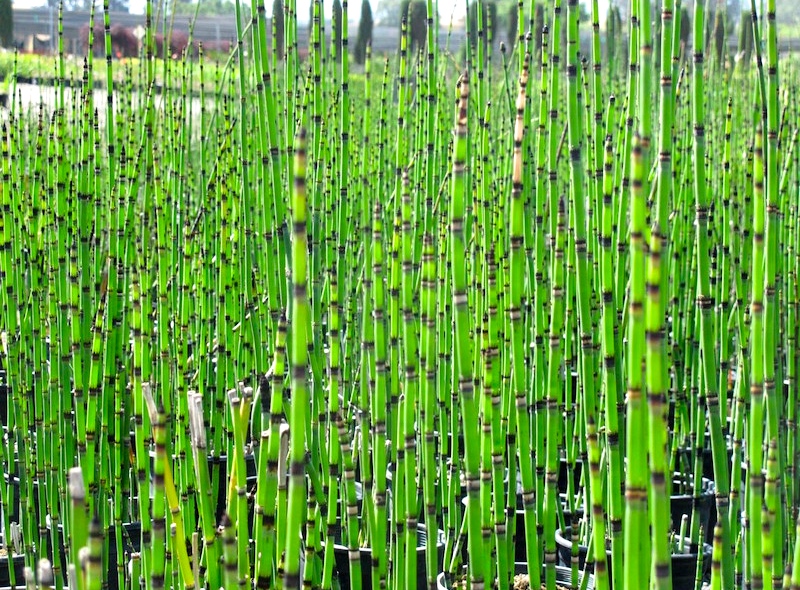
Walking the neighborhood with Isaac brought us to resting by a planter of weird plants — tall, stiff, hollow tubes in sections, living green things with no hint of flowers or seeds — outside Joe and the Juice at 240 Hamilton Ave. (at Ramona St., a block and a half from my house). I noted how tough the plants were (with some moisture, they grow ferociously, and their stems are naturally coated with silica, so that the stems can actually be used to scour pots and pans). Unfortunately, I forgot the evocative names of the plant — common name horsetail, botanical name Equisetum (Latin for ‘horse bristle’) — or the significant fact that the plants had neither flowers nor seeds because (like ferns) they were modern plants surviving in much the same form as their ancestors from prehistoric times, before the invention of sex in plants, and produced spores rather than seeds.
An impressive stand, in the wild, of the species Isaac and I rested by at Joe and the Juice, Equisetum hyemale:
The prehistoric plants included gigantic horsetail trees
On this blog. From my 2/19/17 “horsetails”:
the plant, viewable locally in planters outside two office buildings, one [roughly] a block north [Joe and the Juice] and one [roughly] a block west of where I live [a former drive-in laundry at Forest and Emerson]. They thrive there; they are tough plants, aggressive even — they are invasive pest plants in South Africa and Australia — though they suffer some from vandals who manage to break their stems off. The local species [is] Equisetum hyemale [hyemale ‘(of) winter’, presumably because of the plant’s interesting appearance (even) in the winter].
Pteridophytes. From Wikipedia:
A pteridophyte is a vascular plant with xylem and phloem that reproduces by means of spores. Because pteridophytes produce neither flowers nor seeds, they are sometimes referred to as “cryptogams”, meaning that their means of reproduction is hidden. They are also the ancestors of the plants we see today.
Ferns, horsetails …, and lycophytes (clubmosses, spikemosses, and quillworts) are all pteridophytes. However, they do not form a monophyletic group [descended from a common ancestor] because ferns (and horsetails) are more closely related to seed plants than to lycophytes.
On the terms. ptero– ‘wing, feather’, hence pterido– ‘feather-like; of ferns’. –phyte ‘(type of) plant’. lyco– ‘wolflike [yes, as in lycanthropy ‘transformation into a werewolf’]; ‘of clubmosses’.
And pteridophyte is then what I’ve called (in another context, in discussions of clitics) an umbrella term, embracing a collection of referents that share some salient characteristics but do not constitute a natural category.
Leave a Reply