Out in my walker recently, getting some exercise, accompanied by my helper Isaac, showing him places in the neighborhood (with some history of those places) and opening up the landscape around us by identifying plants, giving him their names (common and taxonomic) and explaining plant families, showing him the scents of the plants, their structures, and how they are used in the neighborhood streets and gardens. From little ground-cover plants to the huge coast redwoods that tower above us. What was once just background becomes a rich, engaging tapestry, full of things to see and talk about.
Isaac has a keen eye for detail and tons of curiosity, and he brings a rich and astonishing life history to our walks: to start with, he’s Fijiian (his native language turns out to be jam-packed with interest for the linguist: its word-order type is the rare VOS, and it has a fabulously intricate suite of personal pronouns).
There’s much more to say, but on to a very specific puzzle from our walk a few days ago, which took us past a number of privacy hedges made from a plant I don’t recall ever having noticed before, but was inescapable because it was covered with bright-red spiky flowers:
The plant in question, growing as a small shrub (photo from the Cambridge University Botanical Garden website )
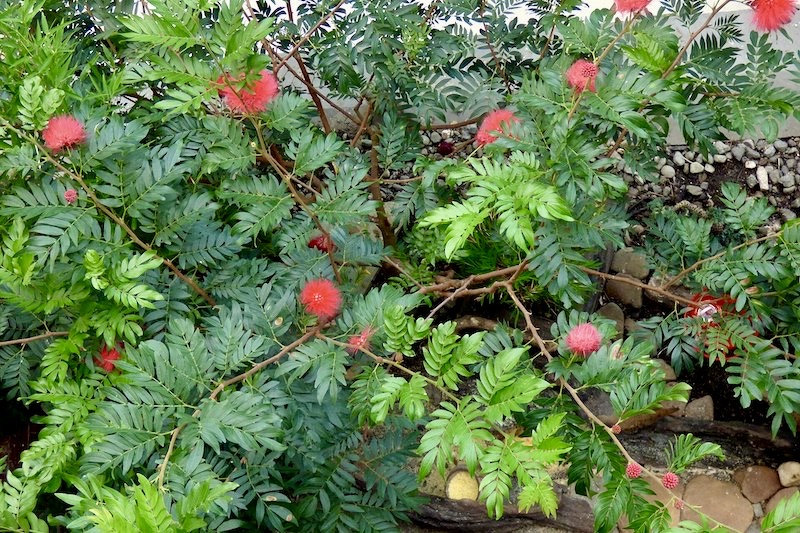
After a considerable amount of digging around, I found a somewhat similar plant, but with different leaves. That got me to the genus Calliandra; from Wikipedia:
Calliandra is a genus of flowering plants in the pea family, Fabaceae [the legumes], in the mimosoid clade of the subfamily Caesalpinioideae. It contains about 140 species that are native to tropical and subtropical regions of the Americas.
Finally, I got to Calliandra haematocephala, the very plant. From Wikipedia:
Calliandra haematocephala, the red powder puff [common Spanish name Carbonerito rojo], is a species of [evergreen] flowering plants of the genus Calliandra in the family Fabaceae.
Rambling shrub or small tree with branched pinnate, silky leaves and powder-puff-like balls of conspicuous dark crimson stamens. Calliandra haematocephala is a fast growing shrub that can grow tall but also spreads wide. It is a shrub or small tree, reaching a size of up to 5 m tall.
… If desired it can be kept smaller by trimming.
It can be trimmed for used as hedge plant. The flowers have a mild and pleasant smell (which Isaac discovered immediately, since we’d been looking at lots of plants with scented flowers and leaves, all in the mint family Lamiaceae or Labiatae — the labiates): lavender, various sages, various mints, oregano, rosemary, various thymes, lemon balm, basil, bee balm / monarda, catnip, hyssop, and more. (Note for Simon and Garfunkel fans: sage, rosemary, and thyme are all labiates, but parsley is in the umbellifer family Umbelliferae or Apiaceae, along with celery, carrot, anise, coriander, cumin, dill, fennel, and, alas, poison hemlock.)
The names. From the Cambridge University Botanical Garden website for Calliandra haematocephala:
The genus takes its name from the Greek kalli (beautiful) and andros (male, in reference to the stamens [AZ: the stamens are the male organ, the source of pollen, pollen being the plant sexual counterpart of sperm for animals], while the specific name haematocephala comes from the Greek haimatos (blood) and kephalé (head).
So, literally ‘blood-headed beautiful man’ — for a red-flowered plant with pretty stamens.
Bonus: the labiates. From NOAD:
noun labiate: Botany a plant of the mint family (Labiatae), with a distinctive two-lobed flower.
In addition to (a) lipped flowers, the labiates often also have (b) leaves (and flowers) with strongly scented oil and (c) square stems.
Bonus: sexual andros. About my 1/6/11 posting “Pseudonyms 2: Samuel Steward”: As the author of gay pulp fiction, Samuel Seward used various pseudonyms, most notably Phil Andros (conveying ‘lover of men’).
Leave a Reply