Rina Piccolo’s Rhymes With Orange strip of 7/21 presents us with a dog that can read — not just converting text to sound (speaking written or printed matter aloud), but, crucially for the strip, converting text to meaning (‘looking at and comprehending the meaning of written or printed matter by mentally interpreting the characters or symbols of which it is composed’ (a definition adapted from NOAD)):
(#1) Panel 1: happy dog, in a state of innocence; panel 2, where all the action happens: dog sees sign, recognizes that it is a sign, reads it, understands that the sign says that its reader should beware of some dog in the sign’s surroundings (specifically, in the yard the sign is posted in), and recognizes that it is a dog in that yard, consequently concluding that it is the dog the sign’s reader is supposed to beware of, and unpacks the meaning of imperative beware as a warning, about the potential danger of this dog, therefore concluding that it has a reputation as a dangerous animal; panel 3, dog exhibits ferocity fitting to its reputation, by growling at passers-by

So that is one astoundingly clever dog. with an understanding of English and a ton of culture-specific information (about keeping dogs as pets and confining them in enclosed yards, about issuing warnings, and about the interpretation of material printed on signs, not to mention self-recognition, the knowledge that he is a dog). Why, you might think that dog was human — an American, in fact.
Now, some earlier postings (from 2015 and 2021), and notes from 2018 for one that never got posted, because it had started to branch into an essay on everything there is to say about signage– so here you’ll get the notes.
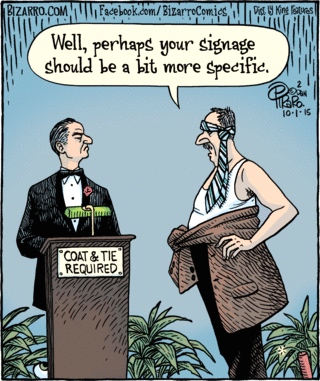
A Bizarro cartoon from 2015. My 10/2/15 posting “Signage”, about this Bizarro cartoon:
(#2)
all bits of language have to be understood in context — the immediate physical context, the immediate social context (who’s speaking, to whom, for what purposes), the larger socioicultural context, and the context of background knowledge about the world. The task of taking all this stuff into account is substantial, but we manage the task pretty well (though by no means flawlessly) all the time. Still, the task is especially complex for highly compressed material, as on signs.
… In the cartoon above, the sign says COAT & TIE REQUIRED, leaving it to those who view it to understand that a coat and tie are required in this particular context, which is that of a formal restaurant (to know that this is in fact a formal restaurant, you need to recognize the figure of the snooty maître d’), and that the requirement is confined to this context. And that the requirement applies only to people asking to be seated to eat in the dining room; it wouldn’t apply to someone merely standing by the entrance or to a photographer allowed to come in to take pictures of certain diners. And that the requirement applies only to men, even though some women, like Marlene Dietrich, are fabulous in a coat and tie
… And that the requirement is that the coat and tie must be worn; merely carrying them will not do. And that the coat requirement is for a suit coat, not just any kind of coat (though it could be a sport coat or the coat of a business suit). And that the tie requirement is for a tie that is a standard article of clothing (in our culture); either a four-in-hand or a bow tie would do, but wearing a twist-tie around your neck will not. And that the coat and tie be worn in the standard fashion (in our culture).
Now the sign specifies very little of this, but assumes that someone reading it can supply most of it from knowledge about the relevant cultural conventions. This the guy in the cartoon, a kind of comic literalist, willfully refuses to do.
Note that there is no sign saying NO SHIRT NO SHOES NO SERVICE, though that stricture certainly applies here; that would be necessary only in a place where some number of people were inclined to appear shirtless or shoeless. In fact, even if the guy in #1 wore his coat conventionally and put his tie around his neck, he still wouldn’t be served, because though he’s not shirtless, the shirt he’s wearing is not a dress shirt, but an undershirt (a t-shirt wouldn’t have done either, or even a collarless dress shirt, or even a collared dress shirt with the tie outside the collar). Formal restaurants never specify that a man must wear a dress shirt with a collar, with a tie under the collar (or a bow tie).
Notes on signage from 2018. Signs can provide five things, in more or less pure form, or of course, with mixed motives:
artwork; entertainment (verbal or visual, or, in cartoon form, both; advertising; information (Turn Left at Albuquerque); regulation
The regulations, in turn, can be warnings (Hitchhikers May Be Escaped Convicts [Oklahoma road sign], Beware of Dog), limitations, or prohibitions; the latter two tend to be related as two sides of the coin (examples just below), and warnings and prohibitions often come together as a package (Loose Rocks / No Climbing), with the warning serving as a reason for the prohibition.
Limitations and prohibitions. Two examples.
On the Steam site on-line:
(#3)
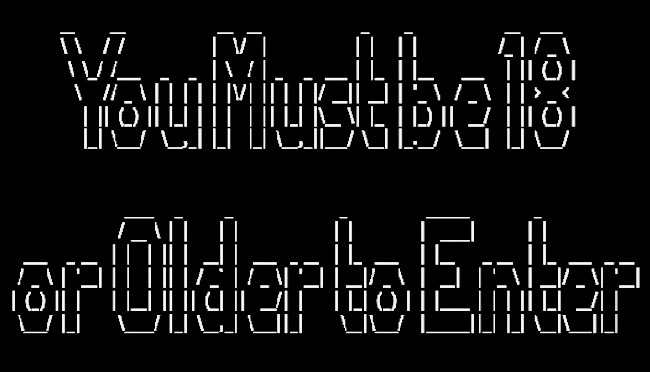
A limitation. Or it could have been framed as a prohibition: Children Under 18 Not Admitted.
And among the signs offered by the My Parking Sign company:
(#4)
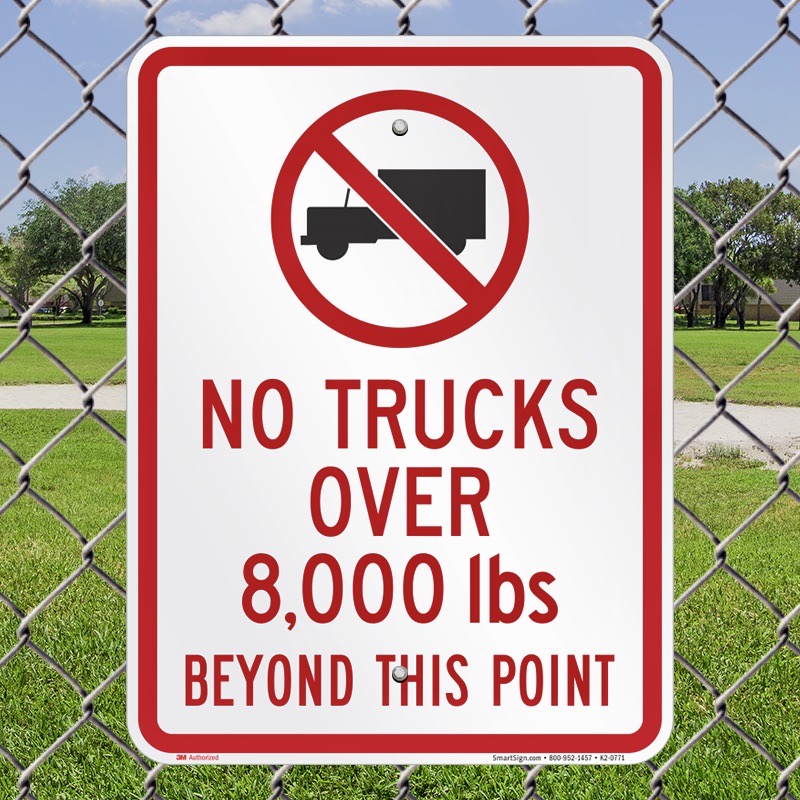
A prohibition. Or it could have been framed as a limitation: Trucks Must Be Under 8,000 lbs.
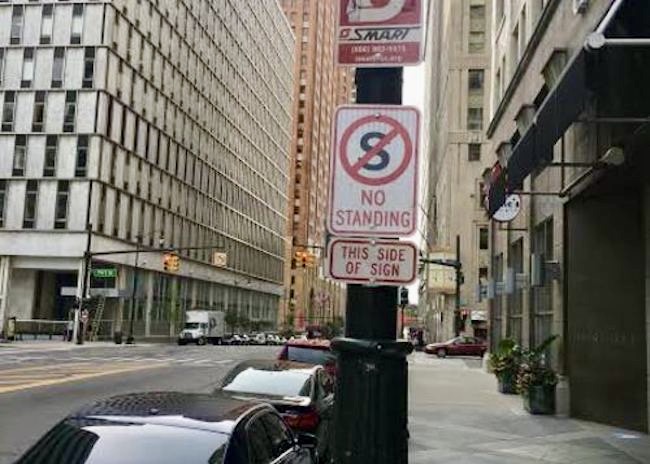
And then there are contextual issues: who does the sign apply to, and where is the sign in force? The regulatory traffic sign NO STANDING must be understood as applying to vehicles, not pedestrians; and there might be some question as to the area covered by its prohibition. As there was in Detroit in 2018; from the Deadline Detroit site on 9/27/18 in “Update: City Installs ‘No Standing’ Sign In Response To Deadline Detroit Column”:
The city of Detroit has installed a “No Standing” sign at a parking spot on Griswold, between Fort and Lafayette in downtown Detroit, in response to a column (below) by Allan Lengel of Deadline Detroit. … [Lengel complained] that he and other motorists were getting ticketed in a parking space next to a SMART bus sign on Griswold … It’s unclear that it was a no parking zone.
So that motivated a NO STANDING sign. But then the city had to add a further sign, a meta-sign of sorts (THIS SIDE OF SIGN), to make clear where the NO STANDING sign applied:
(#5)
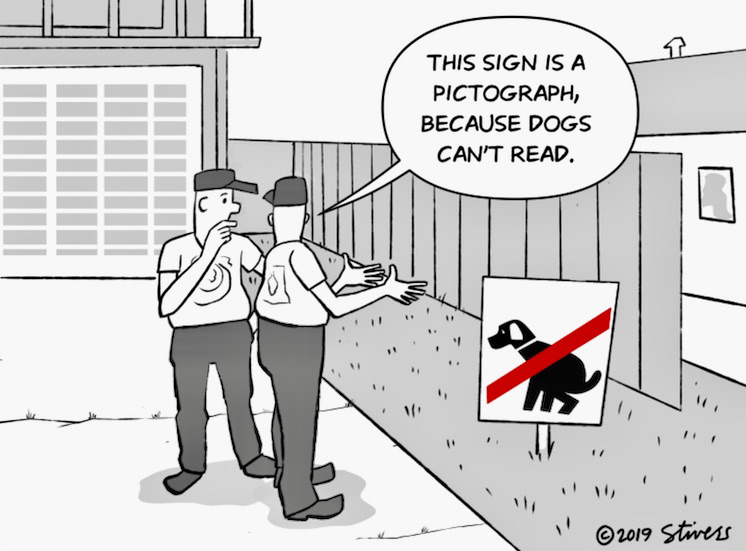
A Mark Stivers cartoon from 2021. From my 4/28/21 posting “Pictographs for dogs”, about this cartoon:
(#5)
Dogs also can’t interpret pictographs, certainly not such abstract ones as the slash of prohibition, the NO symbol (seen here in a non-standard orientation and missing part of its conventional accompaniments). It’s doubtful, in fact, that they can recognize dog pictographs, highly stylized representations of a dog — and incredibly doubtful that they can recognize a pictograph of a dog taking a poop, and understand that a prohibition against dogs pooping applies to them. In fact, it’s beyond doubtful that even if they recognize the sign above as a prohibition against dogs pooping, they understand that the sign is locationally deictic, applying not just to the spot where the sign is planted, but to some contextually (and socioculturally) determined area around the sign — in this case, applying to the whole strip of lawn on this side of the fence (but not to any larger area).
Leave a Reply