From my 7/14 posting on this blog: my life has recently been extraordinarily difficult and extravagantly painful; and so it continues, with the added complications of medical appointments, on 7/14 and 7/16; a new helper / caregiver, starting on 7/15 and 7/17; and a series of computer disasters, one a day for three days (7/14 – 7/16) running.
But then in clearing out the innumerable closets, shelves, drawers, and storage spaces in this house, preparatory to moving, many months from now, to a much smaller apartment in an assisted living facility, I have unearthed two decorative artworks — of cross-stitching and Mexican folk pottery — recognizing and celebrating threesomes, more specifically the affectional and sexual triple of me, my wife Ann Daingerfield Zwicky, and my husband-equivalent / Ann’s lover Jacques Henry Transue, in the years 1975 through 1985 (when Ann died, and Jacques and I became just an everyday gay male couple). Both were presents: the cross-stitching of three monograms from the creator, our daughter, Elizabeth Daingerfield Zwicky; and the three pottery doves from my former UIUC student and our old friend David Stein, who found them in a crafts market in Tijuana during a day trip from San Diego that David took me on, all those years ago.
The triple monogram. Found at the back of a drawer otherwise full of very old financial records (clearing stuff out is unbelievably tiresome), who knows how it got there; but calling out to be properly framed:
(#1) AMZ (well, AmZ), ADZ, and JHT (well, JhT); Ann should have kept her maiden name — Ann Walcutt Daingerfield — but we were married in 1962, in a very different time; and Jacques and I eventually — in 1996 — got a domestic partnership certificate from the city of Palo Alto in a vey sweet ceremony, and we’d said our solemn vows to each other privately, ten years earlier, but he died before same-sex marriage was available to us, so we never got to be legally husbands [here the audience hisses]
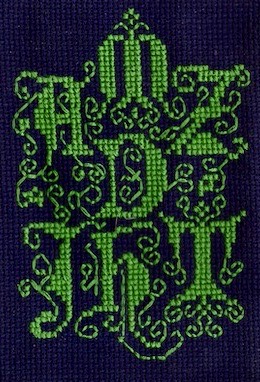
Meanwhile, Elizabeth went through adolescence with a mother and two fathers. And then made this elegant tribute for us.
On cross-stitching, from Wikipedia:
Cross-stitch is a form of sewing and a popular form of counted-thread embroidery in which X-shaped stitches (called cross stitches) in a tiled, raster-like pattern are used to form a picture.
Las tres palomas. The three ceramic birds David Stein picked out for us in Tijuana, here posed on nests in my Palo Alto kitchen:
(#2) The bird on the right is the main bird of the three — the head dove, so to speak — the one with the crucial information about the trio inked on its base:Posada 1965 Solis Mexico
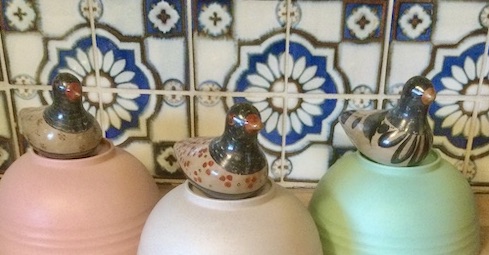
Solis is a family name (from Latin sol ‘sun’), the name of the potter, who made these pieces in 1965. And the three birds were intended to symbolize the Holy Family, as in a posada ritual; from NOAD:
noun posada: [a] (in Spanish-speaking regions) a hotel or inn. [b] (also Las Posadas) (in Mexico) a ritual re-enactment of Mary and Joseph’s search for a lodging in Bethlehem, performed just before Christmas: the famous Oaxacan pre-Christmas posadas and processions.
The dove motif, the shape of the bird figures, and the designs on them identify the trio as coming from the potteries of Tonalá in the state of Jalisco (capital: Guadalajara). On the crafts of the state, from Wikipedia:
Ceramics of Jalisco, Mexico [have] a history that extends far back in the pre Hispanic period, but modern production is the result of techniques introduced by the Spanish during the colonial period and the introduction of high-fire production in the 1950s and 1960s by Jorge Wilmot and Ken Edwards. Today various types of traditional ceramics such as bruñido, canelo and petatillo are still made, along with high fire types like stoneware, with traditional and nontraditional decorative motifs. The two main ceramics centers are Tlaquepaque and Tonalá, with a wide variety of products such as cookware, plates, bowls, piggy banks and many types of figures.
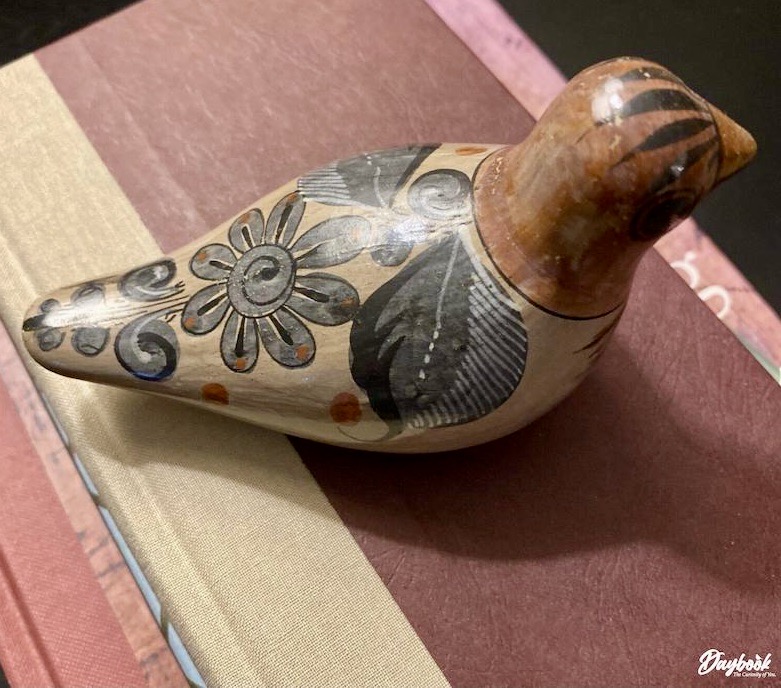
Then about the birds of Tonalá, from an entry in Kristy Dodson’s Daybook site about “Mexican Bird Pottery” on 5/4/21:
(#3) From Dodson’s collection, this ceramic dove with the very same design as on the main bird in my trio (while differing in small details)Tonalá pottery is certainly not just birds. You can find serving pieces, dishes, decorative items, and a whole lot more. However, the birds have caught my attention and I am becoming slightly obsessive about finding them in the most unexpected places. To identify them as Mexican bird pottery, look for MEX to be hand-painted on the underside; on lucky occasions, you may find state abbreviations or the artist’s initials. Some of the birds are primitive while others are simply vintage. Either way, if you find one you have found an artisan’s treasure.
So, what is Tonalá Pottery? To begin with, Tonalá, Jalisco is in the greater metro area of Guadalajara and is home to one of the largest open-air Mexican craft markets. Tonalá pottery is made of burnished, petatillo (woven-straw), canelo (cinnamon), or scented clay and is typically created for decorative use but can also be found as food-safe pottery.
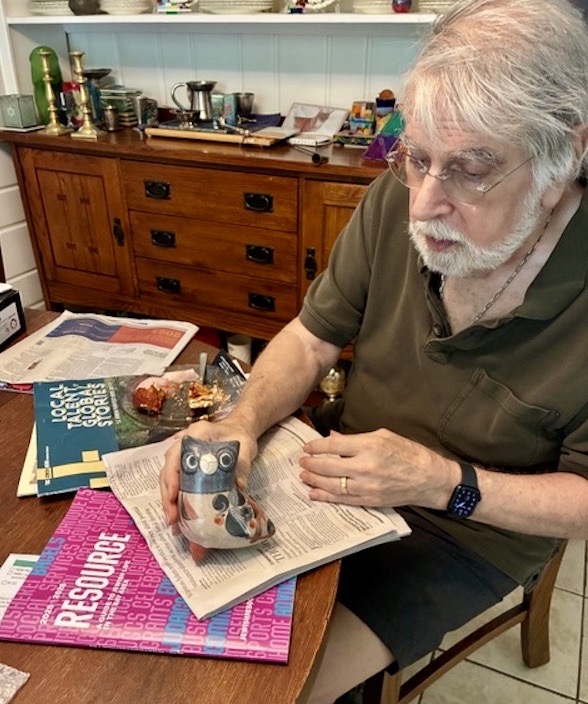
[Bonus on 7/19: This photo of David Stein, from his husband, Bill Stewart:
(#4) DS with a ceramic owl from Tonalá; the owl is David’s totem animal, and Bill’s as well]
Leave a Reply