Sweet Gee (an alter ego of Gadi Niram’s) wrote on Facebook yesterday about a character in the delightful Hetty Wainthropp Investigates tv show, who I took to be the character played by the adorable Dominic Monaghan, but turned out to be Joe Peluso’s. I wrote:
Ah, I am mollified. I’d completely forgotten JP. Meanwhile, I know that mollify has to do, etymologically, with softening, but I couldn’t help thinking of it as Molly-fy ‘make into a Molly’, presumably by getting into drag.
Two clusters of things here: the Wainthropp show and DM; and the verb mollify and the noun molly / Molly.
The tv show. From Wikipedia:
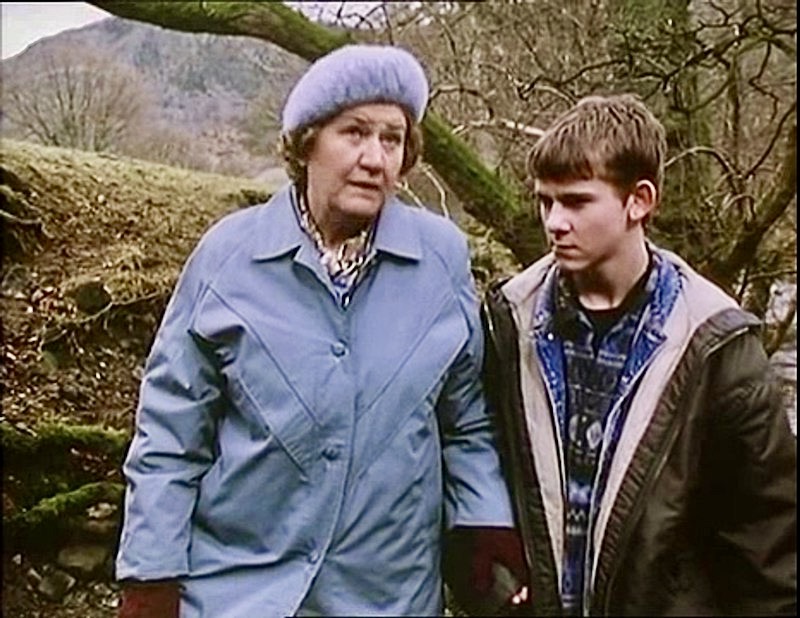
Hetty Wainthropp Investigates is a genteel British crime–comedy drama television series which aired from 1996 to 1998 on BBC One. The series starred Patricia Routledge as the title character (Henrietta “Hetty” Wainthropp), Derek Benfield as her patient husband Robert, Dominic Monaghan as their [underage] lodger (and her assistant [in investigation]) Geoffrey Shawcross and John Graham Davies as DCI Adams.
An eccentric screen shot of Hetty (PR) and Geoffrey (DM) from S1 E1
About DM, from my 1/29/13 posting “Dominic Monaghan”:
Monaghan is definitely one of my “types”: a relatively small guy (5′7″), slim [AZ in 2025: I note that I am now 5′7″ myself, but far from slim]. And projecting sweetness, openness, and earnestness. (For me, hotness is as much a matter of character as body type.)
DM (born in 1976; he was 19 when the series started and is now 50) went on to (among other things) fame in the films of The Lord of the Rings, to a major role in the tv series Lost, and to the starring role in the tv show Wild Things with Dominic Monaghan (in which the actually tough and outdoorsy guy DM engages in closer encounters with wild animals that most people would risk).
He still has a wonderful smile.
mollifying. From NOAD:
verb mollify: [a] appease the anger or anxiety of (someone): nature reserves were set up around the power stations to mollify local conservationists. … ORIGIN late Middle English (also in the sense ‘make soft or supple’): from French mollifieror Latin mollificare, from mollis‘soft’.
And then GDoS on the noun molly [usually Molly}:
1 a male homosexual, an effeminate man [1st cite 1693, from ‘Jenny Cromwells Complaint against Sodomy’: Scarsdale … skulks about the Alleys And is content with Bettys, Nans, and Mollys] [and then in molly / Molly man (from 1928), Miss Molly (from 1725), and Tom Molly (from 1821), all ‘an effeminate homosexual’ and in molly / Molly house ‘a male homosexual brothel’ (from 1726)]
Bonus. Swiss sources say that the origin of the name of the town Mollis in Canton Glarus (in northeastern Switzerland) — the place that Zwickys come from — is in fact also Latin mollis ‘soft’. So we’re soft, perhaps in the sense that we’re emotionally soothing, perhaps by being effeminate.
April 6, 2025 at 6:20 am |
I note that in German music terminology, the words for major and minor are dur and moll respectively, clearly from the French for hard and soft. This is due to some complex history about hexachords (which also accounts for the peculiarity that German uses B and H to represent the pitches and keys that English-speakers call B♭ and B, respectively).