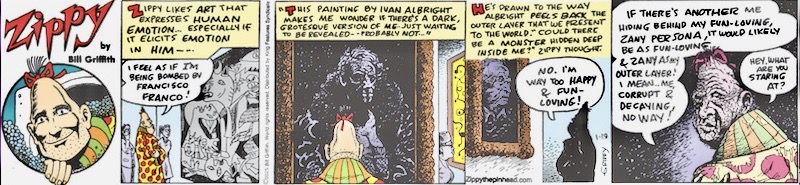
In today’s Zippy strip, our zany, happy-go-lucky Pinhead finds himself drawn to dark imagery in art: in the wartime horrors of Picasso’s Guernica, in the monster within Albright’s Dorian Gray:
(#1) The Albright is especially unsettling for Zippy; what if his goofy exterior is only a mask for such a monstrous being within him? (Am I a monster?)
These musings on dark art follow immediately on Zippy’s anxiety yesterday, in my posting “Tell a joke, go to jail”, in which
Z confronts a pair of clay wraiths, lifeless in body and dead in soul, and tries desperately to interject fun … into the conversation; to counterpose silliness, play, and sheer joy against the dead weight of the world’s pain, suffering, and injustice; to plead for humanity over humorlessness; to advocate for delight, even in the smallest everyday things
A few notes on the two paintings, then a quick view of the ideas that made the Albright so disturbing to Zippy.
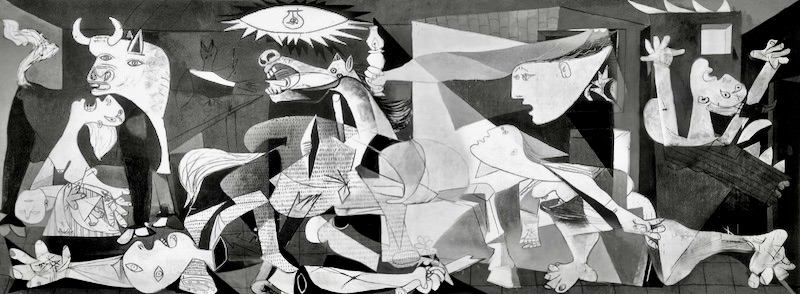
The paintings. From my 8/17/23 posting “Pablo Picasso and Eminem, together”:
(#2) The anti-war painting Guernica (1937), a dramatic portrayal of the bombing of Guernica by German and Italian air forces during the Spanish Civil War
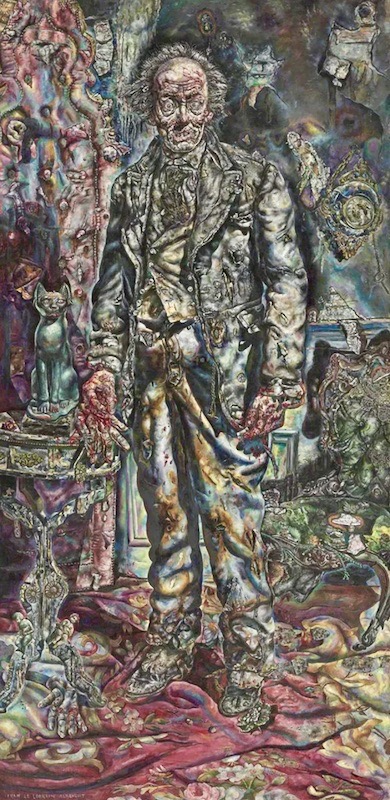
Then the Albright painting Picture of Dorian Gray (1943), followed by some information on the painter from Wikipedia:
(#3)
Ivan Le Lorraine Albright (February 20, 1897 – November 18, 1983) was an American painter, sculptor and print-maker most renowned for his self-portraits, character studies, and still lifes. Due to his technique and dark subject matter, he is often categorized among the Magic Realists and is sometimes referred to as the “master of the macabre”.
From a family of artists and artisans, Albright emerged on the American art scene in the 1930s and established a reputation as one of the most enigmatic of the American Realists. He shocked, awed and upset the viewing public through his emphasis on the fragility of the body, flesh and the human condition with such works as The Lineman (1928), That Which I Should Have Done I Did Not Do (The Door) (1931), and The Picture of Dorian Gray (1943). His work to highlight the minute detail and texture of every surface often required him to spend years or decades on a single painting.
Two themes. From my 4/13/23 posting “Escape from the lab!”, taking off from a panel from a comic book of my childhood (Weird Science #8 (July 1951)):
The panel evokes (at least) two themes from philosophy, literature, and popular culture:
— the Ungodly Knowledge theme — there are things we were not meant to know — the products of which are then inadvertently released onto the world; the prototype is the story of the monster created by Victor Frankenstein
— the Beast Within theme — we are both good and evil, a beast lurks within us — related to the larger theme of transformation into a monster (a werewolf, a vampire, whatever); the prototype is the story of the monstrous Mr. Hyde, released in the lab from within Dr. Jekyll and then onto the world
… These stories center on monsters created by human action. Alternative story lines feature monsters created by magical or demonic means [golems, gargoyles]; or monsters that are, or are created by, aliens [as in Invasion of the Body Snatchers (1958, 1978) and The Thing (1982)]
Both themes were explored pointedly in the imaginative fiction of the 19th century and in the films of the post-WWII period.
Leave a Reply