The Bizarro of 11/11, about birthday presents in Batworld: Selina Kaye (in her alter ego as Catwoman, where she is both woman and cat) and Dick Grayson (in his alter ego as Robin, where he’s a boy named Robin, and not a bird) grouse about the presents they receive — probably from Bruce Wayne (in his alter ego as Batman) — by virtue of their creature-name aliases:
(#1) Selina gets cat presents, but at least her alter ego is a hybrid of cat and woman; but Dick gets worms (because the bird the robin is famously fond of eating them) even though there’s nothing avian about his alter ego (not even his name, which is a diminutive of the name Robert), so he is no doubt doubly pissed off — Wayno’s title for the strip is the ironic “Thanks a lot, Bruce” (if you’re puzzled by the odd symbols in the cartoon — Wayno says there are 4 in this strip — see this Page)
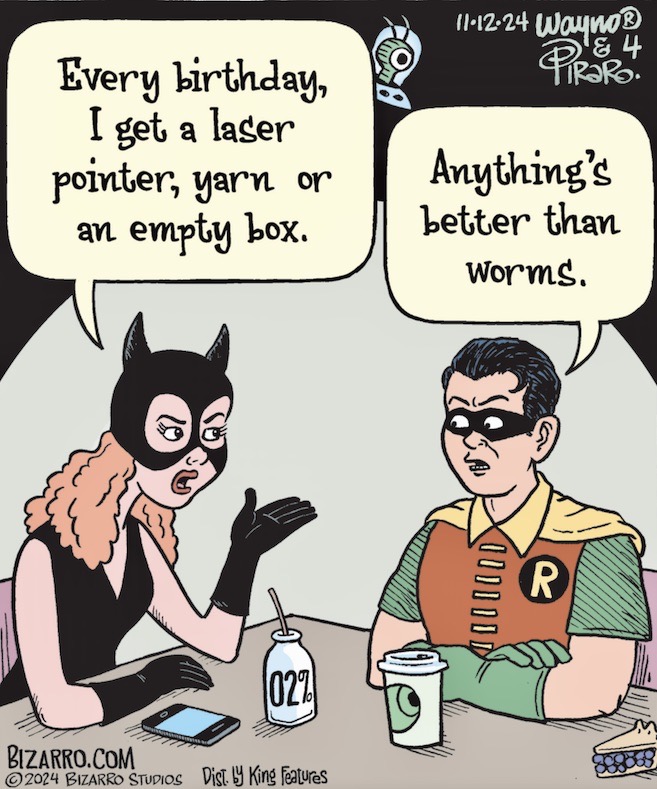
As it happens, the proper name Robin is historically not unconnected to the common noun robin, but the connection runs the wrong way: the noun robin comes from the name Robin. As far as modern English is concerned, robin and Robin are just unrelated homophones, so giving Robin birthday worms because of his name is like giving Peter and Dick birthday condoms because of their names; it embodies a (crude) pun.
Catwoman and Robin, the background.
— from Wikipedia:
Catwoman is a character appearing in American comic books published by DC Comics. Created by Bill Finger and Bob Kane, she debuted as “the Cat” in Batman #1 (spring 1940). She has become one of the superhero Batman’s most prominent enemies, belonging to the collective of adversaries that make up his rogues gallery, as well as Batman’s best known and most enduring love interest, with many stories depicting their complex love–hate relationship.
… Catwoman is the alter ego of Selina Kyle, a burglar in Gotham City who usually wears a skintight bodysuit and uses a bullwhip for a weapon. She was originally characterized as a supervillain and adversary of Batman, but has been featured in an eponymous series since the 1990s that portrays her as an antiheroine, often with a utilitarian moral philosophy.
… Catwoman has been adapted in various media incarnations, having been portrayed in film by Lee Meriwether in Batman (1966), Michelle Pfeiffer in Batman Returns (1992), Halle Berry in Catwoman (2004), Anne Hathaway in The Dark Knight Rises (2012), and Zoë Kravitz in The Batman (2022). On television, she has been played by Julie Newmar and Eartha Kitt in Batman, where the name Selina Kyle was never used; and Camren Bicondova and Lili Simmons in Gotham.
— from Wikipedia:
Robin is the alias of several superheroes appearing in American comic books published by DC Comics. The character was created by Bob Kane, Bill Finger, and Jerry Robinson to serve as a junior counterpart and the sidekick to the superhero Batman. As a team, Batman and Robin have commonly been referred to as the Caped Crusaders and the Dynamic Duo. The character’s first incarnation, Dick Grayson, debuted in Detective Comics #38 (April 1940). … He made regular appearances in Batman-related comic books and other DC Comics publications from 1940 through the early 1980s, until the character set aside the Robin identity and became the independent superhero Nightwing.
The Wikipedia entry goes on to provide a catalogue (of byzantine complexity) of the Robins in various comics and comic universes, not to mention movies and tv.
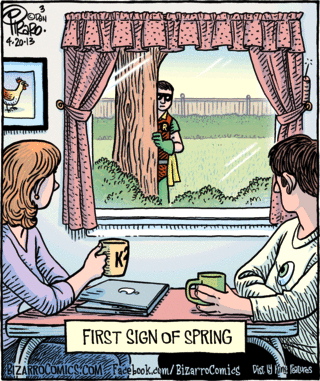
The Robin / robin pun on this blog. At least once before, and also in a Bizarro strip: from my 4/20/13 posting “Indirect pun”:
(#2) The first Robin of spring
November 18, 2024 at 2:36 pm |
There are over 80 years of Robin canon and many contradictory stories, but current canon is that Mary Grayson nicknamed her son that because he was born on the first day of spring — so the hero name is, in fact, based on the bird and not the human name. (The original creators drew from Robin Hood legend, but that’s almost never referenced in the comics.)
November 18, 2024 at 4:26 pm |
It’s still true that “As far as modern English is concerned, robin and Robin are just unrelated homophones” (though it now seems that there’s a historical relationship; my original take on the situation was that there wasn’t even that).