In an on-line notice of a journal article, a language name that I don’t recall having come across before, but one I understood after a moment’s thought: Hexagonal French, the French spoken in the hexagon of France — that is, Metropolitan French, or more plainly, the French of France, France French, French French (occasionally referred to as European French or Continental French, but those terms would take in Belgian French and Swiss French, which are outside the hexagon). Meaning, of course, the standard, Paris-based, varieties of this language; there are plenty of provincial varieties in the country, plus other Romance languages related to French, and, even further afield, non-Romance languages within the hexagon, like the Celtic language Breton in Brittany.
From Wikipedia:
French of France is the predominant variety of the French language in France, Andorra and Monaco, in its formal and informal registers. It has, for a long time, been associated with Standard French. It is now seen as a variety of French alongside Acadian French [in the Maritimes], Belgian French, Quebec French, Swiss French, etc.
Lots to unpack here, starting with the hexagon. Which will lead immediately to names of regions, including those that constitute the land masses of political entities. including countries like France.
The hexagon of France. First, the map:
The six sides, starting from the upper left (Brittany) and moving clockwise: 1 a stretch on the English Channel, facing the UK; 2 a northeastern stretch, bordering Belgium, Luxembourg, and Germany; 3 an eastern stretch, bordering Germany, Switzerland, and Italy; 4 a southern stretch, on the Mediterranean; 5 a southwestern stretch, bordering Spain and Andorra; and 6 a western stretch, on the North Atlantic (Wikipedia map)
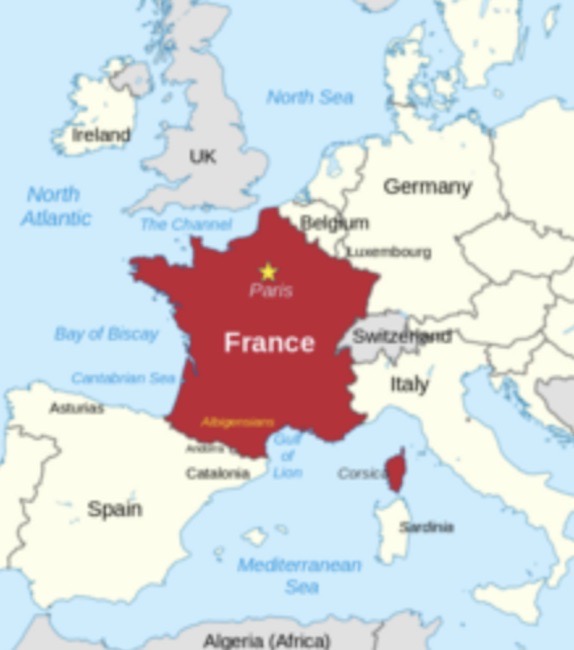
Well, yes. but then since 1788 the large island of Corsica has counted as part of the hexagon for administrative purposes, despite its being out there in the Mediterranean, essentially next to the Italian island of Sardinia. Region-naming for political entities often follows the logic of administrative and bureaucratic purposes rather than mere geography. So for metropolitan France. As for France itself, things are far stranger.
France and its administrative regions. From Wikipedia:
France, officially the French Republic, is a country located primarily in Western Europe. Its overseas regions and territories include French Guiana in South America, Saint Pierre and Miquelon in the North Atlantic, the French West Indies, and many islands in Oceania and the Indian Ocean, giving it one of the largest discontiguous exclusive economic zones in the world. Metropolitan France shares borders with Belgium and Luxembourg to the north, Germany to the northeast, Switzerland to the east, Italy and Monaco to the southeast, Andorra and Spain to the south, and a maritime border with the United Kingdom to the northwest. Its metropolitan area extends from the Rhine to the Atlantic Ocean and from the Mediterranean Sea to the English Channel and the North Sea. … France is divided into eighteen administrative regions, of which thirteen are located in metropolitan France (in Europe), while the other five [Guadeloupe, Martinique, French Guiana, Mayotte, Réunion] are overseas regions.
France and its overseas collectivities. But wait, there’s more. From Wikipedia:
The French overseas collectivities (French: collectivité d’outre-mer, abbreviated as COM) are first-order administrative divisions of France, like the French regions, but have a semi-autonomous status. … As of 31 March 2011, there were [five] COMs: French Polynesia, Saint Barthélemy and Saint Martin [both in the Lesser Antilles], Saint Pierre and Miquelon [a group of islands off the coast of Newfoundland], and Wallis and Futuna [three small islands in the Pacific Ocean].
I’m just going to let that sit there. And turn to the terms metropolis and metropolitan.
metropolitan, metropolis, metropolitan again. Taking the adjective first, because one of its senses supplies the source for the noun senses, which are the source of another adjective sense. Let’s just dive in.
From NOAD, two relevant senses of metropolitan, the second of which is where all this starts:
adj. metropolitan: 2 relating to or denoting the parent state of a colony or dependency: metropolitan Spain.
Well, that’s a surprise. Further surprise: the metro part is from (ancient) Greek, where it’s a variant of the Greek ‘mother’ word, cognate with Latin mater. Originally, metropolitan referred to the ‘mother state’ of colonial power. Peninsular Spain as the mother state of the far-flung Spanish empire, hence peninsular Spain as metropolitan Spain. Hexagonal France as the mother state of the equally far-flung French empire, hence hexagonal France as metropolitan France.
Then from a metropolitan state, by metonymy to the capital city of that state as a metropolis. From NOAD:
noun metropolis: [a] the capital or chief city of a country or region: he preferred the peaceful life of the countryside to the bustle of the metropolis.
And from that by metaphor:
noun metropolis: [b] a very large and densely populated industrial and commercial city: by the late eighteenth century Edo had grown to a metropolis with a population of nearly one million.
And then an adjective derived from these nouns:
adj. metropolitan: 1 relating to or denoting a metropolis, often inclusive of its surrounding areas: the Boston metropolitan area.
(And from that the element metro– of metrosexual, metro as the name for the underground / the subways, and more.)
November 8, 2024 at 4:46 am |
From Luc Vartan Baronian on Facebook:
November 8, 2024 at 7:00 am |
Please tell me that I’m not the only one who saw the title of this post whose mind went immediately to “hexagonal wrench”. (Was this deliberate?)
November 8, 2024 at 7:18 am |
It hadn’t even occurred to me, probably because I say hex wrench, never hexagonal wrench. But the expression came to me from articles on French, where it appears to be a common alternative to metropolitan French (no doubt because *that* expression is opaque to many people). It depends on seeing the European landmass of France as a hexagon, and that imagery is not a recent invention (though I don’t know the history — but surely someone has traced this history).
November 8, 2024 at 7:45 am |
As a child learning French at a bilingual school, the “Hexagone” label for France always puzzled me. Looking at the outline of France without surrounding context, it seemed to much more closely resemble a regular pentagon. The entire southern border seemed fairly similar in length to the remaining sides, and certainly more similar than the two mini-sides created by splitting the border in half. I figured the French probably just liked hexagons more.
It wasn’t until I was older that I understood it as you have described here: Not “Which regular polygon does the border most resemble?” but “What are the different parts of the border and what’s on the other side of those parts?” To people in France, there is of course a great deal of difference between bordering the Mediterranean and bordering the Pyrenees.
March 11, 2025 at 3:25 am |
I had always assumed that metropolitan in this context was an example of synecdoche (as in, the land with the capital city) rather than the other way round. Nice to know the correct reason