Yes, I’ve given the punchline away. It’s the delicious pun on Antony and Cleopatra in this Wayno Bizarro strip from 6/21/23, which has recently been reproduced on Facebook:
(#1) A fish-headed suitor — Mark Anchovy — offers anchovies to the Queen of the Nile (if you’re puzzled by the odd symbols in the cartoon — Wayno says there are, wow, 9 in this strip (well, there are plenty of Egyptian hieroglyphs to subvert)— see this Page)

Wayno returned to the Antony and Cleopatra theme recently, so I’ll start my discussion in Roman-occupied Egypt. Then it turns out that though I’ve often mentioned anchovies in culinary contexts on this blog, I seem not to have actually posted about them, so I’ll remedy that; there will be tiny salted fishes.
The cartoon glory that was Rome. The title of my 9/4/24 posting, with a Bizarro “Antonym and Cleopatra” cartoon (plus some exploration into Antony and Cleopatra):
(#2) Antony, adaptable to every circumstance — here exhibiting his oppositional abilities

Sail on, silver fish. From Wikipedia:
An anchovy is a small, common forage fish of the family Engraulidae. Most species are found in marine waters, but several will enter brackish water, and some in South America are restricted to fresh water
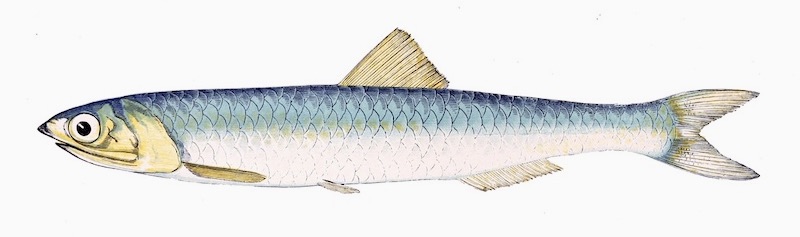
(#2) European anchovy, Engraulis encrasicolus…The anchovy is a significant food source for almost every predatory fish in its environment, including the California halibut, rock fish, yellowtail, shark, chinook, and coho salmon. It is also extremely important to marine mammals and birds; for example, breeding success of California brown pelicans and elegant terns is strongly connected to anchovy abundance.
(#3) Antonio Sicurezza, Still Life with Anchovies (1972); Sicurezza (February 25, 1905 – August 29, 1979) was an Italian figurative painter; his artistic production includes still lifes, portraits, landscapes, nudes, and altar pieces (adapted from Wikipedia)… A traditional method of processing and preserving anchovies is to gut and salt them in brine, allow them to cure, and then pack them in oil or salt. This results in a characteristic strong flavor and the flesh turning a deep grey. Pickled in vinegar, as with Spanish boquerones, anchovies are milder and the flesh retains a white color. In Roman times, anchovies were the base for the fermented fish sauce garum. Garum had a sufficiently long shelf life for long-distance commerce, and was produced in industrial quantities. Anchovies were also eaten raw as an aphrodisiac.
Today, they are used in small quantities to flavor many dishes. Because of the strong flavor, they are also an ingredient in several sauces and condiments, including Worcestershire sauce, caesar salad dressing, remoulade, Gentleman’s Relish, many fish sauces, and in some versions of Café de Paris butter. For domestic use, anchovy fillets are packed in oil or salt in small tins or jars, sometimes rolled around capers. Anchovy paste is also available. Fishermen also use anchovies as bait for larger fish, such as tuna and sea bass.
The strong taste people associate with anchovies is due to the curing process. Fresh anchovies, known in Italy as alici, have a much milder flavor. The anchovies from Barcola (in the local dialect: sardoni barcolani) are particularly popular.

As for anchovies on pizza, there are many who maintain that no pizza is complete without them, and others who find even a delicate tang of salty fishiness offensive. (As you might have guessed, I am fond of them.)
Leave a Reply