From a 9/16 visit to Stanford’s Arizona Garden — the “cactus garden” in local talk — engineered by my caregiver León Hernández Alvarez (who will be L from here on out), to investigate new things (for him) in the area — so many wonderful places open to the public for free — and to provide me with enjoyment (and useful exercise with my walker).
When we came around a corner of the path from the parking lot, and suddenly faced an alien-planet vista of huge astonishing plants of all sorts, as far as the eye could see in every direction, L gasped in surprise and delight. And close to the ground there were all manner of other plants, every one of them a novelty. Nothing labeled, no information supplied, but I could provide some facts from memory. Though mostly L was being carried away in delight by the visual excess: everywhere you looked, another bit of (mostly dangerous) living magic.
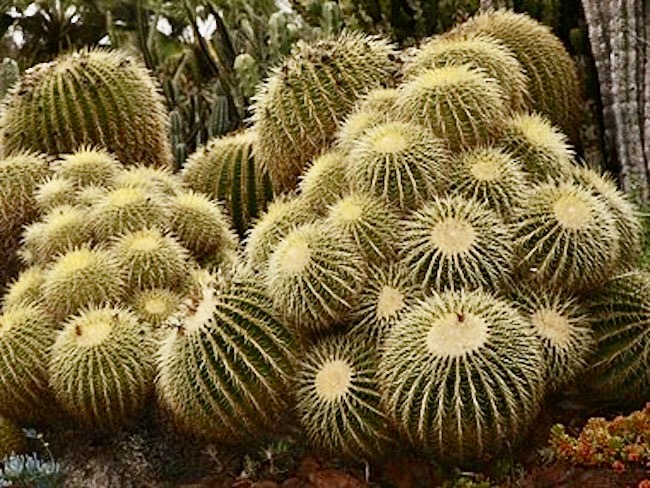
Then, around a corner there was a large garden island populated by cactuses I certainly recognized. “These are called barrel cactuses, for obvious reasons”, I said, but for a few moments he didn’t care what they were called, they were amazing, and in fact adorable. Some of them were arranged in what you could think of as family groups. They were golden-green, with huge spines all over them. Spines so big you could feel them individually, discover they were soft and flexible, but with spear-sharp tips.
Eventually, L looked them up on his phone and discovered that they were, specifically, golden barrel cactuses. From Mexico originally, but in the desert far from the Mexico City region he grew up in.
(#1) Echinocactus grusonii in a cactus collection (Wikipedia caption and photo)
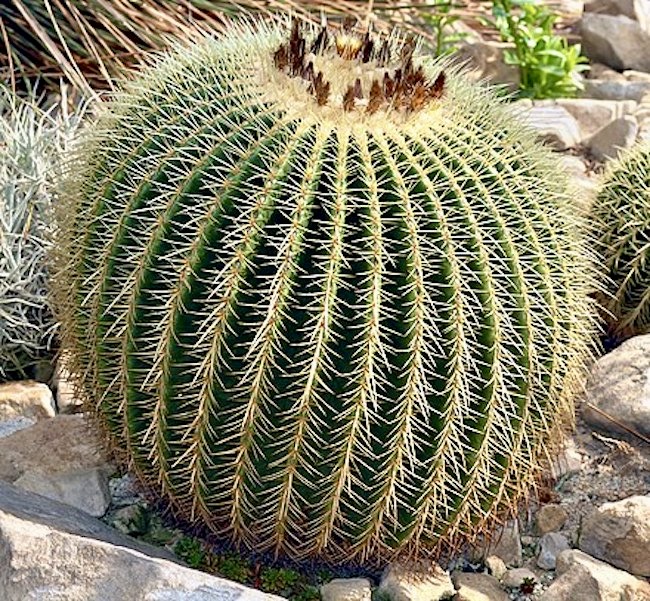
From Wikipedia:
Kroenleinia grusonii [formerly named Echinocactus grusonii], popularly known as the golden barrel cactus, golden ball, “mother-in-law’s cushion” or “mother-in-law’s chair”, is a species of barrel cactus which is endemic to east-central Mexico.
The golden barrel cactus is rare and endangered — potentially regionally extinct — in nature. It is native to the Mexican states of Querétaro and Hidalgo, particularly near Mesa de León.
Kroenleinia grusonii is widely cultivated by specialty plant nurseries as an ornamental plant, for planting in containers, desert habitat gardens, rock gardens, and in conservatories.
And then the “families”:
(#2) Mature golden barrels showing their distinctive clustering habit (photo from the Huntington Desert Garden in San Marino CA)
L has now begun to imagine his fantasy garden, which would start with golden barrel cactuses. The full program probably isn’t going to be realized, since it includes a sequoia (a truly gigantic tree found only on the western slopes of the Sierra Nevada in California) — though he could probably be bargained down to a coast redwood (which are big and impressive but also positively common where he and I live now; there’s one about 40 feet from my front door, on the street).
October 2, 2024 at 6:18 am |
I’m reflecting on the cultural implications of the “mother-in-law” references among the common names.
October 3, 2024 at 1:41 pm |
There is also mother-in-law’s tongue (Dracaena trifasciata). But there has been a movement, at least locally, to stop calling it that because of the “cultural implications.”