A follow-up to my 6/25 posting “Dogs on wheels”, about the ambiguity between low attachment (LA) and high attachment (HA) of modifiers, as exemplified in a memic joke about a dog chasing people on a bicycle (in the LA reading, people on a bicycle are chased by the dog; in the HA reading, the dog chasing people is on a bicycle):
(#1) One version of the dogs-on-wheels joke
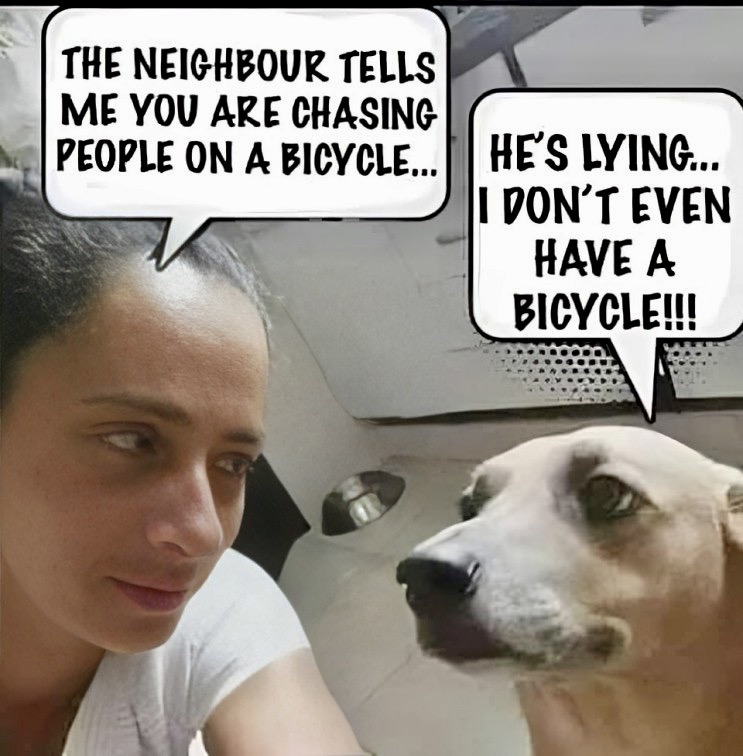
In that posting, I complained:
I was … sure that I’d seen a version of [the “dog chasing people on a bicycle” meme] and had posted about it; but then I couldn’t find it on any of my blogs or in the “to blog” files on my computer or in the “to blog” images on my desktop or in my stored albums of images. Much annoyed growling.
I surmised that I had indeed saved it for later posting, but then deleted the image and my notes on it in one of the necessary periodic purges of my “to blog” material.
Then, yesterday, I noticed an oddly named image on my desktop display of images (which, even pared down, is still sizable): MooseAttachment.jpg. This turned out to be a different memic joke exploiting a LA / HA ambiguity:
(#2) This time it’s saw a moose on the way to work — who was on the way to work, the moose (LA) or the speaker (HA)? — instead of a dog chasing people on a bicycle — who was on a bicycle, the people (LA) or the dog (HA)?

(There are, of course, many different versions of the meme on the net.)
This might well be the memic joke I was remembering as having seen before; I see that I saved it back in 2018, and might well have forgotten the details — dog, moose, whatever, that was 6 years ago, and a hell of a lot of stuff happened in those 6 years.
You will have noticed that the two cases aren’t parallel in detail. Ceteris paribus, LA is the favored reading, but plausibility in context is a powerful effect, as you can see from these two cases. A dog on a bicycle (the HA reading in #1) is implausible, so that reading is funny there. A moose on its way to work (the LA reading in #2) is implausible, so that reading is funny there. The joke memes are arranged so as to present someone foolishly espousing the implausible reading (whether that’s HA or LA); their foolishness is the joke.
June 27, 2024 at 9:42 am |
I know that we rarely see dogs on bicycles, but isn’t that almost as likely as multiple people being on a bicycle?
June 27, 2024 at 9:48 am |
Well no, except in certain circuses. We even have the song “A Bicycle Built for Two”, and the image is culturally current, recognizable even for people who’ve never been on such a bicycle. A bicycle built for a dog, not so much.
June 27, 2024 at 10:25 am
Well, yes, I’ve actually seen multiple people on bicycles many times but don’t recall a dog on a bicycle even once, and “A Bicycle Built for Two” has been around since the 1890s, not all that long after the introduction and popularization of the safety bicycle. I chose to ignore those inconvenient facts for the sake of the joke. In any case, in a universe where dogs can talk and own bicycles, the possibility that the dog was riding one does not seem all that remote.
I was exploiting a different ambiguity in the human’s statement, which sounded like multiple people were on a bicycle. In fact, in the absence of real world knowledge I would have considered that the more likely interpretation. Any thoughts from you on that, Arnold, would be appreciated.
June 27, 2024 at 10:52 am
Reply to John Baker, asking about multiple people on a bicycle. Eek. That hadn’t even occurred to me; I understood “people on a bicycle” to refer to multiple instances of single-person-on-single-bicycle. But now that you point out the possibility of multiple-people-on-single-bicycle, yes, that’s there too. And, oh alas, single-person-on-multiple-bicycles. Here, I think we need an actual expert on distributivity, but really we need someone who studies the usage of these distributed readings. I am an idiot in these departments.
June 27, 2024 at 12:14 pm
I’m not getting the single-person-on-multiple-bicycles reading. After all, the human refers to “people,” plural, and “a bicycle,” singular. The potential readings I get are:
1. The dog, riding a bicycle, is chasing people.
2. The dog is chasing multiple people who are on a single bicycle.
3. In the presumably intended meaning, the dog is chasing multiple persons, each of whom is on a bicycle. I would probably have referred to this as “chasing people on bicycles.”
June 27, 2024 at 10:03 am |
There’s also a looseness of terminology, where an indefinite number of people can (each) be “on a bicycle” (each on their own single bicycle). A person riding multiple bicycles simultaneously is a circus trick like a dog on a bike…
June 27, 2024 at 10:53 am
Ah, see my (hopeless) reply to John Baker.