Passed on by Lisa Cohen on Facebook on 6/2: a bulletin about the world’s largest perogy, in Glendon AB. From the Atlas Obscura site, in “Giant Perogy… Roadside tribute to a staple of eastern European cuisine”, published on 9/5/10:
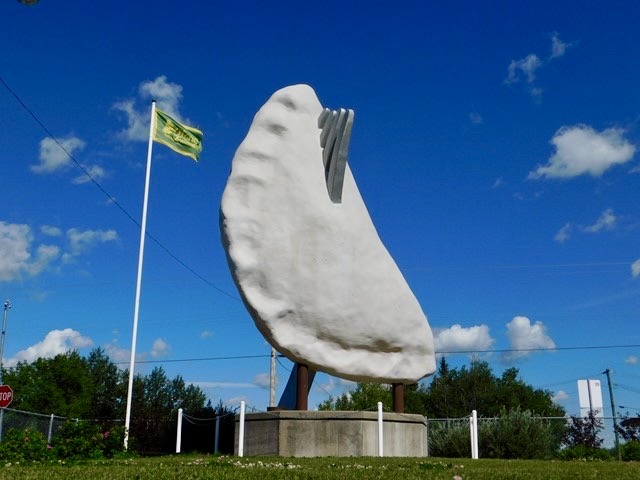
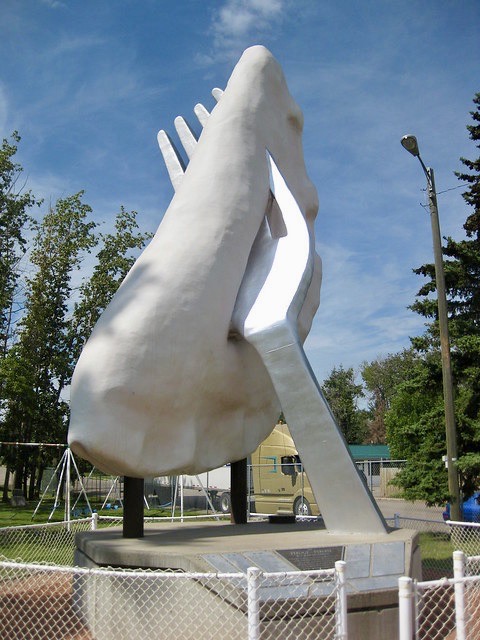
In 1993, Glendon, a village in Alberta …, unveiled its roadside tribute to the perogy. The town’s [fiberglass and steel] Giant Perogy, complete with fork, stands 27 feet tall, weighs approximately 6,000 pounds, and is considered one of the “Giants of the Prairies,” a collection of massive sculptures that can be found across this geographic region of North America.
The fork was added to the sculpture so that people would have some idea as to what it was supposed to be. The first design, without the fork, left passersby baffled. “The first design wasn’t [with] a fork, but then people went by and they responded that it looked like a cow pie or something,” said Johnny Demienko, who dreamed up the sculpture when he worked as the town’s mayor and also a school bus driver.
Apparently, a Perogy Cafe, serving “Ukrainian and Chinese perogies”, was located next to the sculpture for some years.
To come: photos of Glendon’s Giant Perogy; the spelling PEROGY; for comparison to the Glendon dumpling, actual pierogies; the Giants of the Prairies.
The Giant Perogy at home. Two views: one focused on the dumpling, the other on the fork:
(#1) Mostly the dumpling
(#2) Mostly the fork
How to spell it. The spelling PEROGY (also PYROGY, PYROHY, and PEROGI) is an older transliteration of the name in Cyrillic orthography; the now-standard English spelling is PIEROGI (which is the Polish spelling for the plural of the dumpling name pieróg).
Actual pierogies. From Wikipedia:
Pierogi or pierogies are filled dumplings, made by wrapping unleavened dough around a filling, and occasionally flavored with a savory or sweet garnish, finally cooked in boiling water.
Pierogi or their varieties are associated with the cuisines of Central, Eastern and Southeastern Europe.
(#3) From the King Arthur Baking Co. site, “Homemade Pierogi” recipe (with a potato and cheese filling)

There are obvious similarities to Chinese dumplings and to the empanadas of Spain, Latin America, and the Philippines.
Giants of the Prairies. From Wikipedia:
The Giants of the Prairies are a group of “world’s biggest” roadside attractions found in Western Canada, especially in small towns populated mostly by Ukrainian Canadians.
Among them, the (reputed) world’s largest: badminton racket, beaver, bee, blue heron, Coke can, chuckwagon, fire hydrant, golf tee, mosquito, mushroom, oil can, oil derrick, piggy bank, softball, sundial, teepee, wagon wheel. And, in addition to the perogy, various giants, including the: gopher, horse, potatoes, pumpkin. pysanka [Ukrainian decorated Easter egg], and skunk.
Giant roadside sculptures or buildings in fanciful shapes are a common feature of wide-open, sparsely populated spaces — in Canada, and also in the US and Australia. They bring in some tourists, and provide a place for drivers to stop (and spend a bit of money locally) on their travels.
Leave a Reply