From the annals of cartoon understanding: about today’s Wayno / Piraro Bizarro, in which an unaccompanied young man in classical Greek attire inquires about the reflectivity of the water in a Tunnel of Love:
(#1) In case you didn’t recognize (a pop-cultural version of) the figure of Narcissus from Greek mythology, the young man sports a buckle with a big N on it; meanwhile, you need to recognize another piece of pop culture, the amusement park ride the Tunnel of Love (which largely disappeared about 80 years ago as an actual amusement park phenomenon, but lives on as a trope in songs, movies, and tv shows) (if you’re puzzled by the odd symbols in the cartoon — Dan Piraro says there are only 2 in this strip — see this Page)
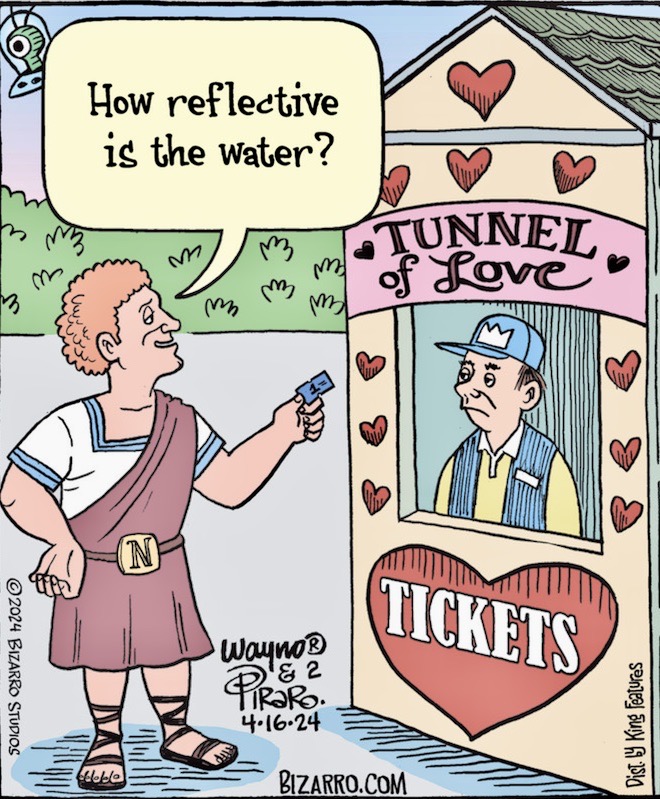
So, yes, you need to bring cultural knowledge to bear on understanding the cartoon — to seeing that it’s hilarious that a Narcissus figure would buy a single ticket for a ride through a Tunnel of Love (designed to provide about 6 minutes alone in the dark for couples to get steamy with one another) and want to know how reflective the water in it is: can I see myself in it?, he needs to know; can I become one with that beautiful man in this dark monument to love?. But all this cultural knowledge is second-hand, coming to us through the distorting, simplifying lens of pop culture: not the myth of Echo and Narcissus, but just a guy foolishly falling in love with himself; not actual amusement park rides, but their pop-cultural echoes in cartoons and the like.
Narcissus: lexical stuff. From NOAD:
proper noun Narcissus: Greek Mythology a beautiful youth who rejected the nymph Echo and fell in love with his own reflection in a pool. He pined away and was changed into the flower that bears his name.
noun narcissism: [a] excessive interest in or admiration of oneself and one’s physical appearance. [b] Psychology selfishness, involving a sense of entitlement, a lack of empathy, and a need for admiration, as characterizing a personality type. [c] Psychoanalysis self-centeredness arising from failure to distinguish the self from external objects, either in very young babies or as a feature of mental disorder.
noun self-love: regard for one’s own well-being and happiness (chiefly considered as a desirable rather than narcissistic characteristic). [AZ: but often used loosely as a synonym for narcissism, also for self-pleasuring ‘masturbation’]
Narcissus in art. A frequent subject, at least in part because it allows for a display of an attractive young man with his body stretched out by the water, as here:
(#2) Detail from Echo and Narcissus by John William Waterhouse (1903) (source: Walker Art Gallery / public domain); works by the “modern Pre-Raphaelite” painter Waterhouse have figured in earlier postings on this blog

The Tunnel of Love. Here we have an excellent survey of the history from the Mental Floss site, “Take a Ride Through the Scandalous History of the Tunnel of Love” by Michele Debczak on 8/30/22, which begins:
When two characters are about to get together on a television show, they may find themselves at an amusement park. There they stumble upon the Tunnel of Love — a boat ride that forces passengers to share a snug seat as they float through a dimly-lit enclosure. What follows has become a pop culture cliché: The would-be couple blushes as they squeeze into a swan-shaped vessel built for two. As they drift past cardboard cupids and neon hearts, their hands inch closer to each other’s in the dark. When they emerge from the tunnel several minutes later, the pair looks much more comfortable than when they entered.
The Tunnel of Love has been a TV trope for decades. Baby Boomers saw it in Scooby-Doo, Gen Xers saw it in The Simpsons, and Millennials saw it in Rugrats. Even younger generations have some familiarity with the concept, with Tunnel of Love scenes appearing in 2010s cartoons like The Loud House and Gravity Falls. The ride is ubiquitous in media, though if you ask anyone under the age of 70 if they’ve seen it in real life, they’ll likely say no.
You wouldn’t be blamed for thinking the attraction is a Hollywood invention, like flying cars or human-sized air vents. But the ride was very real 100 years ago. The Tunnel of Love exploded in popularity in the early 20th century, and after serving an important function for courting couples for several years, it disappeared in what seemed like an instant.
I’ll reproduce (most of) the rest of the entertaining Mental Floss history in a moment, interrupting the story to note that, of course, tunnel of love is available as a metaphorical reference to sexcavities, sexually purposed bodily orifices (the vagina, especially, but also the anus as an organ of sexual pleasure). So Tunnel of Love comes with raunchy undertones.
The tale of the Tunnel. Or the Old Mill, as the case might be.
In the Mood for Love At the turn of the 20th century, Americans with disposable income were eager to experience a new form of entertainment called the amusement park. These venues — which differed from carnivals and world fairs in that they operated at a fixed location — began popping up during the Gilded Age and multiplied through the early 1900s. Innovations in ride technology ushered in a golden age of amusement parks. (Rides at this time were also more loosely regulated than they are today, which led to some perilous designs that thankfully haven’t been replicated since.) In between taking a dark ride to hell and losing consciousness on a looping coaster, guests could have a more relaxing — and more romantic — time in the Tunnel of Love.
According to Hopes&Fears, the ride originated as the Canals of Venice in London, but it really took off in the amusement park-obsessed United States. The attraction followed a basic formula: Riders would climb into a small boat and embark on a gentle ride through dark tunnels. The theme of the tunnels varied, and most early iterations had nothing to do with romance. Before it became the Tunnel of Love, the ride was often called the Old Mill in America. Instead of hearts and Greek gods of love, passengers may have encountered fake rocks and stalactites, or murals of mythical creatures like leprechauns and gnomes.
Even if the theming wasn’t overtly romantic, many riders didn’t need an excuse to cuddle close to their seat-mate. Old Mill rides gained popularity at a time when unchaperoned dates between young people were still viewed as risqué. Unless they were married, couples had few chances for privacy. A slow-moving dark ride presented one of the only socially acceptable opportunities for men and women to be alone together on a date and share physical contact. The ambiance in the tunnel didn’t matter—what was going on inside the boat tended to be much more exciting than what was happening outside of it.
A Useful Purpose According to a 1950 report in The Daily News, a trip through the Tunnel of Love lasted about 6 minutes on average — and many passengers made the most of their time. At the time, it was the belief of Paul Huedepohl, the then-secretary of the National Association of Amusement Parks, Pools, and Beaches, that “more romances are started in these tunnels than there are syllables uttered in a Congressional filibuster.”
… What unwed couples were really using the Old Mill for soon became an open secret, leading many amusement park operators to embrace the ride’s romantic reputation. Palisades Park [in Bergen County NJ, across the Hudson River from NYC] was the first to name its boat ride the Tunnel of Love, and parks across the country quickly followed suit. Other places were more subtle in how they acknowledged the attraction’s unspoken purpose. If the inside of an Old Mill didn’t look like a cave, a love nest, or a gnome’s den, it likely resembled a haunted house. Embracing the dark and dank atmosphere, ride designers outfitted the tunnels with rubber spiders and cloth ghosts. As The Daily News humorously explained, leftover halloween props were often more romantic than pink-and-red decor.
“Research has shown that the snarls, howls, and groans of the hideous sights along the way, while palpably phony, will cause the female to precipitate herself into the male’s arms,” the 1950 article reads. “Her fright is usually as phony as the hazards of the course, but it serves a useful purpose.”
… Jumping Ship There were roughly 700 Tunnels of Love operating in the U.S. in 1950, and in the following decades most of them vanished. Today that number is down to the single digits. In the end, it wasn’t bat-wielding guards or scandalized parents who doomed the ride. Ironically, it was the sexual revolution that caused the Tunnel of Love’s demise.
As societal norms around sex and dating relaxed, unmarried couples no longer had to get creative to spend time alone. They could go out unchaperoned, or in some cases stay in. A regular date wasn’t as thrilling as fitting a relationship’s worth of pent-up passion into a six-minute boat ride, but it was definitely more convenient.
As America’s attitude towards sex evolved, so did its taste in amusement park attractions. Though they were less likely to engage in hanky panky on rides, mature guests still wanted to feel their hearts racing. In the 1960s, parks moved away from slow-paced, old-fashioned rides like the Old Mill and went all in on roller coasters. Instead of demolishing their tunnel rides, a few parks tried to update them for modern times. Dorney Park [in Allentown PA] added fake monsters to its Mill Chute and rebranded it as the Journey to the Center of the Earth. After partnering with famed cartoonist Jim Davis, Kennywood [in West Mifflin PA, southeast of Pittsburgh] transformed its Old Mill into a 3D black-light ride called Garfield’s Nightmare …
These revamped incarnations didn’t last long, and the few tunnel boat rides that still operate today stay true to their early 20th-century roots. Most modern amusement park guests have never seen a Tunnel of Love in person, and they may have no idea what made the rides so popular in the first place. But this doesn’t mean the attraction has been forgotten. Its place in American society was so massive that its echoes are still rippling through pop culture decades later. The ride’s legacy lives on in numerous songs, movies, and TV shows. And whether they know it or not, young couples honor the memory of the Tunnel of Love every time they snuggle close on a dark ride — even if they no longer have to hide their public displays of affection.
Leave a Reply