Very much a MQoS Not Dead Yet posting, as I’m barely functioning after one of those stunning drops in air pressure. Hanging around on my desktop for just just an occasion, this mystery-pun Pearls Before Swine cartoon from 2002 featuring Pig and Goat:
Pig, who has the personality of a trusting (but sometimes ignorant) child, assumes Goat doesn’t know the title of the book he’s reading — so does everything but point to the front of the book, to show that title.
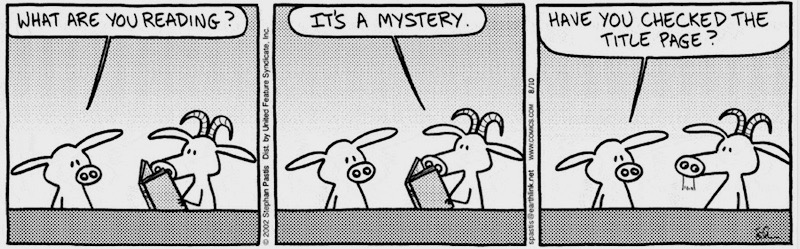
Goat’s reply in panel 2, It’s a mystery, is ambiguous. Notably because mystery is ambiguous in this sentence. But so is it. And these two ambiguities are linked, by virtue of an ambiguity as to the construction they’re in. Now I’m going to cut a lot of corners in my discussion, because I’m barely able to get this posting done
The noun mystery. From NOAD:
noun mystery-1: 1 [a] something that is difficult or impossible to understand or explain: the mysteries of outer space | hoping that the inquest would solve the mystery. [b] the condition or quality of being secret, strange, or difficult to explain: much of her past is shrouded in mystery. [c] a person or thing whose identity or nature is puzzling or unknown: “He’s a bit of a mystery,” said Nina | [as modifier]: a mystery guest. 2 a novel, play, or movie dealing with a puzzling crime, especially a murder: the 1920s murder mystery, The Ghost Train.
Goat takes Pig to be asking about what sort of thing he’s reading, and therefore replies with mystery in NOAD‘s sense 2 (he’s reading a mystery novel; mystery here is etymologically a kind of abbreviation, a beheading of something like mystery narrative). But Pig was asking about the identity of the book Goat is reading, so understands Goat’s answer to be using mystery in NOAD‘s sense 1c.
The pronoun it. It’s a mystery with Goat’s concrete narrative sense of mystery has the pronoun it referring to the book Goat’s reading; while It’s a mystery with Pig’s abstract nature sense of mystery has the pronoun it referring to something like ‘the answer to the question What is that you’re reading?‘.
The construction they’re in. It should now be clear that Pig’s It’s a mystery is a pretty simple subject-predicate construction, with a predicative noun mystery as the predicate; while Goat’s It’s a mystery is a more complex construction paraphrasable as ‘what the identity of this is is unknown’ or ‘it’s a mystery what the identity of this is’.
(There’s also a subtle difference in the way Goat’s It’s a mystery can be understood: a mystery to Goat (or, more generally, to the speaker of the sentence) or a mystery to everyone, only God knows.)
Leave a Reply