Suppose you investigate a cultural domain, or category, with many things in it — samples of the color pink, forms of the letter T, pieces of flatware, hybrid tea rose plants, and so on. It will turn out that people distinguish a (large) number of different subtypes, or subcategories, within that domain — different shades of pink, different typefaces, different patterns of silverware, different cultivars of hybrid tea roses. And then they will need labels for reference to these subcategories. These could be given code numbers of some sorts (and for some purposes such coding is entirely adequate), but people, quite reasonably, want memorable and at least somewhat meaningful names, in a language. Flamingo pink, a Times typeface, a Shell silverware pattern, the Mr. Lincoln rose, that sort of thing.
In the real world, especially for commercial purposes, the number of subcategories in a domain can be immense, reaching into the hundreds in some domains, and (in some of them) ever-expanding. So names will have to be coined by the barrel, churned out by the yard, and often the best a name creator can do is pick a name with positive associations. It would be entirely possible for there to be an Imperial pink, an Imperial typeface, an Imperial silverware pattern, and an Imperial rose.
Every now and then, I’ve commented on this blog about the profusion of names within some domain. Most recently, in my 12/3/23 posting “Waxed amaryllis” (with lists of some named amaryllis cultivars). You can find some meaningful themes in these lists; plenty of the names for solid red cultivars are associated with Christmas (with its red and green) and Valentine’s Day / love (with a red heart). But then there are Hope, Miracle, and Grand Diva. For solid white cultivars, Amore and Festive Parade. For red with white stripes, Ambiance. For white with red stripes, Besties. At some point, names will have to be plucked out of the air.
Which brings me to Karen Schaffer posting on Facebook on 9/13 about the melons in her garden.
KS wrote:
I was chatting with friends about the melons I’m growing and the sometimes odd names they have. I’m growing one called Courier, for instance, which doesn’t exactly say melon to you, does it? Unlike, say Ambrosia and Tasty Bites (which live up to their names, happily).
I mention that I’ve also grown a melon called Passport, an equally odd name. We joke around a bit, and then I remember that there’s a melon called Diplomat too. Now I’m really wondering.
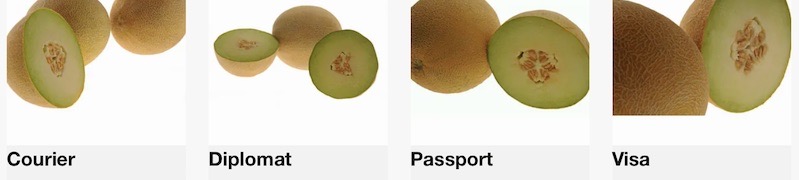
It turns out that this ‘traveler’ series of melons was developed by the Hollar Seed Company of Rocky Ford, Colorado (Rocky Ford, btw, is a famous heirloom melon from this region). [AZ: these are the Galia melons offered by Hollar, whose varieties have ‘traveler’ names] There are four melons in the series: Courier, Diplomat, Passport, and Visa. No explanation for why they’re called that, but someone had some fun.
I feel like I just played a real-world ‘Connections’ game!
From the Hollar Seeds site about their Galia Melons:
There’s also a video about Hollar’s four branded Galia melons
And then from Wikipedia about Galia (yes, a woman’s name) melons:
The Galia melon, also known as sarda in Southeast Asia, is a type of F1 hybrid melon originating from a cross between the green-flesh melon cultivar ‘Ha-Ogen’ and the netted-rind melon cultivar ‘Krimka’. Developed in Israel at the Ne´ve Yaar Research Center of the Agricultural Research Organisation by the melon breeder Dr. Zvi Karchi, and released in 1973, the Galia melon was named after Karchi’s daughter, whose name means “God’s wave” in Hebrew.
Hollar sells melon varieties in four categories: Orange Flash Ananas, Cantaloupe, Canary Melons, and Galia Melons. Most of the melon varieties just have numbers, but some are branded (with names).
Category structure. Hollar’s category structure for their products has one higher level, with Melons as just one of categories at this top level: Cucumbers, Gourds, Melons, Pumpkins, Summer Squash, Watermelon, Winter Squash (there is an Uncategorized category, but there are no products listed in that category). The Hollar “About” page tells us:
Hollar Seeds is a family owned business that has specialized in the breeding and development of cucurbits since 1950.
So it looks like their name for the whole taxonomy is Cucurbits (in this they closely follow the biological taxonomy). Of which Melons (along with Watermelons) is a subcategory, Galia Melons (along with Cantaloupe) being a subcategory of Melons, and the four ‘traveler’ varieties being subcategories of Galia Melons.
The Hollar taxonomy follows the modern English lexicon in recognizing that cantaloupes are just one type of melon. From NOAD:
noun melon: 1 the large round fruit of a plant of the gourd family, with sweet pulpy flesh and many seeds: a ripe melon will smell sweet | a slice of melon. 2 the Old World plant which yields the melon. Cucumis melo subsp. melo, family Cucurbitaceae: many varieties.
noun cantaloupe (also cantaloupe melon): a small round melon of a variety with orange flesh and ribbed skin. ORIGIN late 18th century: from French cantaloup, from Cantaluppi near Rome, where it was first grown in Europe after being introduced from Armenia
There are, of course, distinct varieties of cantaloupes, as well as many distinct varieties of non-cantaloupe melons (many more, all in Cucumis melo subsp. melo, than I had realized before reading KS’s posting).
What, then, of watermelons (which are not melons at all)? Again from NOAD:
noun watermelon: 1 the large fruit of a plant of the gourd family, with smooth green skin, red pulp, and watery juice. 2 the widely cultivated African plant that yields the watermelon. Citrullus lanatus, family Cucurbitaceae.
Well, watermelons don’t look at all like any kind of melon, so the botany should come as no surprise.
But … watermelons and melons (cantaloupes, Galias, and all the rest) do stand together as against all the other edible cucurbits, in that they are culinarily fruits, valued for their sweet flesh, while cucumbers, squashes, and pumpkins are culinarily vegetables. So it’s not crazy that they have similar names. (Culinary categories tend to cut across botanical ones.)
December 9, 2023 at 3:43 pm |
Watermelons being colloquially regarded as melons is similar to tomatoes being regarded as vegetables. They have different classifications in different domains.