More bulletins from the News for Penguins department here at AZBlog. Two recent items brought to me by Michael Palmer. One about the tv and movie character Pingu, the other about living chinstrap penguins, on an Antarctic island.
Pingu subtitled. This Facebook posting (intended to provoke a laugh) from Michael Palmer on 12/6, ultimate source unknown:
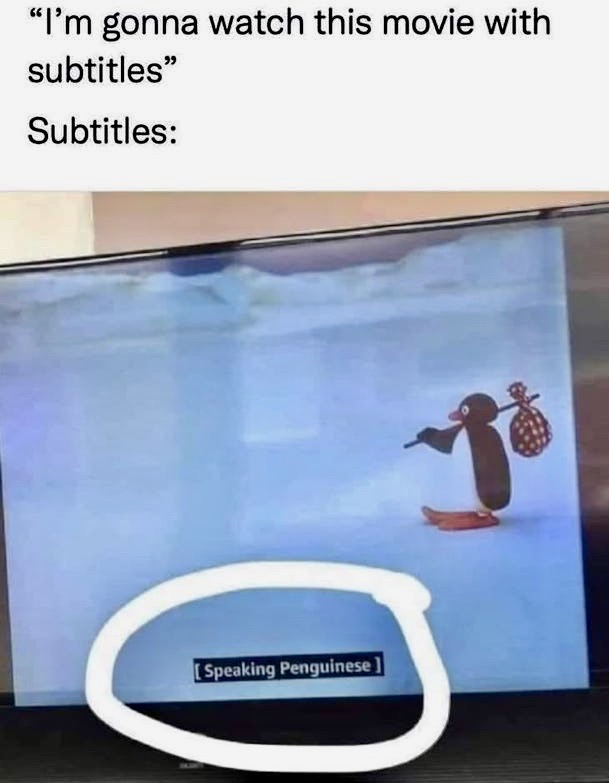
If the subtitle had said [Speaking Portuguese], we would certainly have felt cheated. Well, yes, speaking Portuguese, but what was he saying?
If the subtitle had said [Que tal amanhã?], as speakers of English, we would still have felt cheated. Subtitles are supposed to supply a language the audience understands; this one should have said [What about tomorrow?], translating the Portuguese.
If the subtitle had said [kay tahl ammona (language-like noises)], we’d really get pissed if it turned out that the noises were words in an actual language, like Portuguese, and meant something in that language.
If the subtitle had said [koo too ah nug nug (language-like noises)], we’d resign ourselves to having to extract minimal content — loose feelings rather than specific meanings — from what we hear and see, relying on Pingu’s delivery and mimicry and bits of sound symbolism.
Well, with Pingu it’s door #4, so [Speaking Penguinese] is pretty much the best a subtitler could have done in the circumstances.
From my 10/21/16 posting “Pingu watches over the gay boys”:
Pingu is a British-Swiss stop-motion clay animated children’s comedy television series created by Otmar Gutmann and produced from 1986 to 2000 for Swiss television by Trickfilmstudio and The Pygos Group. It centres on a family of anthropomorphic penguins who live at the South Pole. The main character is the family’s son and title character, Pingu.
… One reason for Pingu‘s international success is its lack of real spoken language: nearly all dialogue is in an invented grammelot “penguin language” consisting of babbling, muttering, and his characteristic sporadic loud honking noise “Nug nug!” accompanied by turning his beak into a megaphone like shape. [Grammelot is an imitation of language used in satirical theatre, an ad hoc gibberish that uses prosody along with macaronic and onomatopoeic elements to convey emotional and other meaning, and used in association with mime and mimicry.] … This feature enables people of different linguistic backgrounds to be able to follow the story. (Wikipedia link)
Chinstraps napping. Michael Palmer posting on Facebook on 12/1, with a shout-out to me (as a penguin person), passing on an article in the New York Times, “Penguins Take Thousands of Naps Every Day: The birds’ impressive ability to nod off may be an adaptation to an environment of constant interruptions” by veteran science writer Carl Zimmer, on-line on 11/30 (reporting on a paper from the journal Science), about a discovery in ethological sleep studies:
The science of sleep got its start in the early 1900s when researchers used scalp electrodes to discover that people produce slow brain waves when dozing.
They found similar wave patterns in mice, pigeons and other captive animals. Over time, scientists discovered that pretty much every animal they studied spent some time each day unresponsive to their environment. Even jellyfish sleep despite their lack of a brain.
But how animals sleep varies a lot. Brown bats remain asleep for 20 hours a day, whereas giraffes get by on less than two hours. Human brains shut down entirely when we sleep, while seals can shut down a single side; with the other still awake, they can continue swimming as they doze.
As technological devices have become smaller and more powerful, researchers have discovered that sleep patterns documented in animals in captivity are significantly different from those observed in the wild. In zoos, for example, sloths will sleep for almost 16 hours a day. But in a Panamanian rainforest, scientists observed the animals sleeping for less than 10.
In 2019, Dr. Libourel and his colleagues tracked sleeping animals in an even more remote environment: King George Island, just 70 miles north of Antarctica.
Won Young Lee, a researcher with the Korea Polar Research Institute, invited the group to accompany him to the island, where thousands of breeding pairs of chinstrap penguins gather in nesting colonies to raise their young. In December 2019, the researchers outfitted the penguins with electrodes and other sensors that recorded their activity for up to 11 days.
The birds split their time between swimming in the ocean and staying at the nests to keep their eggs and chicks warm. Between each trip to sea, which took around nine hours, the penguins spent 22 hours, on average, taking turns caring for their young.
While in the ocean, the birds barely slept, spending just three percent of their time resting on the surface of the sea, the study found.
When the penguins returned to their nests, their brain waves slowed to a pattern that is typical for sleeping birds — but only for a few seconds. They woke up again, only to fall back asleep. The birds sped through this cycle 600 times in an hour.
Humans, too, can experience this sort of microsleep, though typically only after failing to get a good night’s rest. It can be dangerous, especially if we’re nodding off at the wheel of an automobile. But for chinstrap penguins, microsleep is the norm.
Dr. Libourel speculated that their sleep patterns reflect the extreme conditions where they doze. Penguin colonies are noisy and crowded, with birds constantly waddling back and forth from the ocean. The habitats are also dangerous: At any moment, a gull-like bird called a brown skua may dive at a nest and eat eggs or chicks.
The fact that penguins manage to sleep so much despite all these disturbances suggests to Dr. Libourel that the microsleep provides some essential benefit. Scientists have proposed many possible benefits of sleep. Some believe the brain needs it in order to clear away its cellular trash, while others argue that the sleeping brain fine-tunes its cellular connections.
But Vladyslav Vyazovskiy, a neuroscientist at the University of Oxford who was not involved in the research, questioned how much penguins benefit from fleeting bursts of sleep. It’s possible, he argued, that we may be thinking about sleep backward. It may be the default setting for the animal brain, and scientists should be trying to explain why animals wake up when they do.
“You’re basically spending your life asleep, and you just wake up when it’s needed,” Dr. Vyazovskiy said.
December 9, 2023 at 2:23 pm |
I feel frustration when the underlying material (the film or TV episode) has a translation “hard subtitled” onto the image, but an overlay close-caption reading something like that “[speaking Portuguese]” or “[foreign language]” is positioned in just the same region onscreen and obscures the translation. Sure, I could shut off the closed-captioning display, and replay the last few seconds – but that is all a bother and I feel resentment that they couldn’t work it out better.