From Ryan Tamares, on a postcard arriving yesterday (8/21) at my place (it was mailed much earlier at Stanford, passed for some reason through San Francisco, and then shunted back down to Palo Alto; the ways of the USPS are sometimes inscrutable), this extraordinary artwork by a Redbubble.com artist using the name UkiyoCities:
“The Scholar’s Path at Stanford”
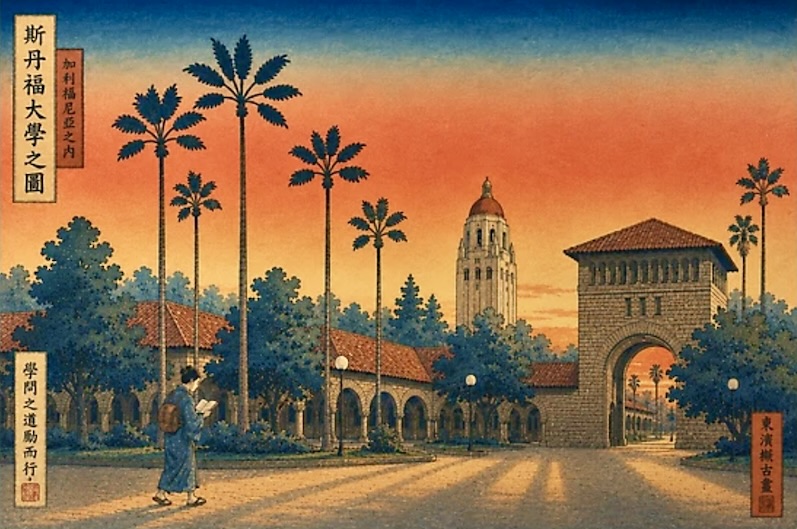
Yes, Stanford in the Floating World, simultaneously in the California of today and in the Tokyo of more than 200 years ago.
The Floating World. From Wikipedia:
Ukiyo (浮世, ‘floating/fleeting/transient world’) is the Japanese term used to describe the urban lifestyle and culture of Edo period Japan (1600–1867), especially its pleasure-seeking aspects
Ukiyo culture developed in Yoshiwara, the licensed red-light district of Edo (modern-day Tokyo), the site of many brothels frequented by Japan’s growing middle class. A prominent author of the ukiyo genre was Ihara Saikaku, who wrote The Life of an Amorous Woman. Ukiyo culture also arose in other cities, such as Osaka and Kyoto.
… The famous Japanese woodblock prints known as ukiyo-e, or “pictures of the floating world”, had their origins in these districts, and often depicted scenes of the floating world itself such as geisha, kabuki actors, sumo wrestlers, samurai, merchants, and prostitutes.
UkiyoCities has produced an extensive series of Floating World versions of scenes from around the world. Rippling with atmospheric magic.
August 22, 2026 at 12:54 pm |
This is wonderful!
Do you know the time-bending ukiyo-e works of contemporary master Masami Teraoka?
August 22, 2026 at 1:02 pm |
Yes, it’s like stumbling into another world. No on Masami Teraoka, but now you’ve alerted me.
August 23, 2026 at 1:46 pm |
Nice touch: The captions on the left read: (top, red box) Within California – (top, yellow box) Drawing/plan of Stanford University – (bottom, yellow box) Street/way of scholarship (+3 characters I cannot handle).
However, I’m not too sure about the choice of some characters. California is written using characters which are used in Chinese to render foreign names (Jialifuniya), I don’t know if these were used in Japanese in ukiyo-e times. In Japanese it would be more likely written with katakana (Kariforunia) or abbreviated in kanji as Ka-state (Ka-shu).
The characters for Stanford would be read as Sidanfu in Chinese or Shitanfuku in Japanese.
(The character used to render both (Cali)-for-(nia) and (Stan)-ford is fu in Chinese and fuku in Japanese, therefore the Chinese reading seems more likely).