Yesterday (4/14), my helper Isaac and I took a walk around the block (Ramona to Forest to Emerson to Homer and back to Ramona), taking advantage of the end of days of rain. Officially we were visiting the oregano plant on Emerson St. (see my 4/14 posting “Things I didn’t know”, in the section on “a labiate plant with fleshy leaves”), but we traversed a largely changed scene: the cat’s-claw creeper on the arbor over my entry was coming to the end of its 4 or so days of bloom; the calla lilies on Ramona St. had finished their days of blooming and dropped their flowers; the rose bushes in Forest Ave. that were all buds before the rain were now a solid mass of beautiful single white roses; there were big passion-flowers on Emerson St.; and the Chinese elms on Homer Ave., totally bare on our last walk, had fully leafed out in green, turning a whole block into a pleasantly shaded path.
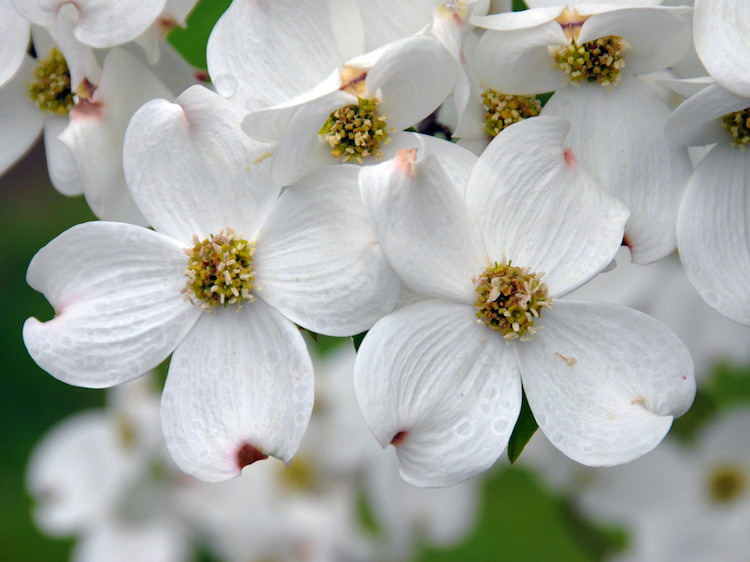
And on the street strip on Forest, a bunch of bare 4-foot sticks had been transformed into a dense display of bright-white dogwood blossoms. Much like these:
4-fold notched bracts around a greenish-yellow head of many tiny petals
From Wikipedia (with some amendments from me):
Cornus florida, the flowering dogwood or American dogwood, is a species of [small] flowering tree [or large shrub] in the family Cornaceae native to eastern North America and northern Mexico. An endemic population once spanned from southernmost coastal Maine south to northern Florida and west to the Mississippi River. The tree is commonly planted as an ornamental in residential and public areas because of its showy bracts and interesting bark structure.
… The [spring-blooming] flowers are individually small, inconspicuous, and hermaphroditic, with four, greenish-yellow petals … 4 mm (0.16 in) long. Around 20 flowers are produced in a dense, rounded, umbel-shaped inflorescence, 1–2 cm (0.39–0.79 in) in diameter. This central flower head is surrounded by four conspicuous large white, [sometimes] pink or [occasionally] red bracts (not petals), each bract 3 cm (1.2 in) long and 2.5 cm (0.98 in) broad, rounded, and often with a distinct notch at the apex.
Isaac had somehow never noticed dogwood before, but now I’ve 0pened up the world of plants around us, and he sees things with fresh eyes, asks about noticeable plants, looks things up, learns about their names and habits, picks favorites (coast redwoods, roses, lavender, sage, and now dogwoods, even before I told him about the Christian symbolism).
The symbolism. It comes with a larger American folk story, but the basic idea is that a dogwood flower illustrates the crucifixion of Christ;
— the 4 large bracts represent the cross
— the bracts have reddish-brown notches, representing 4 nail holes
— and in the center of each flower is a cluster representing Christ’s crown of thorns
The name. Almost immediately, Isaac wanted to know: why dogwood? What do dogs have to do with it? The OED‘s dog entry, revised in 2010, concedes that there is some dispute about the history here, but strongly relies on this subentry for the animal word:
dog n.1 (the animal) in compounds: In the names of plants, often denoting kinds considered inferior, worthless, or unfit for human consumption. See also dogberry n.1, dogwood n., etc.
Now, in fact, Cornus florida wood isn’t at all worthless. It’s strong and tough, and can be shaped to make durable useful wooden objects, like handles, golf club heads, archery bows, and mallets. So dog as a modifying compound element might be glossed as something like ‘minor, insignificant’.
April 16, 2026 at 6:20 am |
I wonder if the crucifixion symbolism is also partially inspired by the fact that in much of its range it blooms around Easter (not here in New England, where it’s much later).
Lewis Carroll had a bit of fun with the name in the second chapter of Through the Looking-glass, where the flowers explain to Alice that the dogwood tree in the center of the garden protects them from danger (“It can bark,” says one, and another adds that it says “bough-wough” – “That’s why its branches are called ‘boughs’!”).