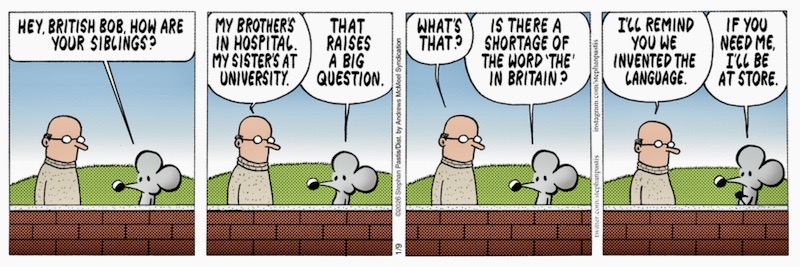
The Pearls Before Swine strip by Stephan Pastis, for 1/9/26:
A difference between British English and American English over constructions with the definite article (arthrous) or without it (anarthrous) — putting aside British Bob’s touching belief in the primacy of BrE over AmE
(There is a Page on this blog with links to postings on Language Log and this blog on arthrousness)
Now for some scholarly observations on BrE vs. AmE practices in arthrousness with various prepositional objects, among them hospital and university. Here I take you to Lynne Murphy’s blog “Separated by a Common Language: Observations on British and American English by an American linguist in the US” — in her posting “(the) menopause, (the) flu, (the) hospital” from 4/17/2007:
My friend (and fellow datebook-sayer) the Recyclist arrived in the UK this weekend, and was surprised by the springiness of the spring here. (This week, it’s worth coming to Southern England for the weather.) As we were walking around Notting Hill on Sunday, she marvel(l)ed at the wisteria in bloom, and lamented to the Networker that while hers used to bloom all the time, it has become very irregular. I (jokingly!) hypothesi{s/z}ed that her wisteria might be going through (BrE) the menopause. Having not heard me, she asked me to repeat myself and I found myself switching to the AmE version: menopause (without the). The is a definite determiner (search ‘determiner’ on that link), which means that it is used to indicate the uniqueness of something within a particular context (well, that’s a good enough description for present purposes). And you could say, ‘ok, that makes sense, since it only comes once in a lifetime.’ But that explanation would predict that BrE would also use the before puberty, which it generally doesn’t. So I don’t know why it’s there, but it’s been there in BrE from the earliest example in the OED (1872).
On the other hand, AmE tends to say the flu and BrE tends to do it without the the (and often with an apostrophe: ‘flu). The Networker tells me that she was more used to hearing it with the the when she was a child, and sure enough, it is the (‘)flu in the OED until the last example, 1957 (which is before the N was born, but no doubt the the lingered beyond that date). In a sense, the AmE the is a bit out-of-date–after all, we usually don’t know which unique influenza bug we’re referring to when we use the term. (And, annoyingly, many people use flu for bad colds, which, like using migraine to refer to any headache, should be a punishable offen{c/s}e.)
So one’s tempted to say that there’s a the balance at work here: if a the goes missing in one dialect, it has to be replaced somewhere else within that dialect. But if I said that, someone would bring up hospital as evidence that AmE has one more the than BrE.) As is well known (so well known that I’m not supposed to be mentioning it), in BrE one ends up in hospital and in AmE one ends up in the hospital when (the) flu gets too bad. Americans often express wonder that there’s no the in this phrase in BrE, but note that there’s no the in go to school or go to church in either dialect. When referring to being in the institution for that institution’s main purpose, there isno the for church, school or (AmE) college or (BrE) university. So, if you’re a (BrE) pupil/(AmE) student (or a teacher) you could say (1), but if you’re not, you’d have to say (2).
1. I left my pen at school.
2. I left my pen at the school.BrE carries this through for hospitals, in that if one is engaged in the business of the hospital in the role of a patient, then the the is left out. So, we get no the with the description of patient in the sickhouse, but a the for a visitor to it, as in (3) and (4).
3. She was in hospital for weeks. (AmE in the hospital)
4. I was at the hospital to visit her. (=AmE)Note that (5) (the hospital equivalent of (1)) is no good because while the person in (1) is still the school’s student after they leave the school for the day, the person in (5) is no longer the hospital’s patient (or at least not an in-patient) after they leave the hospital. So, (5) sounds like someone took their sick pen to the pen hospital for treatment.
5. *I left my pen in hospital.
February 16, 2026 at 12:24 pm |
I’d think anarthrous meant ‘without joints’.
February 16, 2026 at 1:19 pm |
It does mean this in some contexts. In discussions of grammar, some words are called “articles” because they are metaphorically joints, connecting certain modifiers to the nouns they modify: the definite article “the” and the indefinite article “a(n)”.