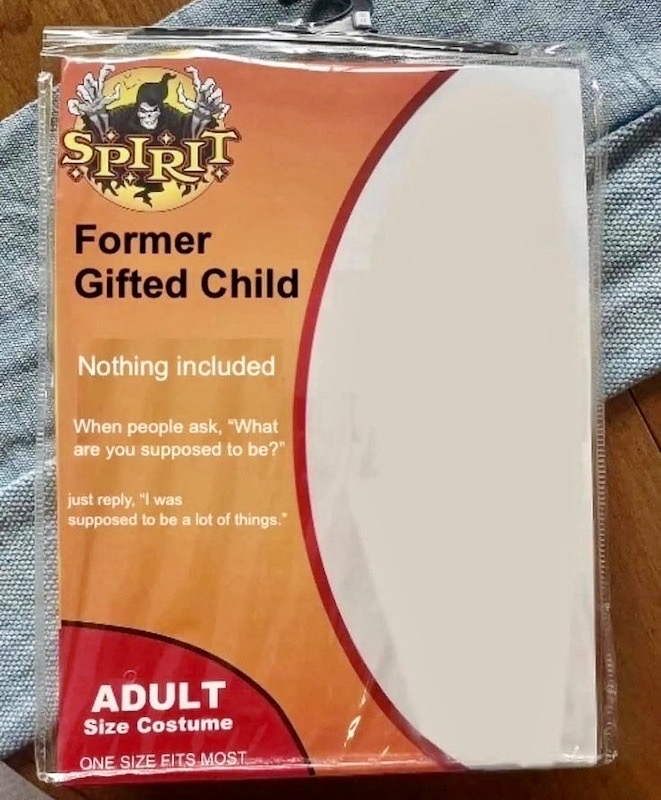
Now coming by me on Facebook every so often, this mock ad for a cosplay costume:
There is of course no Spirit costume supplier; the ad is a total invention, serving as a vehicle to heap scorn on adults who were gifted children / (child) prodigies — I’ll call them g/ps for short — in one of the four ways Americans spew hostility towards these kids and the adults they become
I was a g/p, and I need to trust someone pretty solidly before I’ll expose my childhood to them. I’m adept at dealing with hostility towards me as a faggot, but the hostility towards me as a former gifted child is hard to cope with; it feels like a contemptuous assault on a defenseless little kid, the one who became the me I am now. But I’m working on unearthing the skeletons in my life history, including this one, in the hope that my openness will help others.
Now: the topic of g/ps is far too complex to do justice to in one posting. This is just a beginning. And, as always, there’s some background to get through.
(child) prodigy, gifted child. Children with exceptional abilities, gifts (of nature). From NOAD:
noun prodigy: [a] a person, especially a young one, endowed with exceptional qualities or abilities: a Russian pianist who was a child prodigy in his day. … ORIGIN late 15th century (denoting something extraordinary considered to be an omen): from Latin prodigium‘portent’.
adj. gifted: having exceptional talent or natural ability: a gifted amateur musician | scholarships for gifted students.
(child) prodigy and gifted child are generally treated as rough synonyms. but historically the gifts / abilities of a prodigy were seen as signs of promise, as portents of things to come. And that foreshadowing role lies behind one of the forms of hostility towards g/ps.
The four attacks on g/ps. There might be more, but this is the inventory from my personal experience to date:
— 1a. How Did That Work Out For You?: the promise failed to be realized; you’re nothing special
— 1b: Quit Your Boasting!: you’re nothing special; stop lording it over the rest of us
— 2 What Use Is It?: there’s little value to the ability
— 3 No Fair!: it’s not fair to have the ability
— 4 That’s Freakish!: the ability’s associated with a disorder or disability, specifically one on the autism spectrum
The Former Gifted Child costume exemplifies attack 1a; how did that work out for you? is to be read with a withering sarcastic intonation, conveying that it didn’t work out for you; you didn’t live up to your promise, you’re a failure. There’s quite a lot to be said about the attitudes and beliefs lying behind that attack, in general and also with reference to my own case.
When I was a child, my father and I talked a lot, explicitly, about my gifts, sweet conversations in which he urged me only to try to do things well, to be good enough at stuff, because that was what everyone should do, and what I’d do then would probably be more than most people could do, just because I had more resources to work with than most people, but whatever I chose he would be proud of me, and, jesus, was he. And said so to me. All through my life.
There’s a lot more to be said about my case. But it has to be seen in the light of the general observation that there are mind-bogglingly many gifts / abilities; that they all vary throughout the population; that they can all appear at exceptional levels in children; so that any particular gifted child will show a small sampling of these, while being all over the map for the rest. The total amount of variation in the population is then astounding. And further, people tend to notice only a few of the abilities: who attends to the ability to mentally rotate images, or to fabulous hand-eye coordination? (I pick two abilities I’ve seen at a remarkable level in other people, while I conspicuously do not have them.)
I learned to read at the age of 3. I’m told that I told my mother, who read to me a lot, that I wanted to. (Note: I was motivated, I was encouraged, I was rewarded, I focused intently on exercising the ability, and I practiced it. Further factors.) And that became a very conspicuous gift; when I entered first grade, I was reading at the 5th-grade level, so some kind of accommodation had to be made. But suppose I had grown up in a non-literate culture. Would anyone have noticed that I was special? (I’m not at all sure.)
Again: there’s a lot more to be said.
Note on cosplay. From NOAD:
noun cosplay: the practice of dressing up as a character from a movie, book, or video game. ORIGIN 1990s: blend of costume and play after Japanese kosupure, ultimately from English costume play.
In my 9/25/17 posting “Naked came the mammoth”, there’s a section on the practice of cosplay.
September 23, 2025 at 4:41 am |
Montana in the 1970s was no place for a gifted child. However, the state started an experimental program in 1970 called PACE (Program for Advanced Children’s Education). I was in the first PACE class in my elementary school. There were five of us.
My parents never talked to me about why I was in PACE. One day in the fall, I was ordered out of the classroom (and drew the inevitable “oooohs!”), and went to PACE class. Mrs. Eisenhower was our teacher. We were there twice a week.
In the third grade, PACE expanded. Now there were about 10 to 15 kids in the class.
PACE lasted through the sixth grade. No PACE in junior high. In the ninth grade, three teachers in my junior high started a PACE-like class. For 40 kids.
The idea of 40 gifted kids in a single school was nonsensical to me.
September 23, 2025 at 11:26 am |
Well, gifts come in different sizes, and in combinations of different sizes, so many different sorts of programs might be appropriate, depending on the circumstances. I’ll write some more about this. I was off the charts in several different respects (my parents were told repeatedly that the entire school system had never had a student as talented as I was, so I clearly needed some unique treatment, which I’ll write about). But smaller gifts, in smaller suites, also need encouragement, so many different sorts of programs might be devised under various names, but all of them could be good ideas.
September 23, 2025 at 10:46 am |
If you follow the “Luann” comic strip, a character introduced last week (but not appearing yet this week) is Piro’s 12-y-o little brother Alan, who has been admitted to college in a special program (“Mooney Uni’s Exceptionally Gifted Program”), and has become Bernice’s class partner in their Psychology class. https://www.gocomics.com/luann/2025/09/09
September 23, 2025 at 12:09 pm |
Ah, the Doogie Howser scenario. And less extreme, grade-skipping approaches (adopted by my daughter and my grandchild). But every case is unique, with a huge number of things to consider. Nobody can truly say they know what’s best for this particular kid, because this kid is unique. It will depend on the context, and the kid’s own assessment of what would be best (the kid is, after all, significantly adult).
My family was working class, with not much money; my schools were extraordinarily good, and flexible; I had managed, despite everything, to establish a surprisingly good network of friends and acquaintances; I could find resources of all kinds in Reading (the regional city) on my own (I was strikingly self-running at an early age). So we negotiated a series of solutions. Which had the pleasant consequence that all those prizes and awards I won, and so on, reflected glory on my wonderful schools and their teachers.
September 23, 2025 at 7:38 pm |
This opens a Pandora’s Box of crazy memories, mostly not great. Thanks for posting. I have way too much to say, but I’ll leave it at “You only got a 95 on the test; why can’t you do better.” Hey, I really won out in the long run as did you, but it’s galling to think that we put unfair burdens on our best and brightest. Shana tova.
September 30, 2025 at 8:44 am |
Oi. There’s a great deal here, and I have a lot to say about it, but I might never be able to get to it.
I did eventually get stuff like “If you’re so fucking great, how come you only graduated magna cum laude at Princeton?” The answer to which is, I think, genuinely revealing: the number of abilities / talents / gifts is really gigantic, and *no one* could be extraordinary at all of them; I was only average, or below, at one that happened to be crucial to a particular course required of math majors at Princeton, so I got one less than stellar grade, bringing my gpa just under the level required for summa. A matter of absolutely no consequence.
And I still get, “If you’re so great, how come you’re not famous / rich / powerful?” Hard to cope with, since it comes from a moral universe alien to mine, from a mindset that takes fame, money, and power to be the motivating forces in fashioning a life. I’m looking to do some things well, to do some good, and to gain pleasure and satisfaction from what I do. So I use my gifts to these ends. I do hope for recognition, enough money to support this life, and enough freedom to choose how I live.
“You only got a 95 on the test; why can’t you do better” is poisonous, inducing a crippling perfectionism (my man Jacques was afflicted in this way).
September 24, 2025 at 5:32 am |
I got crap in perry as a kid for being smart, though we did also have a “gifted” program. We also had BOCES, which was a vocational program that I keep telling people we need in every school system.
I get crap now too, and keep telling people to stop trying to dumb down the country by telling their kids it’s a problem to be smart and do well. The deep-seated ego fragility of a lot of white men dealing with independent women with brains and means is unreal. (I had one spit viciously at me when I told him aunt terry had a degree in engineering)
I also tell them that the Women in the Trades in Seattle just wanted to know if our family is smart, because they already knew that Gillian was an electrician and we grew up in Perry. So they were thrilled to find that Aunt Terry was an engineer, and mother got her masters in anthropology at Yale.
It’s all bound up with class, status, and yes racial and cultural identities.
Mother always called it American anti-intellectualism.
One of my talking points to the white-class haters is that if our parents had been our cousins Norma and Clarence who lived up the road from us, none of them would have a problem with us. It’s just that our dad was smarter, so he ended up with a very different life.
September 30, 2025 at 9:34 am |
Yet another facet, well set of facets, in the intersections of sex, class, and racio-ethnicity, and (since I’m the person writing this) conformity to gender norms. My guiding principles here come from my father, and then from Stephen Jay Gould, both of whom held that gifts, great and small, were pretty much evenly distributed across the population, so that we have to recognize that significant gifts appear in women, the poor, the working class, racial and ethnic and religious minorities of all sorts, sexual-orientation minorities, untouchables, enslaved people, gender-nonconforming people, the physically disabled, hyperactive people, disfigured people, and so on, and should be nurtured there; and that if we fail to do this, then society loses the benefits of what these people could contribute.