First, apologies for losing a day. I fell victim to some sudden and overwhelming intestinal affliction that I would prefer not to describe here — it’s profoundly disgusting — a disaster that took me an entire day to do basic cleanup on, and then took most of my helper’s day yesterday to do a proper cleansing. Resilient AZ then kicked in, so by 4 yesterday afternoon I was back into the business of dispossession, mostly on office supplies (the house I am in has three fully working desks, each overstuffed with its own contents, oh Jesus), but now some tackling of framed artworks. Which brought me to works that I hadn’t previously posted about, so this is my chance to record them before they go away.
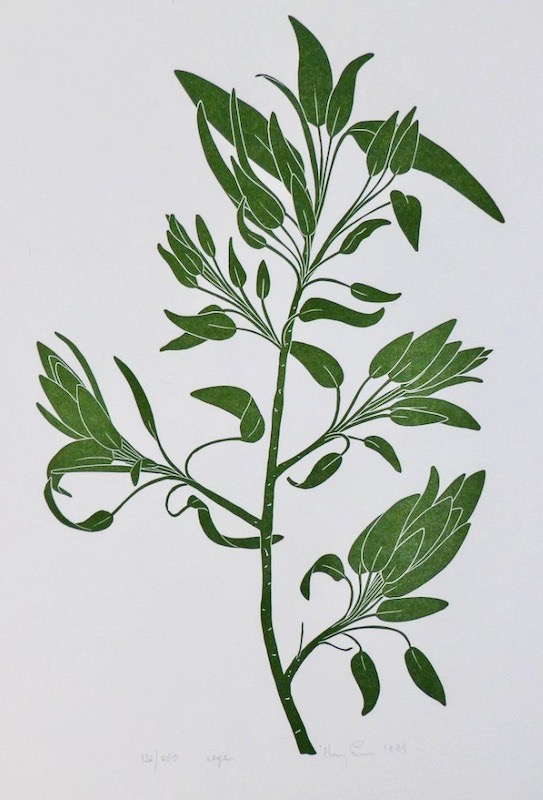
Some are penguin-oriented. On 8/11, I posted “i just gotta be me”, about a penguin photo montage by Steve Raymer. Still to come (when I get good photos of them) are works by two wildly dissimilar painters: the California surrealist Cliff McReynolds and the Oregon artist Ann Munson, loving enthusiast of the Oregon landscape, garden art, and creatures, both domestic and exotic. Today I bring you Henry Evans, a printmaker — a linocut artist, to be specific — devoted entirely to botanical subjects. Someone Jacques and I discovered many years ago, in a long-gone science and art store in Stanford Shopping Center. Where we bought, and then had framed, two elegant one-color linocuts of herbs, “Sage” (1984) and “Worm Wood” (1985).
Our two linocuts.
(#1) Common sage, Salvia officinalis
(#2) Common wormwood, Artemisia absinthium

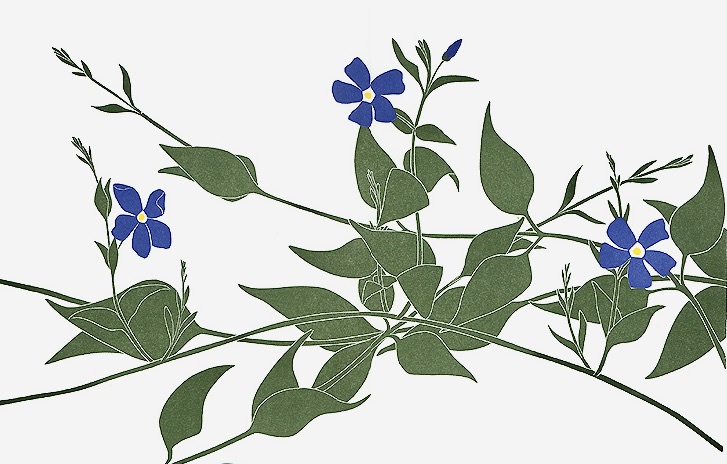
More colors. And into the field and garden.
(#3) “California Poppies”, in two colors (they grow everywhere)
(#4) “Periwinkle (Vinca)”, in three colors (very subtly)

About Evans. From the “Henry Evans, Printmaker” site, a big piece of puffery almost surely written by Evans’s wife Marsha:
Henry Evans (1918–1990) began making botanical prints in 1958, depicting some 1400 subjects in 31 years. In that time, he was accorded more than 250 one-man shows in many countries around the world and, almost every state in the union.
Admired by art lovers and naturalists alike, Henry’s work reveals a style intriguingly personal and botanically faithful, unerring in its feeling for rhythm and design. Self-taught as a printer, botanist, and artist, he developed a unique style and technique. He drew directly from living subjects, and all subjects were portrayed life-size. He used linoleum as a printing surface and an 1852 Washington Hand Press to make the prints.
All of the work was done by hand. All of the materials that were used were of the best quality, and all of the editions were limited. Each linoleum-block print was numbered, dated, and signed by the artist. After printing, the blocks were destroyed.
Henry Evans’s linocuts are found in the great print collections of the Albertina in Vienna, the Library of Congress in Washington, and the New York Public Library; in various museums and libraries across the country; and in numerous private collections in America and abroad.
Henry Evans wrote and illustrated books and magazine articles, talked before groups both here and abroad on printmaking (including a stint of lectures for the State Department in Europe and the Middle East), and, along with his wife, Marsha, met the public in their galleries in the Napa Valley and San Francisco. From 1974, Marsha worked on shows and gallery arrangements and did most of the presswork on the prints. Henry selected the subjects, made the drawings, cut the blocks, and mixed the colors. It was, in the best sense, a husband-and-wife team. Among numerous publications, the artist’s most important books and portfolios include The State Flowers of the United States (1972); Botanical Prints: With Excerpts from the Artist’s Notebooks (1977); and California Native Wildflowers (1985).
Leave a Reply