🗡 🐉 4/23 St. George’s Day, celebrating the dragon-slaying patron saint of England, who (according to tradition) died on this day in the year 303 — the most martial of the British fab four (David, Andrew, George, and Patrick); meanwhile, thanks to Ann Burlingham, today I also celebrate the superb fairy wren, a colorful little bird of southeastern Australia
The little bird first, then the sword-wielding saint of legend.
The little bird. In yesterday’s mail, this greeting card from Ann Burlingham (who sent it from Pittsburgh on 4/18):
(#1) A superb fairy wren, in the SuperCute Australian Animals line of cards from Gillian Mary (distributed by Aero Images)

About the bird. From Wikipedia:
The superb fairywren (Malurus cyaneus) is a passerine bird in the Australasian [Australia and New Guinea] wren family, Maluridae, and is common and familiar across south-eastern Australia. It is a sedentary and territorial species, also exhibiting a high degree of sexual dimorphism; the male in breeding plumage has a striking bright blue forehead, ear coverts, mantle, and tail, with a black mask and black or dark blue throat. Non-breeding males, females and juveniles are predominantly grey-brown in colour
… Like other fairywrens, the superb fairywren is notable for several peculiar behavioural characteristics; the birds are socially monogamous and sexually promiscuous, meaning that although they form pairs between one male and one female, each partner will mate with other individuals and even assist in raising the young from such pairings.
The fairy in the common name is the modifier noun fairy ‘diminutive or delicate creature’ of fairy penguin and fairy shrimp.
The fairywrens / fairy-wrens / fairy wrens belong to the genus Malurus; according to the Wikipedia entry for the fw genus, the common names for the species in the genus are:
emperor, lovely, superb, splendid, variegated, purple-backed, red-backed, white-shouldered, blue-breasted, purple-crowned, red-winged, white-winged
The superb in the common name suggests the extraordinary color of the male wrens in breeding plumage (as in #1)
About the card. From my 6/21/22 posting “Leaves like lemons, leaves like holly”, about
a Gillian Mary greeting card from Ann Burlingham … — a joyously bright representation of a flowering bottlebrush (genus Callistemon)
… That led to more cards from this source — Gillian Mary is a trade name, not a person — and ultimately to the actual artist, illustrator and painter Jill Brailsford (who’s the owner and designer of GMC).
The saintly dragon-slayer. St. George is one of those saints who seem to be known to us only through hearsay — legends, traditional stories, travelers’ reports, and third-hand chronicles. Here’s the main Wikipedia take:
Saint George (Ancient Greek: Γεώργιος, romanized: Geṓrgios; died 23 April 303), also George of Lydda, was an early Christian martyr who is venerated as a saint in Christianity. According to holy tradition, he was a soldier in the Roman army. Of Cappadocian Greek origin, he became a member of the Praetorian Guard for Roman emperor Diocletian, but was sentenced to death for refusing to recant his Christian faith. He became one of the most venerated saints, heroes, and megalomartyrs in Christianity, and he has been especially venerated as a military saint since the Crusades. He is respected by Christians, Druze, as well as some Muslims as a martyr of monotheistic faith.
In hagiography, he is immortalized in the legend of Saint George and the Dragon and as one of the most prominent military saints … His feast day, Saint George’s Day, is traditionally celebrated on 23 April. Historically, the countries of England, Bosnia and Herzegovina, Bulgaria, Georgia, Ukraine, Malta, Ethiopia, the regions of Catalonia and Aragon, and the cities of Moscow and Beirut have claimed George as their patron saint
4/23 in the year 303 seems to have been a good day to die. We are so fortunate that a scribe was on hand close to Lydda, in Syria Palaestina, to record the day on which he was decapitated for his Christian beliefs.
Then there’s the dragon. From Wikipedia:
In a legend, Saint George — a soldier venerated in Christianity — defeats a dragon at Dragon Hill, Uffington [AZ: in Oxfordshire, far far from Cappadocia]. The story goes that the dragon originally extorted tribute from villagers. When they ran out of livestock and trinkets for the dragon, they started giving up a human tribute once a day. And, one day, the princess herself was chosen as the next offering. As she was walking towards the dragon’s cave, St. George saw her and asked her why she was crying. The princess told the saint about the dragon’s atrocities and asked him to flee immediately, in fear that he might be killed too. But the saint refused to flee, slew the dragon, and rescued the princess [AZ: here a voice whispered to me: Thousand and One Nights]. The narrative was first set in Cappadocia in the earliest sources of the 11th and 12th centuries, but transferred to Libya in the 13th-century Golden Legend [AZ: a collection of hagiographies first complied in the 13th century and added to it over the years].
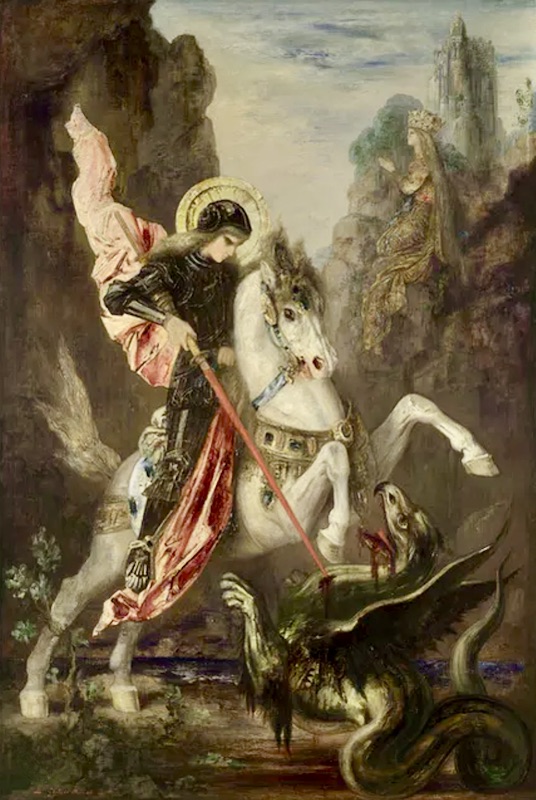
The drama of St. G. and the princess-devouring reptile has been depicted by vast numbers of artists, but I especially admire Gustave Moreau’s complex composition, with its vivid, detailed foreground — a young and beautiful but also fierce (but also saintly too) George lancing the fearsome beast, while his crazed mount rears back — and with a misty, sketchy princess and her idealized castle receding into the background:
(#2) Saint George and the Dragon (1889-90) by Gustave Moreau (The National Gallery, London)
Then I have this dream — Tourist From Oz Intervenes In Serpenticide — in which a determined superb fairy wren teams up with the noble saint, to fly in the face of the dragon and peck its eyes out so that George can dispatch it with a single swift stroke of his sword. While the wren flies off to live with the princess in her castle. They live happily ever after.
Hey, it could have happened. Look at what Uffington, Oxfordshire, was like in those remarkable times!
April 25, 2025 at 3:18 pm |
Meanwhile, I celebrate the day because it’s also considered the birthday of Shakespeare and of Prokofiev. WGBH, in the 70s when I lived in the Boston area, often compactly recognized both luminaries by playing Prokofiev’s Romeo and Juliet ballet, which I love.
April 25, 2025 at 3:57 pm |
Oh, this is lovely. Wonderful comment. And then it turns out to be from an old friend (of 53 years now, if I calculate correctly) who’s been battling WordPress for many months over their inexplicable unwillingness to let her post comments on this blog. But now she’s gotten through, with this preposterous username (but her real institutional e-mail address, which I can see — because this is my blog — but you can’t). Now that I’ve hand-approved this comment from her, she’ll be able to post (as cloudlucky…) whenever she wants. And that would be truly excellent, because she knows a lot about many things, and she’s had a fascinating life, and she’s both smart and humane. (This is my three-second encomium; I could go on. I could be specific and give examples)
And now I can cross HELP NN GET WP ACCESS off my Things To Do list. That is in itself a sufficient cause for dancing in the streets.