[Sex work, naked boys, nude statuary (classical in theme, but, yes, full frontal) — generally not suitable for kids or the sexually modest]
Das wäre Ihr Mädchen, Herr Jakob Schmidt
… Ach, bedenken sie was man für dreißig Dollar kriegt— Weill & Brecht, Havanna Lied (from the 1930 opera Aufstieg und Fall der Stadt Mahagonny)
How is a man to choose? He could have that one for $30. But then the other one looks eager to please. And the third one looks really hot naked.
That was Jakob Schmidt in the imaginary city of Mahagonny — part America, part Weimar Germany — but then this morning Pinterest brought me another man, call him Alex, picking one of three for sexual services, under the watchful eye of an arranger, the clever and mischievous H, in a painting by Cornelius McCarthy:
(#1) Which boy is the hottest? — daddy Alex weighs their qualities (top to bottom, fore and aft) in McCarthy’s Judgment of Paris, whose title moves us beyond Mahagonny’s conventional brothel and McCarthy’s boy brothel to Greek myth, where the boys correspond to the goddesses Hera, Athena, and Aphrodite; Alex to Prince Paris of Troy (also known as Alexander); and the arranger to the god Hermes (who assembled the goddesses so that Paris could choose the fairest one, further details to follow below)

The painting takes off from the situation of Paris choosing one of the three as the fairest, but doesn’t attempt to reproduce the full story of the Judgment of Paris — no golden apple of discord, no one corresponding to Helen of Troy, no ensuing Trojan War (in which Paris is mortally wounded; he was beautiful himself, but not much of a commander or combatant). It’s just a homotranslation of a single scene.
The artist. From my 9/19/24 posting “Painter of the male form”:
Cornelius McCarthy (1935 – 2009), nonrepresentational but definitely figurative: intensely focused on the male body (single men, couples, groups — often with matter-of-fact penises in the compositions, but no sexual acts, or even bodily contact), in a series of styles, most notably in a cubist-influenced period that then developed into the late style of the painting that caught my eye on Pinterest [Moonlit Park (2008)]
The judg(e)ment of Paris. From Wikipedia:
The Judgement of Paris is a story from Greek mythology, … of the events that led up to the Trojan War, and in later versions to the foundation of Rome.
Eris, the goddess of discord, was not invited to the wedding of Peleus and Thetis. In revenge, she brought a golden apple, inscribed, “To the fairest one”, which she threw into the wedding. Three guests, Hera, Athena and Aphrodite, after some disputation, agreed to have Paris of Troy choose the fairest one [with Hermes as their guide].
(#2) The Judgement of Paris (1599) by Hendrick van Balen the Elder (Gemäldegalerie, Berlin): Hermes (with helmet and caduceus), Paris (with the golden apple), and the goddesses (embellished by cherubim)Paris chose Aphrodite, [because she] bribed him with the most beautiful mortal woman in the world, Helen of Sparta, wife of Menelaus. Consequently, Paris carried Helen off to Troy, and the Greeks invaded Troy for Helen’s return. Eris’s Apple of Discord was thus the instrumental casus belli (or her not being invited to the wedding in the first place [was]) of the Trojan War.

About Paris. From Wikipedia:
Paris (Ancient Greek: Πάρις, romanized: Páris), also known as Alexander (Ancient Greek: Ἀλέξανδρος, romanized: Aléxandros), is a mythological figure in the story of the Trojan War. He appears in numerous Greek legends and works of Ancient Greek literature such as the Iliad. In myth, he is prince of Troy, son of King Priam and Queen Hecuba, and younger brother of Prince Hector.
And then two accounts of his appearance and character. Inconsistent accounts (well, he’s a mythical figure), but agreed on his physical beauty:
Paris was described by the chronicler Malalas in his account of the Chronography as “well-grown, sturdy, white, good nose, good eyes, black pupils, black hair, incipient beard, long-faced, heavy eyebrows, big mouth, charming, eloquent, agile, an accurate archer, cowardly, hedonist”. Meanwhile, in the account of Dares the Phrygian, he was illustrated as “fair, tall, and brave. His eyes were very beautiful, his hair soft and blond, his mouth charming, and his voice pleasant. He was swift, and eager to take command.”
All this so I can include a reproduction of a statue of Paris, looking generally like an ordinary human being but with an idealized classical face:
(#3) Paris With the Apple (1841) by Danish sculptor H. W. Bissen (Ny Carlsberg Glyptotek, Copenhagen)
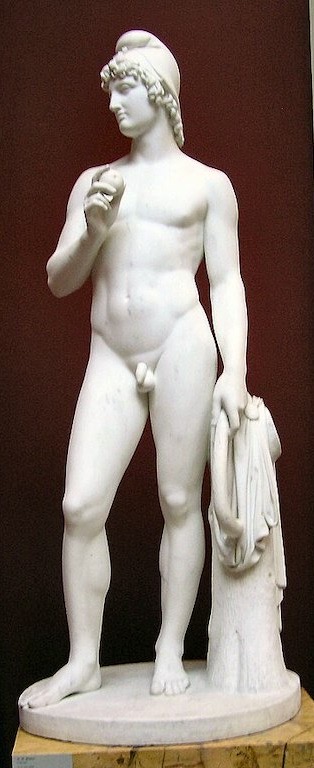
A long, long way from the Paris / Alex figure in #1.
Leave a Reply