This posting is in a genre I’ve come to think of as Kharkiv Opera: a pleasant, playful, or joyous event staged in the face of terrible times; from my 3/2/25 posting “Three men walk into bar”:
the Ukrainians have been managing to mount opera performances in an underground bomb shelter in the city of Kharkiv. They sing and dance and enjoy one another’s company.
Today’s pleasure is the enjoyment of the plants and flowers around us, something that has been with me since I was a child at my father’s knee (so, for 80 years now), and was shared with Ann Daingerfield Zwicky (who was a wildflower enthusiast) and my guy Jacques Transue (whose passion for gardening matched mine), and survives now in my little patio garden (with super easy-care plants on it that I can look at through French doors while I work at the computer) and in occasional short walks in my neighborhood (with my sturdy outdoor walker to rest in as needed, and with the company of a caregiver, who I can talk with about what we see, while we refer frequently to on-line sources in Spanish and English).
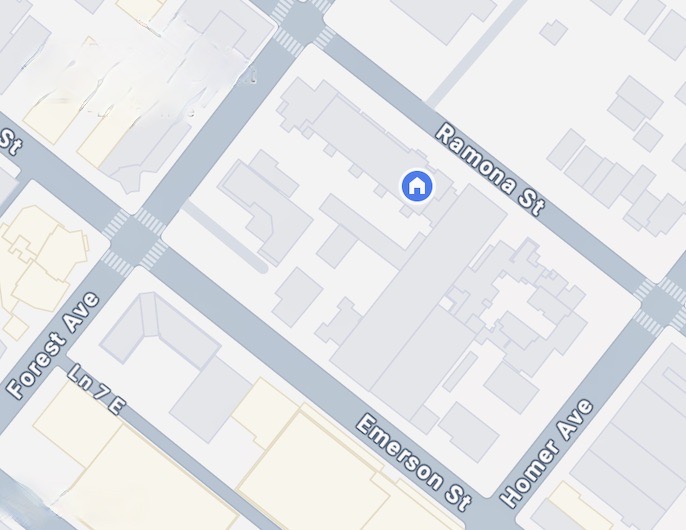
Which brings me to a Thursday afternoon walk, with my caregiver J, around one block (up Ramona St to Forest Ave., left on Forest to Emerson, left on Emerson to Homer Ave. — the corner where the Whole Foods store and the restaurant Taverna stand — left on Homer to Ramona, and left on Ramona back to my house:
(#1) The block in question, with my condo complex marked; the composite flower that set off the dandelion discussion was roughly in the middle of the Emerson St. block
Along the way we stopped often to comment on plants, shrubs, and trees. Now, just a few of our vegetation pauses (which were punctuated with bits of Palo Alto history — that the Whole Foods building was once a Chevrolet dealership; that the church-like building at 819 Ramona was in fact originally the University AME Zion church, the first Black church in Palo Alto, now thriving at another location; and so on). I’ll give the taxonomic species names here, but I didn’t burden J with them; I was more interested in helping him to see the wondrous things around us, and to begin to become attuned to similarities in plant characteristics that group them into large families, so that you can appreciate that (for example) rose plants, almond trees, strawberry plants, and apple trees have similar flowers that point to their belonging to one family, the rose family (roseaceae, technically).
[Eventually we’ll get through labiates, with their characteristic lipped flowers (lamiaceae, but for J I don’t use the new family names based on type genera, in this case the genus name lamium of dead-nettles), think mints and sages; legumes (fabaceae) with their characteristic seedpods, think peas and beans; umbellifers (apiaceae) with their characteristic umbrella-like flowers, think parsley and celery; and, yes, composites (asteraceae), with their characteristic circular arrays of composite flowers, think daisies and asters.]
On the walk. The exterior walls of my condo complex are covered with English ivy (Hedera helix), which has quite suddenly put out huge new leaves of glossy light green that J marveled at. Then, just a bit up Ramona St., we came across a stand of wild callas (Calla palustris) about to bloom (I managed not to quote Katharine Hepburn). And at the corner of Forest and Ramona, I rested under a huge coast redwood (Sequoia sempervivens), the species of the tree El Palo Alto (roughly ‘The Tall Tree’, not far from the block in #1), for which the city of Palo Alto is named.
At the corner of Forest and Emerson I rested again, this time underneath a small street tree that I identified for J as a California pepper tree (Schinus molle) — no relation to black pepper (Piper nigrum) — which had clusters of small buds on it that would soon flower and then bear peppercorn-like fruits with a sharp peppery smell. (A lot of our tour involved sniffing bits of plants.)
Next came some roses, one already in bloom, and several multicolored-flower common lantanas (Lantana camara), which prompted me to discourse on beautiful ornamental plants that could become terrible invasives in the wrong places (like lantana in Hawaii and elsewhere).
And then, about halfway down the block, a pretty little plant with orangish daisy-like flowers — certainly a composite, but not one I recognized. I then struggled to explain the gigantic family of composites, reeling off a short list of such plants, marveling at how the flower heads were actually assemblages — composites! — of a great many little flowers, adding, triumphantly, and dandelions (because everyone has seen dandelions).
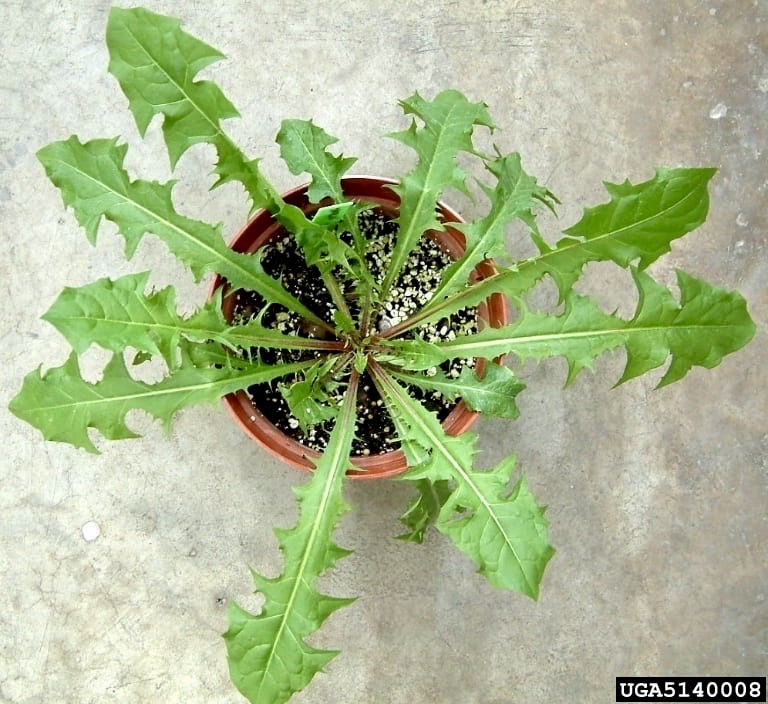
And J had no idea what I was talking about. I stupidly asked him what dandelions are called in Spanish, and of course he had no idea. Eventually I looked it up: diente de león, Like French dent de lion and Italian dente di leone. And German Löwenzahn. All ‘lion’s tooth’, after the jagged leaves:
(#2) Leaves of the mature common dandelion, Taraxacum officinale (photo by Lynn Sosnoskie via University of Georgia, Bugwood.org), from the Cornell Weed Identification site
But he didn’t know the name. I then described the plant in some detail, ending with a description of the wonderful seedheads, delicate ovals of filaments each with a tiny seed attached:
(#3) The blowball, or clock, of a common dandelion
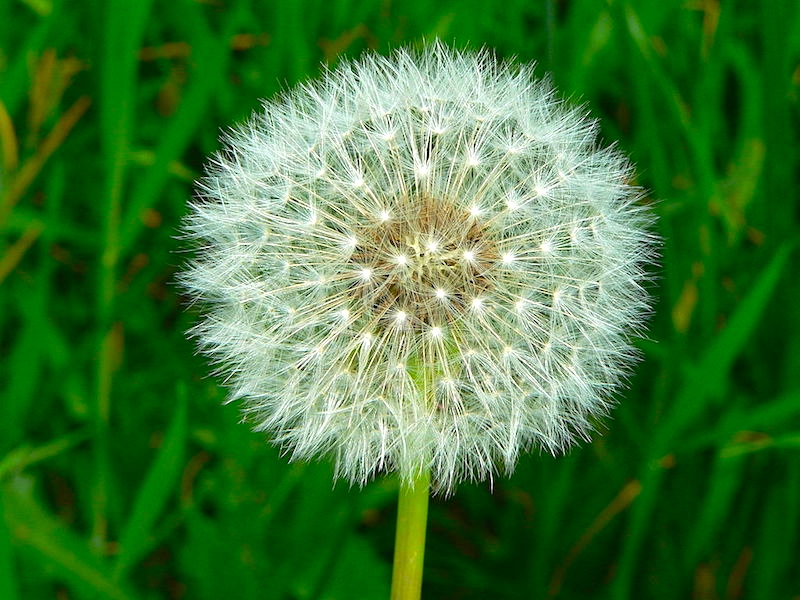
Ah, this he recognized instantly; his young daughter picked these weeds to blow on the ball and send the seeds floating away on the air. (In Russian the name for dandelion is based on the verb meaning ‘to blow’.)
Back on the walk, we continued to the corner of Emerson and Homer, across the street from the Whole Foods, where I rested under a still winter-bare Chinese elm (Ulnus parvifolia), an excellent street tree that lines this block of Homer Ave. I talked about the area in earlier days, and we admired the big old house at our corner, so beautifully kept up, with a manicured front lawn of green grass.
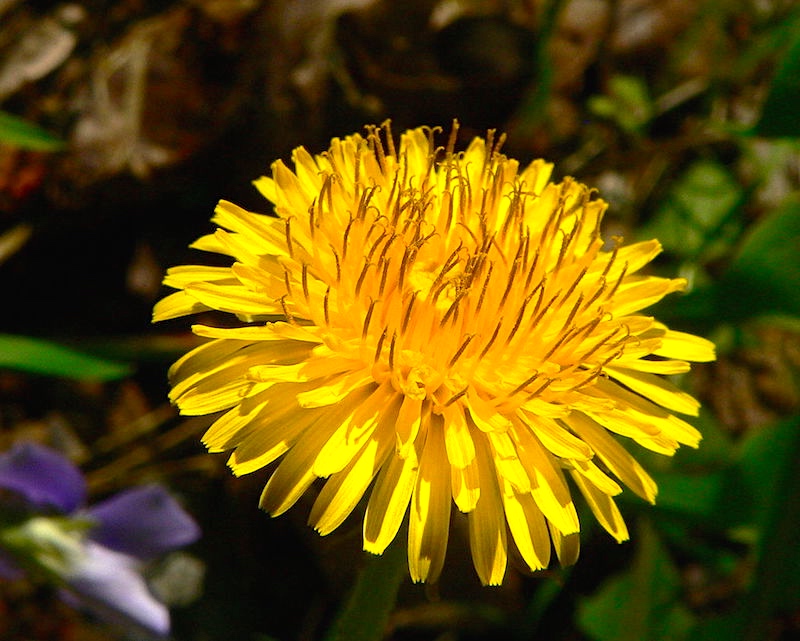
In the middle of which there bloomed a bright yellow weed — a common dandelion! Like this one:
(#4) Taraxacum officinale in bloom; one of the first weeds to sprout in spring
On composites, dandelions in particular. From Wikipedia on composites:
Asteraceae is a large family of flowering plants that consists of over 32,000 known species in over 1,900 genera within the order Asterales. The number of species in Asteraceae is rivaled only by the Orchidaceae, and which is the larger family is unclear as the quantity of extant species in each family is unknown. The Asteraceae were first described in the year 1740 and given the original name Compositae. The family is commonly known as the aster, daisy, composite, or sunflower family.
… In plants of the Asteraceae, what appears to be a single “daisy”-type flower is actually a composite of several much smaller flowers … The previous name for the family, Compositae, reflects the fact that what appears to be a single floral entity is in fact a composite of much smaller flowers
A poster of twelve different species of flowers of the family Asteraceae, belonging to the three most representative subfamilies: Asteroideae (Ast), Cichorioideae (Cich) and Carduoideae (Card):
(#5) #5 is closely related to the common dandelion (Wikipedia image)
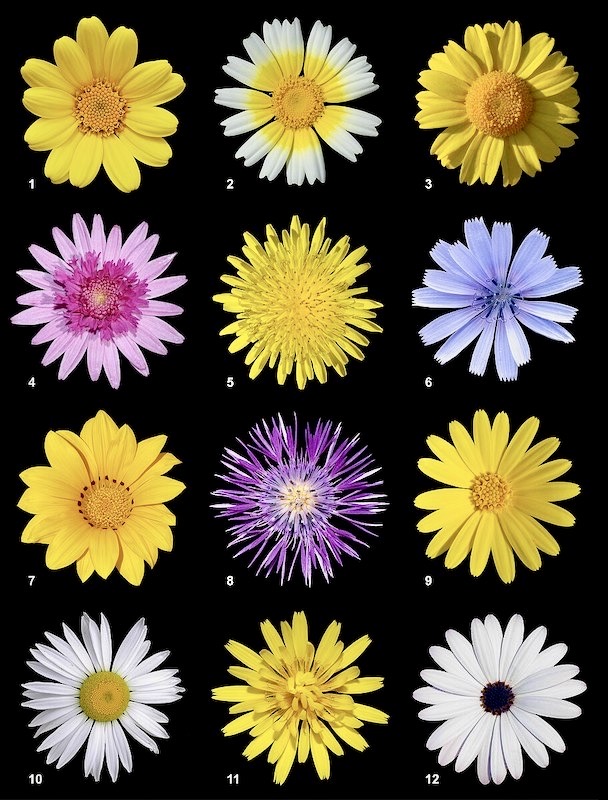
Key to the poster:
1 yellow chamomille – Anthemis tinctoria (Ast)
2 crown daisy – Glebionis coronarium (Ast)
3 corn marigold – Coleostephus myconis (Ast)
4 marguerite – Argyranthemum frutescens ‘Bridesmaid’ (Ast)
5 sow thistle – Sonchus oleraceus (Cich)
6 chicory – Cichorium intybus (Cich)
7 treasure flower – Gazania rigens (Cich)
8 galactites – Galactites tomentosa (Card)
9 field marigold – Calendula arvensis (Ast)
10 ox-eye daisy – Leucanthemum vulgare (Ast)
11 common hawkweed – Hieracium lachenalii (Cich)
12 cape daisy – Osteospermum ecklonis (Ast)
Then from Wikipedia on dandelions:
Taraxacum is a large genus of flowering plants in the family Asteraceae [subfamily Cichorioideae], which consists of species commonly known as dandelions. … The genus is native to Eurasia but the two most commonplace species worldwide, T. officinale (the common dandelion) and T. erythrospermum (the red-seeded dandelion), were introduced from Europe into North America, where they are an invasive species. Dandelions thrive in temperate regions and can be found in yards, gardens, sides of roads, among crops, and in many other habitats. Both species are edible in their entirety and have a long history of consumption. The common name dandelion (from French dent-de-lion ‘lion’s tooth’, referring to the jagged leaves) is also given to specific members of the genus.
And from my 8/31/15 posting “Eat your weeds”:
As I recently wrote,
dandelions (Taraxacum officinale) — these plants are quadruple-threat invasives, spreading their tiny seeds on the wind, growing very fast, tolerating drought, and suppressing the growth of surrounding plants
Still, they’re pretty, and their leaves are edible, in fact, tasty when young.
… My Pennsylvania Dutch grandmother went a-gathering dandelion shoots in the spring, often with my help, and then served them in “wilted dandelion salad”, with a hot dressing of crumbled bacon and curdled milk. She never wrote this (or any) recipe down, nor did she show anyone how she made the dish — and though I’ve found lots of recipes for wilted-greens salad with a hot vinegary dressing, none of them looks quite like Grandma Sue’s.
March 9, 2025 at 11:26 am |
And then there’s an alternative French name for dandelion: pissenlit ‘piss-in-bed’, from the reputed diuretic properties of dandelion greens.
March 9, 2025 at 7:56 pm |
When I was young (around the same time you were young), we little German children called Löwenzahn “Pusteblume.” Pusten means blow on something. And we did spread the seeds by blowing on the seedhead.
March 10, 2025 at 6:18 am |
Having acquired my smattering of plant taxonomy a long time ago, I still have trouble not thinking of the composites as Compositae – a family which includes zinnias and lettuce as well, I believe.
Back in my college German class, we had a collection of German radio plays, in one of which there was mention of Löwenzahn with an alternative name of Butterblume (“butter flower”).