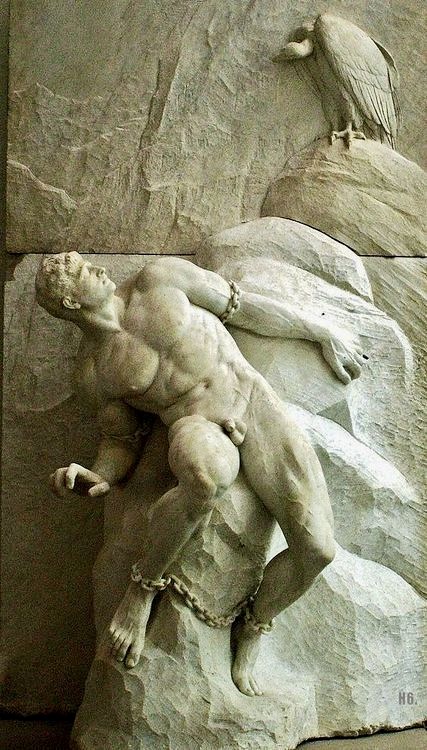
On my Pinterest feed yesterday — no doubt because of my interest in men’s bodies — this portrait of Prometheus, writhing mad-eyed in agony, shackled on a rocky ledge, as Zeus’s punitive eagle flies in to gnaw on his liver once again:
(#1) Frank Buchser, Prometheus Forged on a Rock (1855)

To come: first, notes on Prometheus and the eagle, from previous postings on this blog.
Then about the artist, who was, first of all, Swiss, from the town of Solothurn. There will be a digression on the town, which is almost impossibly picturesque.
But for the middle part of his life FB wandered from Solothurn, traveling widely around the world, including five years in the US, where he changed his personal name from Franz to Frank and painted a huge series of works depicting post-Civil War America for an European audience — three of them reproduced here.
Prometheus and the eagle. In my 7/25/23 posting “Prometheus and the eagle: the statue”, a dramatic statue of Prometheus and the eagle, by German sculptor Reinhold Begas:
(#2) Prometheus chained up on the face of a mountain; the eagle scrutinizing its prey
Then from my 4/26/24 posting “A Promethean hepatical”:
In the hands of French illustrator Charles Lemmel (1899 – 1976), the task of devising a poster to advertise a hepatical (a patent medicine for maladies of the liver) somehow fixed on the myth of Prometheus, punished by Zeus (for having stolen fire from Olympus and given it to humans) by being chained, naked, to the side of a mountain and subjected to endless hepatophagy: every day, Zeus’s eagle feasts on the Promethean liver, which then regrows for the next day’s torture.
Not, you might have thought, an ideal theme for a medicine ad; but look what Lemmel did with the idea in the poster (from the 1930s):
(#3)

Solothurn. From my 5/14/20 posting “Urs on drums”:
Saint Ursus of Solothurn. In military uniform, at his fountain in Solothurn [photos of the fountain and the Cathedral of St. Ursus]
… From Wikipedia:
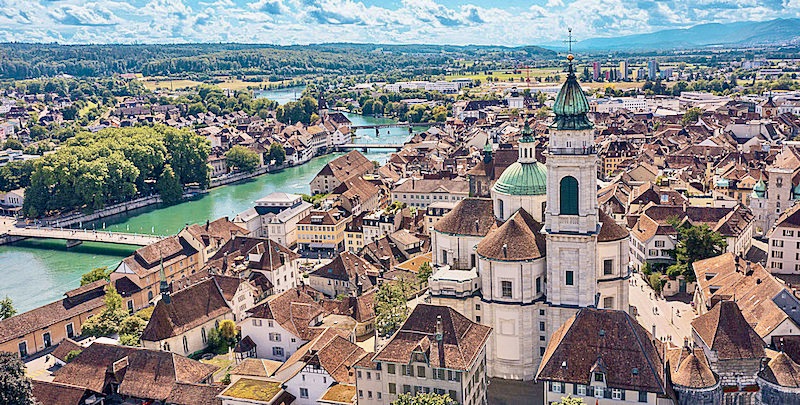
Solothurn is a town, a municipality, and the capital of the canton of Solothurn in Switzerland. It is located in the north-west of Switzerland on the banks of the Aare and [at] the foot of the Weissenstein Jura mountains.
A view of the town, nestled in the valley of the Aare (a tributary of the Rhine), with mountains in the middle distance:
(#4) (photo: Kanton Solothurn)
Frank Buchser. From Wikipedia:
Frank (originally Franz) Buchser (1828–1890) was a Swiss painter. He is noted for his portraits of notable American figures of the post civil war period and for his works with Oriental themes.
Born Franz Buchser on 15 August 1828 near Solothurn in Switzerland, he was the son of a farmer, Niklaus Josef and his wife Anna Maria, née Walker. At the age of 18 he was apprenticed to a piano builder and organ maker. However, his apprenticeship ended abruptly when the master found him in bed with his daughter. [AZ: FB had an eye for women, in several senses]
In 1847, he decided to become a painter
… Buchser travelled extensively in Europe, Africa and England. A personal highlight of his travels was a visit to Fez, Morocco in 1858 where he painted many street scenes and pictures of the Bedouin people.
… In 1866, Buchser visited the United States and remained there until 1871. He painted scenes of the American plains, with an emphasis on color that was new at the time. He caught up with a military expedition led by General William T. Sherman and painted scenes of the places they visited, including Fort Laramie. While in the US, he painted portraits of many notable personalities, including President Andrew Johnson, Secretary of State, William Seward and General Sherman and the last known portrait of Robert E. Lee. He also painted a series depicting African Americans in a sympathetic manner. During this period, he Americanised his name to Frank, and retained that form for the rest of his life.
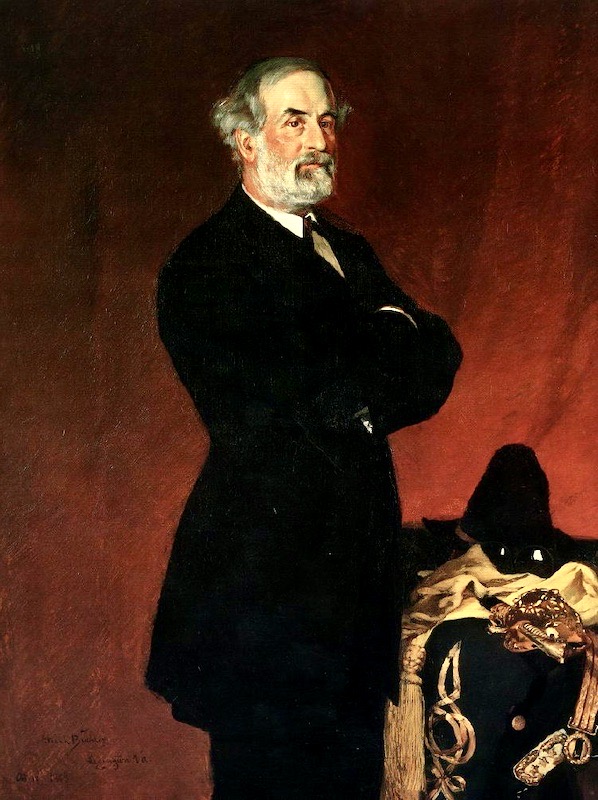
Buchser paintings. First, a formal portrait:
(#5) Frank Buchser, Robert E.Lee (1869)
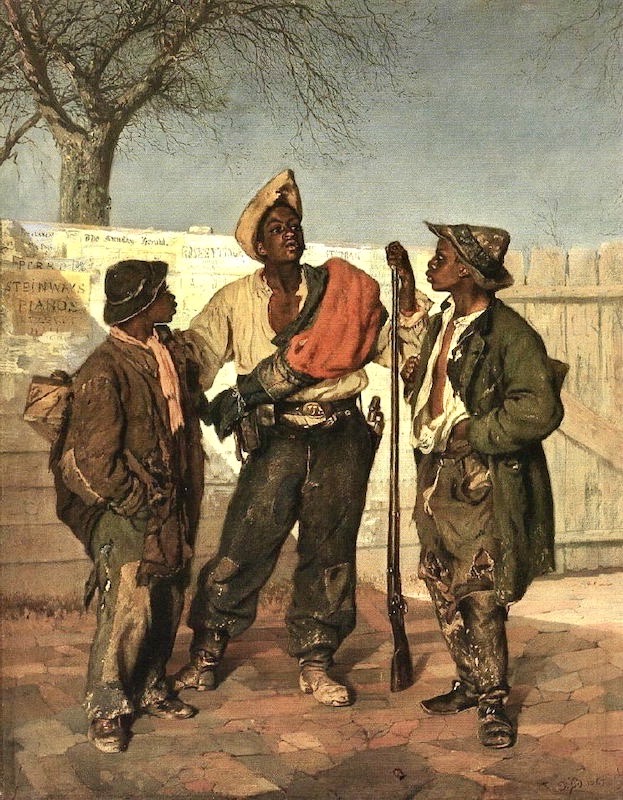
Then one of his many paintings of Black folk:
(#6) Frank Buchser, The Volunteers Return (1867): volunteer Black soldiers in the Union army back home after the war
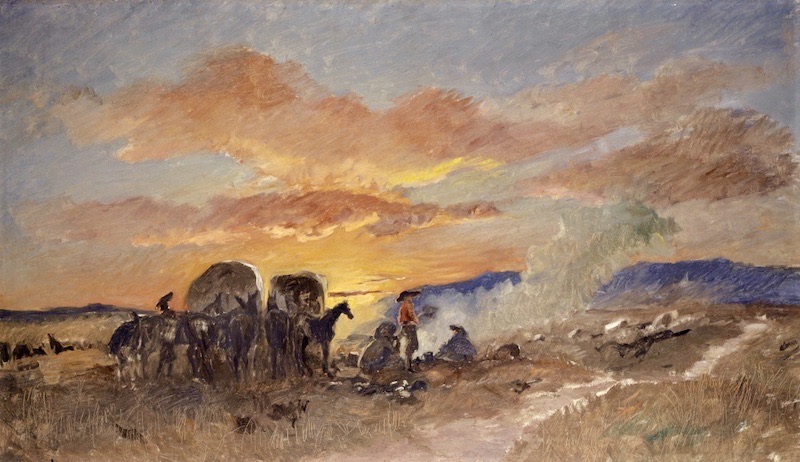
And then a painting of life in the real Old West — cowboys at Laramie WY:
(#7) Frank Buchser, Campfire at Sunrise in the Laramie Plains (1866); a kind of quick sketch in oils, with the look of early Impressionist painting some years before actual Impressionism
For Buchser, America was as strange and full of marvels as Morocco.
Leave a Reply