I blame it all on Alex Grosu*, who e-mailed me this greeting on 1/2:
Happy New 2025! As a mathematician**, you might like what follows***:
1) 2025 itself is a square: 45 × 45 = 2025
3) It’s a product of 2 squares: 9² × 5² = 2025
4) It is the sum of 3 squares: 40²+ 20²+5² = 2025
5) It’s the sum of cubes, of all the whole numbers from 1 to 9: 1³+2³+3³+…+9³ = 2025
6) Also: 2025 = (1+2+3+…+9)²
It’s the year in mathematics.
Notes:
* Alexander Grosu, Professor Emeritus of Linguistics at Tel-Aviv University; MA (1971) and PhD (1972) in linguistics from Ohio State University (with me as his adviser)
** I have a BA in mathematics (1962) from Princeton University
*** Edited a bit by me
Back to the e-mail.
AZ: Thanks. the cool part is that properties 5 and 6 are provably identical.
AG: Wow! Can you send the proof? In general, it is by no means the case that the square of a sum of numbers is identical to the sum of the cubes of those numbers.
AZ: But … but … the sum of the first n³ = the square of the sum of the first n, however surprising that might seem. A proof by induction, done slowly and in comprehensible steps, is available on YouTube, here. Apparently, the identity was recognized in ancient times.
The sum of the first n whole numbers is known, for good reason (as we’ll see in moment), as the nth triangular number, or T:n for short (subscript n is the usual notation, but WordPress handles subscripts messily, so I’ve resorted to this colon alternative) . So:
Cubic Sums: the sum of the first n cubic numbers is equal to (T:n)²
Now about …
Triangular numbers. From Wikipedia:
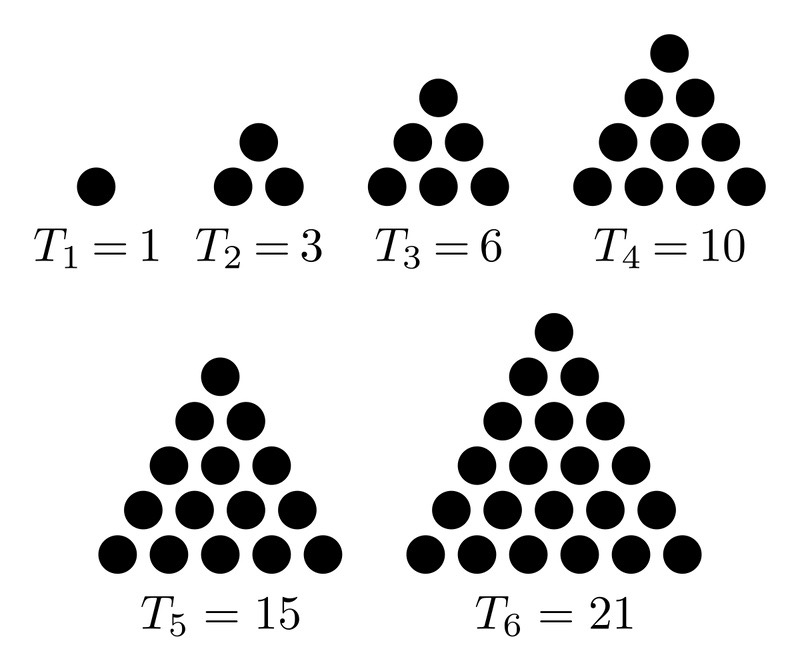
A triangular number or triangle number counts objects arranged in an equilateral triangle. Triangular numbers are a type of figurate number, other examples being square numbers and cube numbers. The nth triangular number is the number of dots in the triangular arrangement with n dots on each side, and is equal to the sum of the n natural numbers from 1 to n.
(#1) The first 6 triangular numbers as piles of dots (Wikipedia image)
(#2) For comparison, the first four square numbers
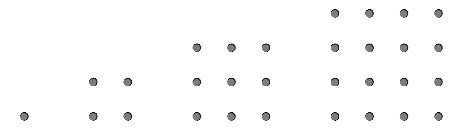
Rotate the squares in #2 45 degrees clockwise and you will see that each square of dots is made up of two triangles of dots, a larger one and and a smaller one — a square number is the sum of two triangular numbers: n² = T:n + T:(n-1), an identity that is easily proven, given the magic of …
The Triangular Number Theorem. T:n = (n × (n+1) ) / 2
Provable by induction, which I’ll now do for you, because the mechanics aren’t complicated, so that this is a nice illustration of proof by induction, which is one of those things I think should be much more widely known (proof by contradiction is another). Before you go on, you should appreciate the first few examples of the theorem:
for T:1, ( 1 × 2 ) / 2 = 2 / 2 = 1 yes!
for T:2, ( 2 × 3 ) / 2 = 6 / 2 = 3 yes!
for T:3, ( 3 × 4 ) / 2 = 12 / 2 = 6 yes!
for T:4, ( 4 × 5 ) / 2 = 20 / 2 = 10 yes!
So the theorem isn’t obviously nutso, but how do we know it’s true for every number, no matter how big? That’s what induction proofs are for.
In a proof by induction, you show (a) that the theorem is true of the number 1, and (b) that if it’s true of the number i, then it’s true of i+1 (this is the induction step, and it’s the guts of the proof), from which it follows, using manipulations from secondary school algebra, (c) that it’s true of every number.
Ok. Step (1), for T:1, is above
Now the induction step. Assume it’s true for the number i, that is, suppose that
T:i= (i × (i+1) ) / 2
Then, by the definition of triangular number, T:(i+1) = T:i + (i+1), which by the induction assumption
= (i × (i+1) ) / 2 + (i+1) ( and then some steps designed to get everything into a numerator over the denominator 2)
= (i × (i+1) ) / 2 + (2 × (i+1)) / 2
= ((i × (i+1) ) + (2 × (i+1)) )/ 2 (now combining the parts of that numerator, in steps)
= ((i² + i) + (2i + 2)) / 2
= (i² + 3i + 2) / 2 (which by factoring the numerator)
= ((i + 1) × (i + 2)) / 2
+ ((i + 1) × ((i + 1) + 1)) / 2
That is, T:(i+1) = (i + 1) × ((i + 1) + 1) / 2, and the theorem is true of the number i + 1. The conclusion (c) follows; the theorem is true of every number.
[Note: the presentation is simplified a bit for an audience of ordinary people, not mathematicians. I’m offering an implicit promise, as you do for people who aren’t specialists, that these simplifications are benign. In exchange, I’m showing a lot of steps you’d omit in a presentation for mathematicians. Some of whom would probably just say, of the Triangular Number Theorem, that its proof by induction was trivial.]
[A final, personal, note. I’ve been fond of triangular numbers, and everything having to do with them, since I was a child. A fondness that led me early to something truly cool, what’s known as Pascal’s Triangle (yes, Blaise Pascal, that Pascal), which comes with an infinitely expanding mantra:
1, 1 2 1, 1 3 3 1, 1 4 6 4 1, 1 5 10 10 5 1, 1 6 15 20 15 6 1, …
at the beginning of which you will see, in the first slot, 1, the foundation of it all; in the second slot, the whole numbers, beginning with 2; in the third slot, the triangular numbers (whoopee!), beginning with 3; and on from there. And then we’re into probability theory (which is how Pascal came to his triangle in the first place) and much more.]
January 8, 2025 at 1:04 pm |
About property 4), Alex Grosu writes me: