🐅 🐅 🐅 three tigers for ultimate September, which has 30 days and, here in the Bay Area, often brings the hottest days of the year; this year, it’s been a strange rollercoaster, erratic enough to puzzle the plants in my little container garden, but hot enough overall to bring me plenty of breathing misery
Today I bring you three pieces of news from my garden: on the persistence of the acorn-burying squirrel Écu and on two disappearances, of the cobwebs that used to festoon the ivy on the walls and the cymbidium orchids in their pots; and of the dark grit that used to rain down on everything outdoors (and undoubtedly will again).
First, some background about the territory.
The patio, the container garden, and the garden strip. Outside the French windows next to my work table is my front patio, a narrow tiled space enclosed in wooden fencing and stuccoed stone walls and containing an even narrower garden strip. The vertical surfaces and almost all of the garden strip are covered with common, or English, ivy (Hedera helix), now increasingly mingled with the vining Dolichandra unguis-cati, cat’s-claw creeper, originally planted by the condo’s gardeners by the trellis over the walkway to my front door, but now inserting itself everywhere it can.
Meanwhile, the garden strip itself served for years as a composting site. with coarsely chopped vegetable matter and some paper products mixed with some garden soil and soaked with my urine, from the many urinals scattered everywhere in my house (its a kidney-disease thing); the garden soil provides good bacteria for decomposition, the urine provides nitrogen to go with the carbon of the compostables. It’s an excellent system, except that urine is also very salty, so that I need to water the composting site a lot to leach the salt out; while the compost is slowly decomposing, there’s still enough salt to keep plants — the ivy especially — from taking over the area.
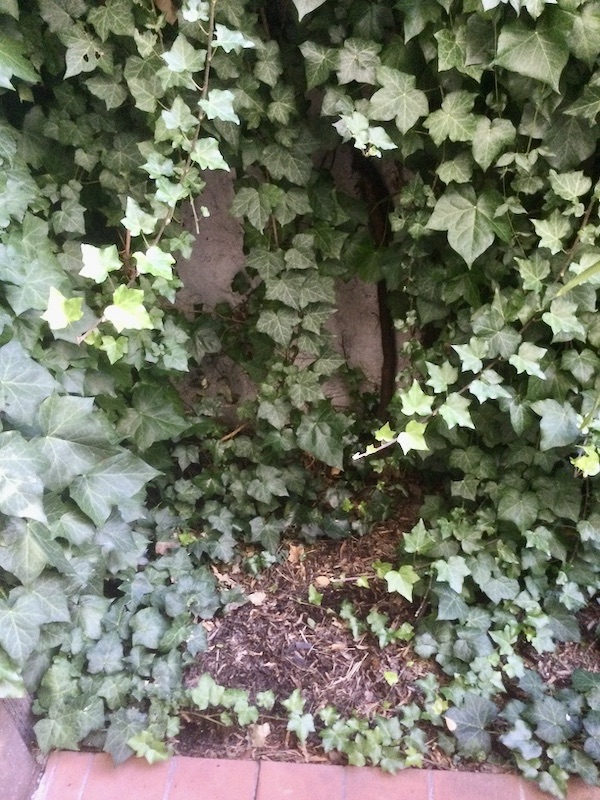
Eventually, the compost will mature, and, unless actively rooted out, the ivy (and sometimes other plants) will green over the area. Recently, there was just one small area not ceded to greenery, a bit at the north end of the strip, right outside my window, but then the ivy began to make incursions into it from three sides at once, signaling that the composting was finished. So I stopped, in effect, whizzing on the garden and let nature take its course. This is how it looks now, about ten days after my decision:
The ivy advances, visibly, every day, from the left (the ivy in front has been crawling vigorously from the left), from the back, and from the right (that little patch of ground on the right was once just the right edge of a huge composting area); those thick back stripes on the wall in the back are in fact stems of ivy plants that have been growing for many decades
You need this background because it provides, astonishingly, the explanation for why Écu the acorn-burying squirrel keeps coming to my patio — of all the gardens in Palo Alto, why this one? — and for where the cobwebs came from and why they have vanished. The (temporary) respite from grit, however, has to do with the earth’s high-altitude wind patterns and is in no way caused by my eccentric composting and gardening practices (though it has an effect on them).
Écu the pest, or: dig we must. From my 9/9 posting “Wildlife bulletin”, on life amid the California live oaks, now dropping acorns across the landscape for the local squirrels:
One of these squirrels has remembered, from months ago, the excellent soft dirt in the little garden strip on my patio [AZ on 9/30: the only soft dirt still available in the garden strip, all the rest of it having gone under a thick mass of ivy stems and roots]. So fine for burying nuts. I spent some time yesterday barking at it (from inside the house) whenever it prepared to descend from the arbor to the garden, until it gave up energetically threatening me in return and finally carried its nut away, in a huff, to some more congenial spot.
It hasn’t come back today, but I view the current state as likely to be a temporary victory.
As indeed it was. On Saturday, while Elizabeth was here preparing my medications for this week, the squirrel returned, acorn in mouth, making a big fuss rooting around in the ivy around the compost spot. I barked at it, so it leapt to the top of the fence, near my window, and hunkered down flat there, trying to minimize its body mass while simultaneously threatening me.
I knocked on the window with my cane, but that just made the squirrel angrier, so it scooted as close to the house as it could on the fencetop, spoiling for a fight. But then I barked again, and it apparently decided I was far too big an opponent for it to prevail over, so it fled once more into the trees with its nut.
But squirrels are persistent devils, and I can’t be on watch all day long: yesterday morning, there was a neat hole right in the middle of the remaining soft dirt, with an acorn in it.
I have given this memorious squirrel a name: Écu, just a clipping of French écureuil ‘squirrel’, though it also happens to be a genuine French word, écu ‘shield; old French coin with a shield on it’ (the two words have nothing to do with one another etymologically); I just liked the clipping — and a sound-association with the Italian announcement expression ecco, in this context conveying something like ‘here it is!’; and with English echo.
(I think of Écu as male, though I have no way of sexing squirrels on sight — but écureuil is of the masculine grammatical gender, and Écu seems aggressively male in behavior. Still, I’ll stick to the pronoun it in English.)
So: Écu comes to my garden strip because it remembers the good earth there, and now the good earth is just in that one spot.
The cobwebs and their disappearance. This one is less obvious. But you can figure it out by working backwards.
First: why are, or were, there cobwebs? Because there are spiders spinning them — little spiders, but spiders nevertheless, and they were noticeable if you messed around in the garden.
Then: why are, or were, there so many spiders? Because there are flies for them to eat — little flies, gnats really, but flies nevertheless, a hell of a lot of them, and they were really noticeable in the garden, visible in fact even from inside the house, buzzing over that nice soft earth.
Then: why are, or were, there so many gnats? Because they’re various species of fungus gnat, and their tiny larvae feed on decomposing organic material.
So it all comes down to that decomposing compost. A wonderland for the little fungus gnats whose larvae feed on it, and then for the little spiders that feed on the gnats, which they net in their … cobwebs (a wonderland also for some small birds, which come to feed on the larvae). When the compost has turned into soil, there’s nothing for the larvae to feed on, so the gnats vanish; and then there’s nothing for the little spiders to feed on, so the spiders vanish; and then once I’ve sprayed the cobwebs away in a morning watering, the cobwebs vanish too.
They have all gone away. It all happened in a few days. Quite dramatically. And in a couple of weeks, the patch of good soft earth will have disappeared too, under a tangle of ivy stems and roots (English ivy is one tough plant). The garden strip will be solid green. Periodically I’ll have to go out and trim the ivy back from where it creeps out of the garden strip and across the patio tiles.
I still put household compost on the garden, but these days I chop it all very fine and disperse the resulting compost fluff over a wide area of the garden strip, then water it down. So no spot gets enough to provide a home for fungus gnats.
One more thought on Écu. Once the last patch has grown over, the squirrel won’t be able to do much in the garden strip. But there are still all those containers. There used to be an enormous number, with many different sorts of plants in them, but it’s all been pared back to things I can cope with in my increasingly disabled state: 22 pots of cymbidium orchids; a small container of haworthia plants, a pleasant little succulent; a huge (now over 3 feet tall) Hydrangea macrophylla, big-leaved hydrangea, in an appropriately big pot; and, out by the street, a big wooden barrel of magenta-flowered ivy-leaved pelargoniums.
The cymbidiums I used to periodically divide and start in new pots, but these days that’s way beyond my abilities; as a result, the pots are now crowded with old pseudobulbs, with no space for a squirrel to bury anything. The haworthia container is too small to give a squirrel any purchase. The root systems of the pelargoniums are so dense that there’s no purchase there either. But the hydrangea pot, with its rich black soil, that just beckons to burying creatures, and I expect Écu to turn its attention to the pot any day now.
It’s not over yet.
What happened to the grit? I’ve written before about the the awful grit from the Gobi Desert that, annoyingly, rains down on us constantly; anything that’s open to the sky gets covered or coated with the stuff, so you have to keep washing things off. It’s carried on high-altitude wind currents, from halfway around the world, but it’s such a part of everyday life here that it was stunning when ten or so days ago it disappeared. Everything stays more or less clean; of course there’s always some dust, and pollen, and junk that falls from the trees, but no grit. It’s positively eerie.
The pattern of those high-altitude winds has obviously shifted, so presumably some other area — Canada? Middle America? Central America? The Andes and the Amazon? — is now getting our grit. But before we all do our happy happy dance, I have to remind you that the grit is rich in micronutrients that are, apparently, wonderful for plants.
So when I spray-wash the grit off the patio tiles and into the garden strip, and when I spray-wash the ivy on the fences and walls, so that the grit falls onto the garden strip, I’m not just cleaning up, I’m feeding my greenery. Well, the ivy and the cat’s-claw vine surely don’t need a shot of plant food. But the rest of the plants probably could use it; I wonder whether I should now be giving them some commercial plant food.
And I worry about what the shift in those high-altitude winds means. And wonder when they’ll change again.
Meanwhile, you can think good thoughts about your pussycat, but I’m thinking evil thoughts about my squirrel Écu .
October 1, 2024 at 5:43 am |
How can you be sure that it’s always the same squirrel?
October 1, 2024 at 6:22 am |
I can’t of course. I’m just applying Occam’s Razor.
October 2, 2024 at 6:14 am
Makes sense. It occurs to me that a few summers ago we had an oft- repeated instance of a chipmunk running across our porch, and I always assumed it was the same one each time.
October 2, 2024 at 10:40 am |
Squirrels are as viciously territorial as hummingbirds, so there’s probably only one.
October 2, 2024 at 12:15 pm
Yes, territorial, excellent point. When there were more squirrels, there were regular disputes over which one could forage in my garden at any given moment. Except for what turned out to be mated pairs.
So this morning (10/2) I went out to water the plants as soon as there was light, in the cool — a high of 90F was forecast for the day — and that set the stage for today’s visit from the hummingbird (surely the same one every day), who got to bathe in giant water drops.
Shortly after that came the first of two visits from Écu, nut in mouth each time. I chased it away each time by barking and knocking on the window. Then, while I was busy getting my lunch (Mexican leftovers) together, a large, misshapen boletus mushroom sprung up from nowhere, in the nice soft (and now very wet) dirt. Well, they flourish in warm humid places and times. Still, the speed they grow at is alarming.