This Charlie Hankin cartoon in the July 29, 2024 New Yorker:
(#1) Hankin is an old acquaintance on this blog; see the Page on my postings about his cartoons

The cartoon shows people queuing up at multiple windows in a bureaucratic office, each line for one type of applicant (as, in the US, at the (state) department of motor vehicles, the (federal) unemployment benefits office, or the municipal permits bureau), with one clerk for each line; in the cartoon, each queued applicant comes with some kind of ticket in hand. So far, that’s a familiar situation.
But then it’s made absurd when the clerks are aquatic mammals; a sea lion appears in the cartoon, which also refers to otters, but who knows what the other clerks are like: a manatee, a dolphin, a seal, a whale (or perhaps a polar bear, a beaver, a muskrat, a mink, a water shrew, a capybara or a hippopotamus) — given a choice, I would go to the otter or the capybara, but that’s my personal taste.
That’s just bizarre. But the situation is the stuff of nightmares, nightmares in which the dreamer doesn’t understand what the office and its separate windows are for, or is told by the annoyed clerk at their window that: they are (inexplicably) in the wrong line, are an ineligible person, don’t have the necessary form or ticket, are submitting the wrong one, or have filled out a form incorrectly.
This is Kafka played for laughs: the bureauratic-office nightmare that Kafka transformed into literature (notably in The Castle), mocked with officious clerks who are aquatic mammals (or, conceivably, zoo animals of all sorts).
Kafka’s The Castle. From Wikipedia:
The Castle (Das Schloss / Schloß) is the last novel by Franz Kafka [published in German in 1926]. In it a protagonist known only as K. arrives in a village and struggles to gain access to the mysterious authorities who govern it from a castle supposedly owned by Graf Westwest.
Kafka died before he could finish the work and the novel was posthumously published against his wishes. Dark and at times surreal, The Castle is often understood to be about alienation, unresponsive bureaucracy, the frustration of trying to conduct business with non-transparent, seemingly arbitrary controlling systems, and the futile pursuit of an unobtainable goal.
The novel is thematically related to Kafka’s The Trial (Der Prozess), and through it to Dostoevsky’s Crime and Punishment and The Brothers Karamazov.
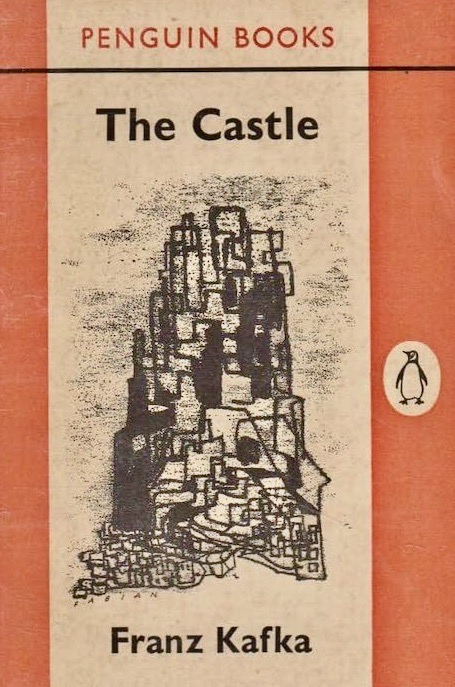
Three covers from the very many editions of the book. First, the 1955 Penguin paperback:
(#2) The edition I read (along with paperbacks of The Trial and Crime and Punishment) in a Modern European Literature course at Princeton, back in 1962
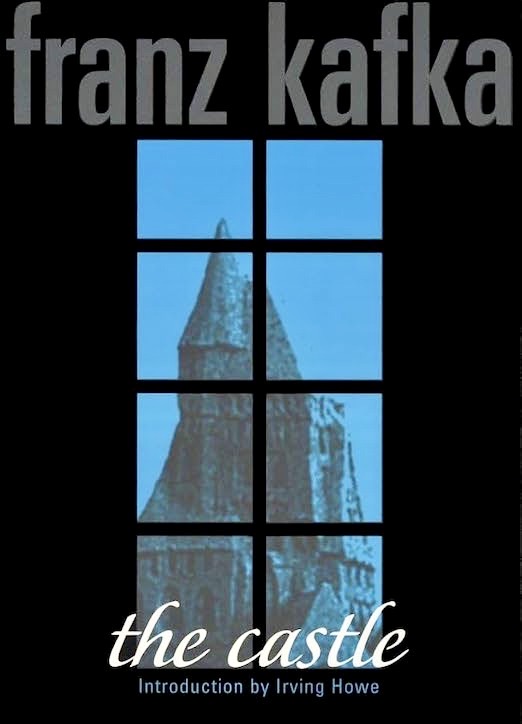
Then the 1995 Schocken edition:
(#3) Again, a depiction of the castle, this time ominously viewed through barred windows
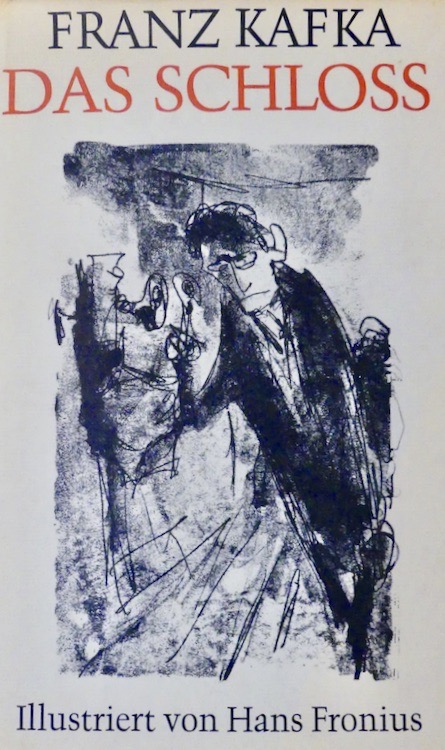
Other cover art focuses on the agonized Everyman, K., in isolation or in conjunction with the castle. As in this 1974 Schocken edition in German:
(#4) K., apparently at a wall of the castle
July 28, 2024 at 6:39 am |
The cartoon also reminds me of the Monty Python sketch in which a member of the public enters the wrong office, finding Abuse when he was seeking an Argument.
July 29, 2024 at 5:34 am |
I suppose I should note that the title of this posting is an instance of the joke form known as a Tom Swifty, described in my 12/23/16 posting “and the art horse you rode in on”, which reflects on a Zippy strip with three art-themed Tom Swifties in succession and includes a description of the joke form:
https://arnoldzwicky.org/2016/12/23/and-the-art-horse-you-rode-in-on/