Well, it’s about attachment ambiguity, in a family of memes about dogs chasing people on two-wheeled vehicles (mostly bicycles). Along the way, I’ll use this opportunity to expose some of the complexities of my blogging life.
The story begins on 6/23, with a message from Ellen Kaisse — a regular on this blog — offering me this memic wheel-dog joke that turns on an ambiguity between low and high attachment of the modifying PP on a bicycle:
(#1) Did the neighbo(u)r report that some people on a bicycle were being chased by the dog, or that the dog was on a bicycle in pursuit of some people? The human in the photo cartoon supposes the former, the dog the latter
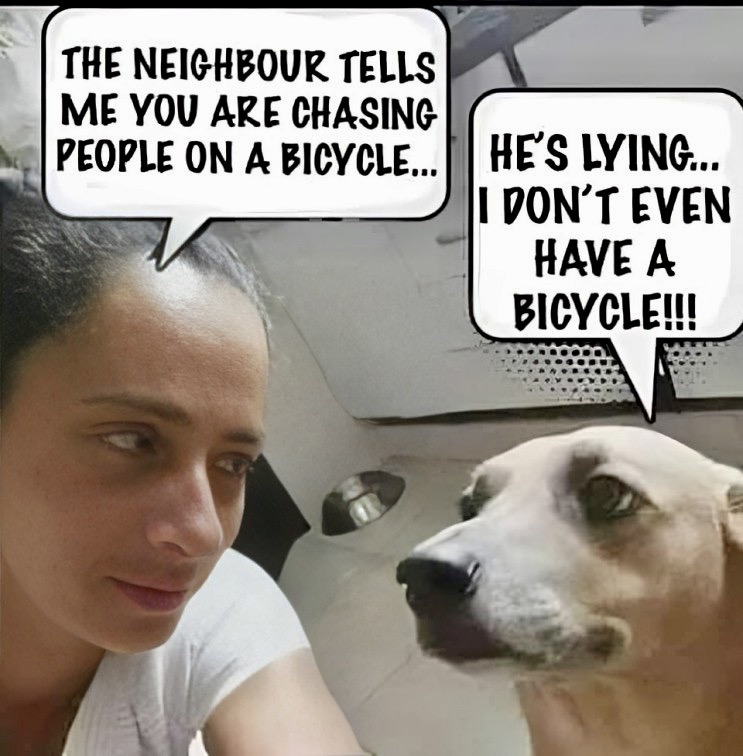
In the human’s report, the PP is intended as a modifier of the head N people within the direct object NP of the verb chasing (low attachment (LA), which you could also think of as narrow attachment); but the dog’s response makes it clear that it understands the PP as modifying the VP are chasing people (high attachment (HA), which you could also think of as wide attachment). (There is a Page on this blog about my postings on modifier attachment, including lots of cases of potential LA vs. HA ambiguity; there’s some overall preference for LA, but how things are understood in actual usage depends very much on the plausibility in context of the two understanding.)
The text in #1 has the BrE spelling neighbour, but there are otherwise identical versions out there with the AmE spelling neighbor, plus otherwise identical versions in which the cycle in the text is a motorcycle rather than a bicycle. And then there are further variations, lots of them, on both image and text (a couple of them reproduced below).
In any case, EK cautiously added the note, “You’ve probably seen this before” — her caution the product of previous occasions on which she sent me some cool example and I told her that I’d posted an analysis of it in 2008 or 2015 or whenever. This time, I was in fact sure that I’d seen a version of #1 and had posted about it; but then I couldn’t find it on any of my blogs or in the “to blog” files on my computer or in the “to blog” images on my desktop or in my stored albums of images. Much annoyed growling.
What went wrong. Eventually, I developed a hypothesis about that probably happened.
You need to know that I come across lots of things to post about every day: some from my comics feed; some from the New York Times, The New Yorker, various lgbtq publications, and so on; some from the events of my daily life; some from discussions on Facebook; and a great many from e-mail in which people suggest neat stuff for me to post about. I see dozens of potential posting topics every day. From these I save, in an on-line file and on little slips of paper, notes about as many as 10 each day.
Now, I struggle to do one posting a day; during my best times, I could do up to three. Obviously, stuff piles up alarmingly. Quite often I delete reminders. Periodically I’m faced with deleting postings in progress where I’ve spent 10 to 20 hours assembling them. But, sadly, I have to get rid of them.
I suspect now that I saved some version of the wheel-dog joke, probably with the image on my desktop, but eventually flushed it out because I’d done so many postings about LA / HA ambiguities. And then I don’t, of course, remember the details of the thousands of things I’ve abandoned (I’m not very good at remembering the roughly 10,000 postings I have done). But traces of the memory of dogs on bicycles lingered on.
Two wheel-dog e-cards. Just two more versions of the rotacanine joke, in e-cards:
(#2) Denial of HA reading: … my dogs don’t (even) own bicycles
(#3) Denial of HA reading: … my dog doesn’t know how to ride a bicycle

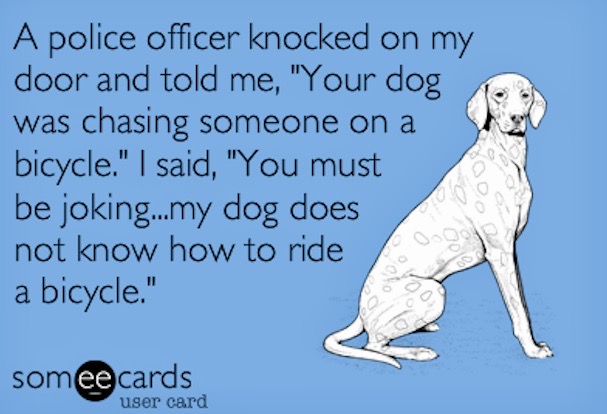
The two e-cards are interestingly different in register:
— #2 is framed in an informal register, with the lexical choices cop and bike; the contracted auxiliary in that’s; and the contracted negative in don’t
— #3 is framed in a very formal register, with the lexical choices police officer and bicycle; and the uncontracted negative in does not
Leave a Reply