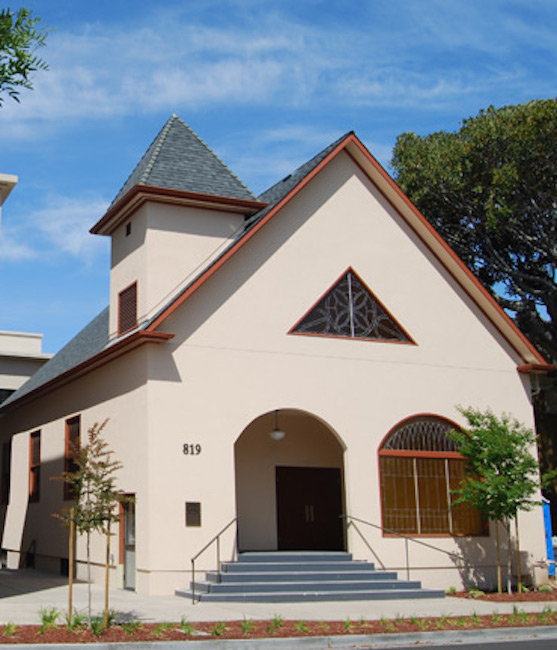
Resting yesterday alongside 819 Ramona St. on an afternoon walk, my helper Isaac and I noted once again that the building started life as Palo Alto’s first Black church. Black meaning African American, one of a number of uses for the racioethnic designator BLACK. As it happens, Isaac, from Fiji, is a Polynesian black person, with BLACK used to refer to people from the Polynesian islands (Tonga, Fiji, Samoa, etc.) with dark skin, curly hair, and broad facial features. It then occurred to me to wonder if Isaac was misidentified as African American on the basis of his BLACK features, as I am misidentified as JEWISH on the basis of my prominent nose and my body language. So this morning I asked him.
The short version of his answer was “Yes, until I talk” (he’s clearly not a native speaker of English), and I admitted that the misidentification of me as JEWISH only got much worse when I talked, especially here in California. And I discovered the wide plain of Isaac’s ignorance of Judaism, its varieties, and its practices, punctuated by verdant oases of actual knowledge (he knows about menorahs, the Sabbath, and some more). I have decades of experience explaining the weirdnesses of Christianity to my foreign students, so I was up to briefings on how guys keep their kippahs on their heads, mezuzahs, Orthodox / Conservative / Reform, Askenazi / Sephardic, and a few other topics. But there is so much.
Back to BLACK. There’s American Blacks (African Americans, going back to sub-Saharan Africa and the slave trade) and, with similar histories, Afro-Caribbeans and British Blacks and Afro-Brazilians and more. And then black folks from Africa.
And then, with no African connection, there are, notably, Polynesian black people and Australian Blacks (aborigines).
819 Ramona St. From the Palo Alto Stanford Heritage site, “University African Methodist Episcopal Zion Church Building” on 1/24/14:
The University AME Zion Church was founded in 1918. It was the first African–American church between San Mateo and San Jose. Its 22 congregants met at Fraternal Hall until they were able to purchase land on Ramona Street. Funds were raised throughout the town for a new church, which was [built in 1924 and] dedicated April 5, 1925.
The church when it was in use; the large tree to its right is a podocarpus, still there and still fruiting in the spring (as Isaac and I can attest)… 819 Ramona’s neighborhood straddled the area between Palo Alto’s downtown businesses and Professorville’s residences. Service providers such as lumber yards, laundries, automobile dealerships, plumbing stores and bakeries commingled peacefully with the homes of the working classes. It seemed like the ideal setting for AME Zion.
… After forty years at 819 Ramona Street, AME Zion moved to a larger facility at 3549 Middlefield Road [in southern Palo Alto]. Sold to the Palo Alto Medical Foundation, the old church deteriorated. A successful battle to prevent demolition resulted in restoration for adaptive reuse in 1985.
Leave a Reply