(Well, all about penises and what men think about their own and other guys’, so edgy for many people — but mostly clinical in content and tone, not at all raunchy)
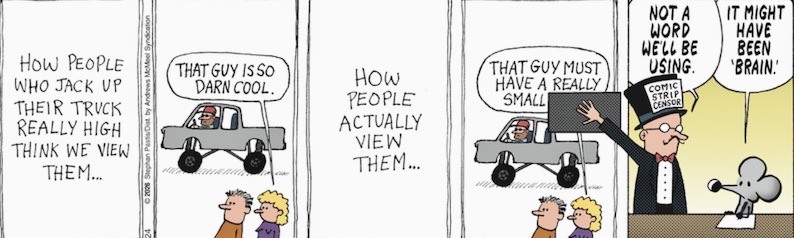
Stephan Pastis’s Pearls Before Swine strip of 2/24, about what we might call little-dick grandiosity — the common belief that megalomania is (in general) a compensation for having a small penis:
There is in fact no evidence for this idea; and we might legitimately question whether there are any actual cases of little-dick grandiosity, as I put it so crudely above, at all
Background: megalomania. Briefly, a preoccupation or obsession with power, size, strength, fame. and domination; characteristic primarily of some men in various cultures.
More carefully, from NOAD:
noun megalomania: [a] obsession with the exercise of power, especially in the domination of others. [b] the delusional belief that one is important, powerful, or famous, as a form or symptom of mental disorder.
Background: penis size envy. From Wikipedia, a thoughtful survey:
Penis size envy is a colloquial term for envy and dissatisfaction arising from unfavorable social comparison about one’s perceived penis size. The feeling can occur across a spectrum — from transient body-image concerns to persistent preoccupation and distress. When severe and accompanied by compulsive checking, avoidance, or marked impairment, related presentations have been described clinically as small penis syndrome (SPA) and, at the extreme, as penile dysmorphic disorder (a penis-focused form of body dysmorphic disorder).
Terminology and scope: Writers and clinicians use multiple overlapping terms for concerns about penis size. Penis size envy [not a formal diagnosis] emphasizes the comparative, emotion-focused aspect (envy of others believed to be larger). Small penis anxiety (or small penis syndrome, SPA) describes a persistent worry about being small despite normal measurements and reassurance. When preoccupation becomes time-consuming and causes significant distress or impairment, clinicians may diagnose penile dysmorphic disorder (PDD), a body-image disorder characterized by obsessions and repetitive behaviors focused on penile size.
Sociocultural influences: Qualitative and survey research suggest that sociocultural factors — including norms linking size with masculinity, locker-room comparisons, jokes, and pornography — shape men’s perceptions of what counts as “normal” and desirable. A narrative review of penile size dissatisfaction emphasizes that complaints should be taken seriously due to psychosocial impacts, yet are frequently driven by unrealistic standards and misperceptions rather than abnormal size. [AZ: men at the lower end of the normal size range — I am one — are frequently stigmatized, mocked as little dicks, and rejected as sexual partners in encounters between men]
Norms and misperceptions: Systematic reviews of clinically measured penis size find average flaccid, stretched, and erect dimensions with relatively narrow normal distributions; many men who believe they are “too small” fall within these normative ranges. An updated meta-analysis aggregating data by World Health Organization region similarly reports typical lengths and circumferences and highlights how regional averages can be misused to bolster stereotypes, potentially amplifying body-image pressures.
Associated experiences and outcomes: Men with lower genital self-image scores more often report sexual difficulties and elevated symptoms of anxiety or depression. In clinical samples, men meeting criteria for penile dysmorphic disorder report greater sexual avoidance and dysfunction compared with men who are merely anxious about size or [with] controls.
Concerns about being “too small” can also affect condom use and sexual comfort, with some men reporting poor condom fit and feel that contributes to slippage, breakage, or avoidance; public health authors recommend better fit options and counseling rather than size-based shaming.
Leave a Reply