From one of my crew of transgender friends, family, students, and colleagues, a pointer to the book To Survive on This Shore (Kehrer Verlag, 2018):
(#1) Cover of the book; from photographer Jess T. Dugan’s website for the book:Representations of older transgender people are nearly absent from our culture and those that do exist are often one-dimensional. For over five years, photographer Jess T. Dugan and social worker Vanessa Fabbre traveled throughout the United States creating To Survive on This Shore: Photographs and Interviews with Transgender and Gender Nonconforming Older Adults. Seeking subjects whose lived experiences exist within the complex intersections of gender identity, age, race, ethnicity, sexuality, socioeconomic class, and geographic location, they traveled from coast to coast, to big cities and small towns, documenting the life stories of this important but largely underrepresented group of older adults. The featured individuals have a wide variety of life narratives spanning the last ninety years, offering an important historical record of transgender experience and activism in the United States.
The resulting photographs and interviews provide a nuanced view into the struggles and joys of growing older as a transgender person and offer a poignant reflection on what it means to live authentically despite seemingly insurmountable odds.
To Survive on This Shore exists as a book, limited-edition portfolio, museum exhibition, and community exhibition. It has also been used extensively in educational initiatives and political campaigns.

From the photos in the book:
(#2)
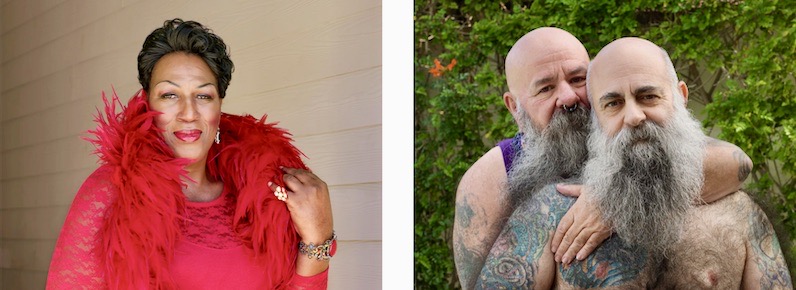
Terminology. The Wikipedia entry shifts uneasily between different senses of gender, but sorting it all out would take quite a lot of exposition, so think of it as a rough approximation:
Gender nonconformity or gender variance is gender expression by [someone] whose behavior, mannerisms, and/or appearance does not match masculine or feminine gender norms. A person can be gender-nonconforming regardless of their gender identity, for example, transgender, non-binary, or cisgender. Transgender adults who appear gender-nonconforming after transition are more likely to experience discrimination.
… The word transgender usually has a narrower meaning and different connotations, including an identification that differs from the gender assigned at birth
I have a long-standing interest in chronicling the way people (of many different sorts) structure their daily lives, folding their various personas, identities, practices, enthusiasms, goals, desires, and affiliations into ways of life; and in the life histories that result. I’m surrounded by wonderful rich data (though I’m inclined to think that everybody’s life structuring and life history will turn out to be interesting, no matter what they think) and have formulated several projects, but now I’m just barely getting from day to day, so I’ve had to abandon plans for interviews. Meanwhile, I’m looking forward to reading the interviews in To Survive on This Shore.
Leave a Reply