In today’s Bizarro cartoon, a hybrid portmanteau, a portmanteau name for one kind of hybrid referent, a referent with an assortment of features drawn from the referents of the contributing expressions; think of triceradoodle (referring to a hybrid of a triceratops and a poodle cross) = triceratops + doodle ‘a poodle cross’ (to be illustrated below):
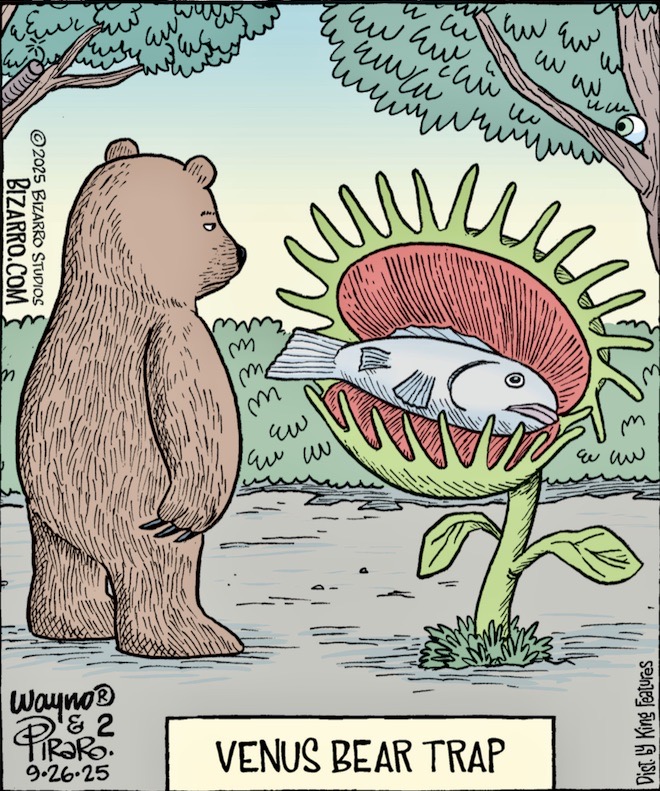
(#1) Venus flytrap + bear trap = Venus bear trap: the appearance of a giant Venus flytrap leaf, with the bait of a foothold bear trap (if you’re puzzled by the odd symbols in the cartoon — Wayno says there are only 2 in this strip — see this Page)
To come: details about the two contributing referents, the Venus flytrap and the (foothold) bear trap; then a factor that makes this portmanteau especially rich and satisfying, in contrast to the less complex (but far more preposterous) triceradoodle.
The plant. From Wikipedia:
The Venus flytrap (Dionaea muscipula) is a carnivorous plant native to the temperate and subtropical wetlands of North Carolina and South Carolina, on the East Coast of the United States.
(#2) The hungry leaves; these are generally rusty-colored on the inside, but here are green (the one on the left has closed on a snared fly)Although various modern hybrids have been created in cultivation, D. muscipula is the only species of the monotypic genus Dionaea. It is closely related to the waterwheel plant (Aldrovanda vesiculosa) and the cosmopolitan sundews (Drosera), all of which belong to the family Droseraceae. Dionaea catches its prey — chiefly insects and arachnids — with a “jaw”-like clamping structure, which is formed by the terminal portion of each of the plant’s leaves; when an insect makes contact with the open leaves, vibrations from the prey’s movements ultimately trigger the “jaws” to shut via tiny hairs (called “trigger hairs” or “sensitive hairs”) on their inner surfaces.
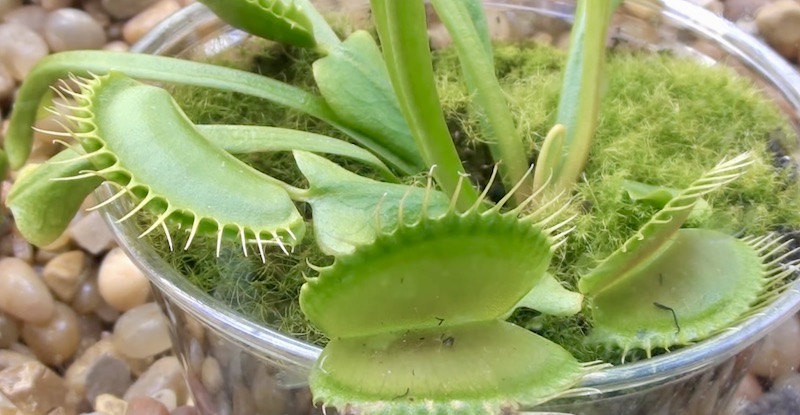
The prey are attracted to the leaves by compounds with a sweet scent.
The metal trap. From Wikipedia:
Foothold traps were invented in the 17th century for use against humans …, to keep poachers out of European estates. The device uses a pressure plate between two metal arms, or “jaws”, lined with spiked protrusions, or “teeth”. Once the plate has been stepped on, the arms close on the ensnared person or animal’s foot. Blacksmiths made traps of iron in the early 1700s for trappers. By the 1800s, companies began to manufacture steel foothold traps. Traps are designed in different sizes for different sized animals.
(I haven’t been able to find an illustration that doesn’t require a fee for use.)
They are now illegal throughout the US, as being inhumane.
Baits used to lure bears for hunting purposes (and formerly used with foothold traps) include raw meat, fish, sweets, human food, and dog food; the use of baits is banned in 18 of the 28 US states that allow bear hunting.
The plant and the metal trap. The trap mechanisms of the Venus flytrap and a foothold bear trap are analogous: a prey creature is attracted to the trap by a scent (for the fly trap, compounds with a sweet scent exuded by the plant itself; for the bear trap, bait smelling like food)); stepping on surface of the trap causes the jaws of the trap to close on the prey (for the fly trap, to enclose the prey within the jaws; for the bear trap, to snap the jaws shut on the bear’s foot).
The referent of the portmanteau expression in #1 is a trap with features of the referents of both the ingredient expressions — it looks like the trap plant, but is baited (with a bear favorite, a fish!) like a metal trap — but the plant and the metal trap are already similar, so the joke in the portmanteau seems especially rich.
But then the triceradoodle. From my 3/31/25 posting “Hybrid portmanteaus”:
From the 12/9/24 issue of the New Yorker:
(#3) [caption:] The triceradoodle is a hybrid of a triceratops and a poodle; its name is a combination of tricera– (from triceratops) and the libfix word-part –doodle ‘poodle cross’
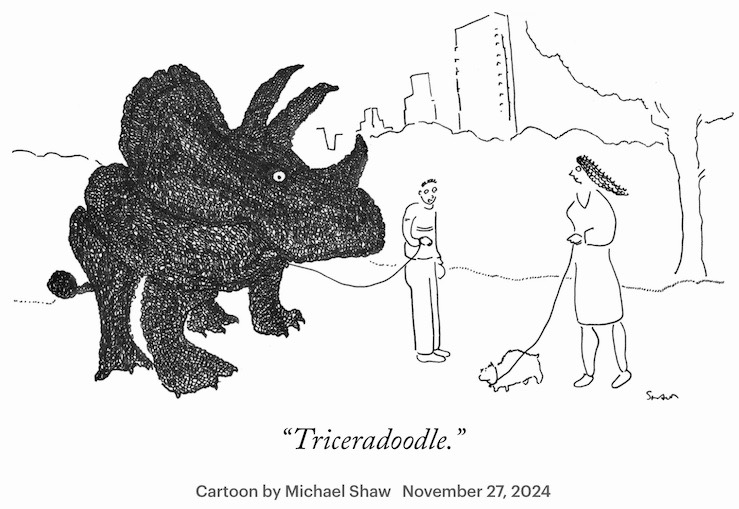
The triceratops and poodle crosses share only being (quadrupedal) animals, and are otherwise hugely unlike one another; their hybridization is preposterous. So the delight of #1 is richer than #3, while #3 is a great deal sillier than #1.
Leave a Reply