When recent chat with my childhood summer camp / Princeton / Wyomissing PA (now Golden CO vs. Palo Alto CA) friend Bill Richardson (William F. Richardson, hereafter WFR) turned to about politics in Reading PA (county seat of Berks County, where we both grew up; and where WFR’s father William E. Richardson (1886-1948; hereafter WER) was a progressive Democratic congressman from 1933 to 1937), I referred to the Socialist Park of my childhood (where we went for 4th of July fireworks):
— WFR: How do I not know there was a Socialist Park in Reading??
— AMZ: You don’t know about Socialist Park because it was in Sinking Spring, not Reading, and because Wyomissing had its own more elegant parks, while Socialist Park was more of a people’s park (with a dance hall and a roller rink).
WFR’s family had status and money, mine came out of the working class, but that was no bar to our friendship.
From the Berks Nostalgia site, “Socialist Park in Sinking Spring”:
Socialist Park, now known as Willow Glen Park, was created in 1929, under socialist Reading Mayor J. Henry Stump. In its heyday, it boasted a dance hall, and a roller-skating rink. Today, the park hosts large local events, including the Apple Dumpling Festival in June, Berks Celtic Fest in July, and Shocktoberfest, a halloween scare attraction September through October.
(#1)
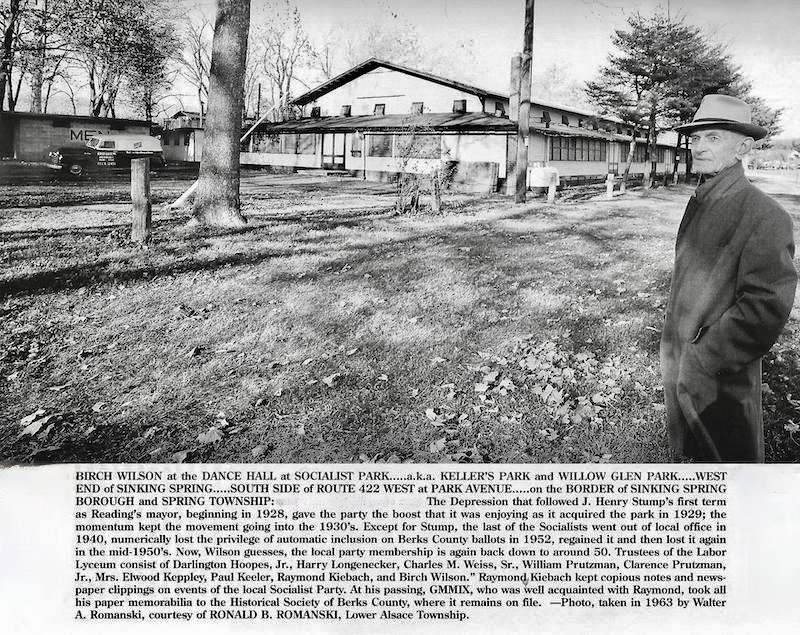
Four things: 1, the location of the park, on the border of Sinking Spring Borough and Spring Township; 2, the Socialist Party, a success (for a while) in Reading; 3, the complicated local party politics of the time; and 4, the photographer of the 1963 picture above, Walt Romanski, who I worked with when I was a floater on the Reading Eagle newspaper (afternoons and Sundays).
Thing 1, location, location, location. First, some background. For various purposes of government, Pennsylvania currently has 67 counties, 56 cities, and 956 boroughs (roughly, towns). Philadelphia is both a city and a county; and many places (like West Lawn — in Berks County — where I mostly grew up) are both boroughs and towns. One level down, counties are divided into townships; Berks County has 44 townships, and West Lawn is in Spring Township.
Counties have principal cities, called county seats: Reading is the county seat of Berks County, but it has many other cities in it (West Reading, Wyomissing, Sinking Spring, Robesonia, Wernersville, Mount Penn, Kutztown, Womelsdorf, Hamburg, to name a few). Correspondingly, townships have principal towns; for Spring Township, this is my town, West Lawn (which is small; in the census of 1940, the year I was born — in Allentown, in Lehigh County, adjacent to Berks — it had only 2,152 residents).
This is complex, but carefully organized. Now the weirdness — which is unfortunately necessary to expose, in order to make sense of the assertion in #1 that Socialist Park is on the border of Sinking Spring Borough and Spring Township. The weirdness is that though many boroughs are jurisdictionally within a township, some are jurisdictionally independent of the townships, even if they are entirely or almost entirely surrounded by some township. As is the case for Sinking Spring and Spring Township. The relevant part of the Google map of Spring Township (outlined by a dotted red line), centered on Wyomissing:
(#2) The west side of Reading; there are lots of places on the border of Sinking Spring and Spring Township; Socialist Park was / is on this border on the south side of a section of US 422, the old post road west from Reading to Lebanon and Harrisburg (near to Berks Lanes on this map)
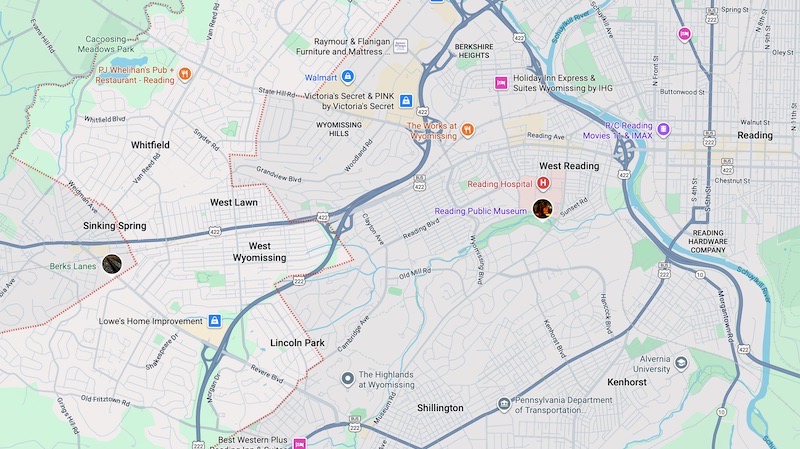
The point is that it takes three specifications, not two, to locate Socialist Park: the boundary of Sinking Spring, the area of Spring Township, and the course of US 422.
And then I can add that Socialist Park was halfway between the house I grew up in in West Lawn and my grandfather’s farm in Sinking Spring. About the same distance to the west as the distance to the east between the house I grew up in and the house Bill Richardson grew up in, on Reading Boulevard in Wyomissing. (And for extra interest, Shillington, to the south, is where the novelist John Updike grew up.)
Thing 2, the Socialist Party in Reading. The Socialist Party got a limited toehold in the US, but was for some time a genuine success in Reading. See the Berks History Center’s “The Reading Socialists in Retrospective” by Raymond J Phillips, Jr., in the Summer 1965 issue of the Historical Review of Berks County.
Thing 3, local party politics from the late 1920s into the early 1930s. Which is what gave us Socialist Park. As I understand things, part of the success of the Socialist Party in Reading came from its making common cause with the local Republicans, against the local Democrats, who were seen as a corrupt arm of the machine Democratic Party in Philadelphia. Bill Richardson’s father WER represented a separate strain of opposition to the machine Democrats: progressive Democrats in the mold of Franklin Delano Roosevelt. My parents were Republicans on economic grounds, but were idealistic egalitarians on social matters; Barry Goldwater’s 1964 presidential campaign drove them from the Republican Party and towards my progressive politics.
Thing 4, Walt Romanski, the photographer of #1. Walter A. [Walt] Romanski (1916 -1992), chief staff photographer for the Reading Eagle newspaper for decades, younger brother of Matthew P. [Matt] Romanski (1911-1983), equally long-time social page editor of the Eagle. I worked at the paper summers from 1958 to 1961 (when I was 17 through 20). mostly as a floater, filling in for anyone who was on vacation or otherwise unavailable, which meant a lot of times with Walt in tow: interviewing participants in hot news stories, running the regular city hall beat, reporting on the local minor league baseball team, and (especially) doing longer interviews for feature stories for the Sunday magazine. Less time with Matt, who I worked with only when I was assigned to the social page.
In one-word summaries, Matt was fussy, Walt was crude. Walt put on the character of a street photographer for a NYC tabloid, complete with a foul mouth. He knew all the nooks and crannies of the local world, from the seamiest (mob operations, the local prostitution industry) to the most delightful (art shows, musical performances). He spit at pretension, evasion, and rank-pulling, but applauded quality and humanity when he saw it.
We worked well together. He was impressed by my writing (he read all the stories his photos were used for, read them with care and a critical ear) and, even more, by my ability to extract good stories by just talking to people (I had no idea I could do that until I was told I had to, so I was just as astonished as Walt was). But I was, in his eyes, the eyes of a grizzled veteran, just a kid — ok, a phenom, but still a kid, so he did his damnedest to care for me and educate me. One of five people on the paper’s staff who did this for me. I was thrown into one tough challenge after another, but by people who helped me meet them, and in the end I was offered the editorship of the Sunday magazine, just in case I could be seduced away from graduate school in linguistics.
I tell people that this was a dream job, and that it changed my life. Here’s a glimpse of why I say that.
And now I will leave Socialist Park to veer (in postings to come) in another direction entirely: to talk about fathers, Bill Richardson’s and mine, the men we might become, in their youth.
Leave a Reply