🐅 🐅 🐅 Three tigers for ultimate July, while we anticipate the inaugural rabbits of August and the cheese and chocolate of 🇨🇭 Swiss National Day🇨🇭 — we await the edelweiss-bedecked Helvetia!
The territory. Meanwhile, I’ve been re-establishing an old friendship, one that goes back to childhood: Bill and I met at Camp Conrad Weiser, a YMCA-sponsored summer camp in the hills of Wernersville PA (some of these details will become relevant). We were later at Princeton together, and in the summer of 1961 (after my parents had moved on to California, while I continued my job as a reporter on the Reading (PA) Eagle and needed a place to stay), he offered a guest room in his family’s big house on Reading Boulevard in the suburb of Wyomissing —
(#1) An aerial shot of some big houses on Reading Boulevard (a stock photo from an article on Wyomissing as a planned community); there was housing for the rich on the boulevards, with workers’ housing in separate sections of Wyomissing (one of which my father grew up in) and on the side streets along the boulevards, in the adjacent boroughs of West Wyomissing, West Lawn (where I grew up), and West Reading, and in Reading itself

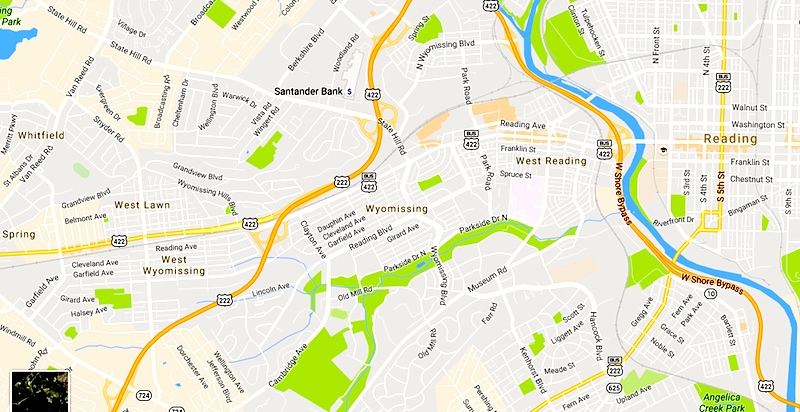
(#2) The areas in question; Wyomissing Hills is just to the east of West Lawn; Wernersville (the camp site) is well to the west, off US 422
Wyomissing High School was an elite public school, though with a significant number of working-class kids, like my father, mixed in with the rich kids. My dad, amiable, energetic, and athletic, got along well there; he was captain of the soccer team. Like many other rich kids in Wyomissing, though, my friend Bill went instead to a prep school, in New York State, but was around during the summers. I went to a remarkable rural-suburban high school in West Lawn, where I managed to fit in, and at that point my family moved up a notch to a new section of Wyomissing Hills, where I had the option of staying in high school in West Lawn or switching to Wyomissing; I was getting a dream education in West Lawn, and though I had some social connections in Wyomissing, was wary indeed of trying to survive among a horde of privileged kids, so I stayed, happily, in high school in West Lawn.
Exclusions: in the neighborhoods. Houses in all the working-class neighborhoods I’ve mentioned came with restrictive covenants: no blacks, no Jews. No doubt they would have excluded Puerto Ricans and Chinese, but these people came along later. So grade school and high school were in fact free of Jews, blacks, any variety of Latinos, and any variety of Asians. There was free-floating prejudice against some of these groups, not very much against Jews (beyond a few kids who earnestly explained to me that Jews were evil because “they killed our Christ” and were immune to having the actual Bible story explained to them); my parents (who ran a small costume-jewelry shop) had plenty of Jewish business acquaintances, and the next-door neighbor who was a professor of theology at Albright College was also a mainstay of the local council of Christians and Jews. For most people we knew, Jews were just part of the fabric of life.
Now Catholics, we had plenty of Catholics, especially of Polish descent (among Eastern European factory workers and their descendants). But most of us were of some variety of Pennsylvania Dutch descent, with names to match. In fact, the social world came in two big relevant categories: Dutch (Pennsylvania Dutch) and English (roughly, all other white people); my Swiss-American father and I counted as English (my mother was Dutch), as did my Polish-American buddy Ernie Ziemba.
Exclusions: at camp. The first important thing about Camp Conrad Weiser is that it was a YMCA camp, and the Christian part was taken very seriously; there were no Jews — though, again, plenty of Catholics. The second thing is that it was also racially exclusionary, though no one ever said this out loud. at least not around me; there were no blacks, no Latinos of any sort, no Asians of any sort, just a very wide range of white kids (Irish, Italian, Polish, even Greeks). The third thing is that it earnestly tried to mix boys all the way across the class spectrum. I had friends who were notably poorer than I was, and a few who were truly rich kids. Bill was one of the rich kids, but he largely concealed this at camp, because that was the sort of person he was (eventually I will celebrate him in a separate posting, as someone who has devoted a big slice of his life working doggedly against poverty, urban decline, and racial injustice). But, then, even at boys’ camp, rich people tend to be assholes of one stripe or another.
High school graduation. Now we get to my story. Writing to Bill, I mentioned a rich guy, Johnny, who became something of a friend at camp. Turns out Bill also was friends with Johnny for a while, and then they drifted apart. The relevant bit of Bill’s account of their history, considerably edited by me:
— Bill: I remember Johnny, whose family lived in a big historic stone mansion out in the country. We were briefly friends. More wealth there than my family had.
— Arnold: Yes, that big stone mansion. He had our village from camp there for a swimming party one summer day — pretty clearly showing off his status. He picked me up as a friend for a while, but eventually I became convinced he just wanted an audience and a follower. So I let the friendship with Johnny fizzle out.
Then, at high school graduation time, I got invited (along with some friends from Wyomissing Hills) to a graduation party at that big stone mansion. I was walking from one room to another, past an open door, when I heard Johnny saying — “Oh Zwicky, his family has a little store, they might as well be Jews”. And I walked right out the front door, got in my car, and drove home, feeling betrayed.
By then, I was into the classical music world, where Jews are part of the fabric, about to go off to Princeton, where a great many of my philosophy and mathematics professors (some of whom changed my life) were Jews, and then on to graduate school in linguistics, where only a few of my professors were not Jewish, so that I came to see that I was seriously Jewish-adjacent. And discovered tikkun olam, repairing the world, the program that drove Bill’s life work (whether he knew about it or not) and began to inform mine.
But back at the graduation party. I had never caught the slightest clue that Johnny was an unthinking anti-Semite, so it was as if I’d been thrust into that sci-fi story where you’re having a delightful conversation with a new acquaintance and they open their mouth in laughter and you see the wet flicking of their forked lizard tongue.
Leave a Reply