E-mail today from Luis Casillas to me and Luc Baronian (it’s a Stanford connection), with his header:
Apparently English “n’t” is trulyn’t an inflectional affix after all
(intending to convey ‘truly not an inflectional affix after all’) and then the comment:
Seen on Twitter:
(#1) deranged grammar advice on-line

Accept for a moment, contrary to fact, that trulyn’t is a correct form; why would it show that n’t isn’t an inflectional affix?
Because wasn’t is definitely possible, so that if trulyn’t is also possible, then n’t acts like a separate word in wasn’t truly ~ was trulyn’t — just like was not truly ~ was truly not — in that it’s mobile, allowing alternative orderings, while inflectional affixes don’t move around this way: there’s nothing like watched happily ~ *watch hapillied.
And then the way was open for me to make a silly bilingual joke (with apologies to Verdi):
Ah, la negazione è mobile ‘negation is mobile’ (more on the joke below)
Now let’s return to the real world, where trulyn’t is trash, and the student Syncurious, speaking for the whole class, shouts out two questions:
Q1: Why would anyone have even suggested that n’t is an inflectional affix? Isn’t it just a reduced, phonologically dependent, variant — a clitic variant — of the negator not?
Q2: Why does the deranged grammar advice reject truly wasn’t sure how? Isn’t that impeccable?
Well asked. But there are two surprises here:
— to Q1: Two entirely serious linguists looked at characteristics of inflectional affixes and clitics and, to their surprise, found that n’t ended up solidly in the inflection column, so they published their evidence in a thoroughly respectable journal. I refer to:
Arnold M. Zwicky & Geoffrey K. Pullum, “Cliticization vs. Inflection: English N’T”, Lg 59.3.502-513 (1983) — on-line copy here, abstract here:
(#2) In a nutshell
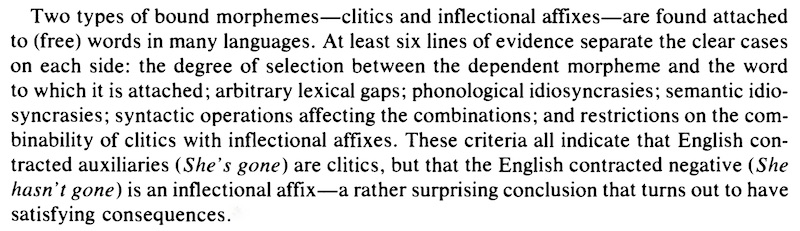
— to Q2: Well, yes, Syncurious, almost everyone accepts truly wasn’t sure, and truly was not sure, and was truly sure too. For starters, you do and I do too. But not everyone: many professional journalists find such phrases lacking, because they’ve been taught a spurious “rule” against split verbs. From my 5/20/18 posting “A zombie lurches in the NYT”, a section about:
an irrational aversion that has an even sadder, and weirder, history than the proscription against SIs [split infinitives]: a proscription against “split verbs” (an SV has material intervening between an auxiliary and its head verb), as in I will soon leave as an alternative to I soon will leave (and Soon I will leave and I will leave soon). Part of the weirdness of the no-SV “rule” is that it’s a journalist thing, essentially unknown outside of style/usage advice for journalists, but held to with great ferocity there.
The no-SV “rule” would presumably cover splitting copular be from its predicative complement, as in was X sure, parallel to was X singing and was X finished. Though I have to admit that it’s not easy to be sure just where deranged grammar advice applies.
But then the tenor sings. From Wikipedia:
La donna è mobile (‘Woman is fickle / flighty / inconstant’, literally ‘mobile / movable / changeable’) is the Duke of Mantua’s canzone from the beginning of act 3 of Giuseppe Verdi’s opera Rigoletto (1851).
Or, for Syncurious: La negazione è mobile ‘negation is mobile’. (Well, probably La negazion’ è mobile)
June 8, 2025 at 8:19 pm |
The problem with citing that tenor aria is that it’s incredibly sticky, a monstrous florid earworm. I am truly sorry to have inflicted it on you.
July 10, 2025 at 3:31 am |
[…] The grammar of “was trulyn’t”. […]