Yesterday, a greeting card from Ann Burlingham, written on 5/5 in Pittsburgh (mostly about the University of Pittsburgh graduation on 5/3, featuring graduate Opal Armstrong Zwicky among the crowd of about 5,000), arrived in Palo Alto on 5/8, with a note beginning:
Another Superb Bird! How many can Australia have?
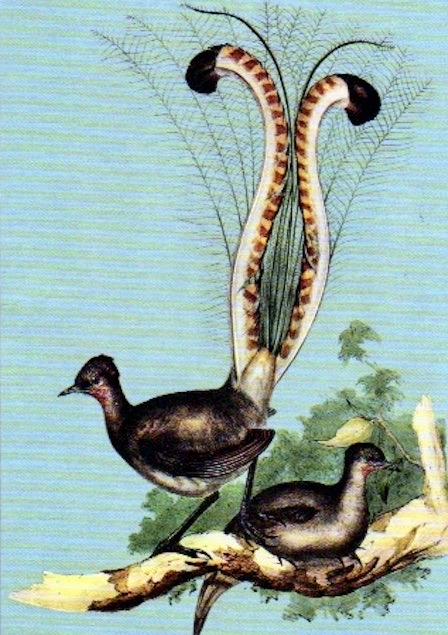
(#1) [from the Ikonink cards website:] Original Artwork: Superb Lyrebird (Menura superba), illustrated by Elizabeth Gould for John Gould’s Birds of Australia (1840-1848). Currently displayed at the Australian Museum.
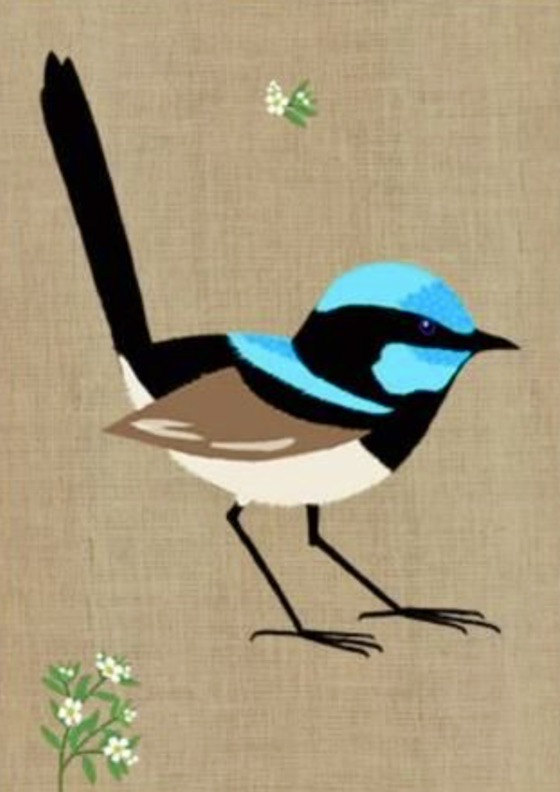
Why did AB exclaim another? Because of an earlier greeting card she’d sent me, with artwork reported on in my 4/23/26 posting “Saint George and the suberb fairy wren”:
(#2) Another Australian card, showing the superb fairy wren
The superb lyrebird. From Wikipedia:
The superb lyrebird (Menura novaehollandiae [earlier, superba]) is an Australian passerine songbird, one of two species from the family Menuridae, with the other being the much rarer Albert’s lyrebird. It is one of the world’s largest songbirds, and is renowned for its elaborate tail and courtship displays, and its excellent mimicry. The species is endemic to Australia and is found in forest in the southeast of the country. According to David Attenborough, the superb lyrebird displays one of the most sophisticated voice skills within the animal kingdom — “the most elaborate, the most complex, and the most beautiful”
The company behind the lyrebird card (#1). From Ikonink’s “About Us” page on their website:
We travel the globe in pursuit of the outstanding. We seek out the world’s finest artisan providers and hand pick the very best of their offerings, delivering them locally.
We curate our collection mindfully, with an emphasis placed on showcasing products that are thoughtfully composed at every level. Our catalogue pays homage to the lost art of careful craftsmanship, highlighted in our selection of products that are made of the finest materials – ensuring durability against the test of time.
We actively exercise a degree of consciousness regarding our environment – many of our paper products are constructed from recycled or biodegradable elements in an attempt to minimise our ecological impact.
At the core, we’re a team of romantics who embrace the chaos and magic of creative thinking. We love getting to know the artists behind the craft, and discovering the inspiration for the stories they tell. In other words, you won’t find anything lacking in substance among our collection
You can figure out that they’re in Australia, and that they have a warehouse somewhere in the country; if they have an actual office, I could find no indication of where it is. But you can see that they are mindfully earnest, environmentally conscious, and artistically romantic. Tonstant Weader fwowed up.
Gould’s Birds of Australia. The monumental work from which #1 comes. From Wikipedia:
The Birds of Australia is a book written by John Gould and published in seven volumes between 1840 and 1848, with a supplement published between 1851 and 1869. It was the first comprehensive survey of the birds of Australia and included descriptions of 681 species, 328 of which were new to Western science and were first described by Gould.
Gould and his wife Elizabeth née Coxen travelled to Australia from England in 1838 to prepare the book. They spent a little under two years collecting specimens for the book. John travelled widely and made extensive collections of Australian birds and other fauna. Elizabeth, who had illustrated several of his earlier works, made hundreds of drawings from specimens for publication in The Birds of Australia.
The plates of the book were produced by lithography, and have been hand-coloured by Gabriel Bayfield’s studio. Elizabeth produced 84 plates before she died in 1841, Edward Lear produced one, Benjamin Waterhouse Hawkins contributed one and the remaining 595 plates were produced by H. C. Richter from Elizabeth’s drawings and were published under his name.
Yes, the nonsense-poetry Owl-and-Pussycat Edward Lear, who was a prominent artist and illustrator.
Leave a Reply