It started with a Pinterest item this morning, a 17th-century engraving of a Hellenistic Roman statue of the god Hermes (Roman Mercury), a statue said to be one of the earliest representations of the god as a beautiful youth:
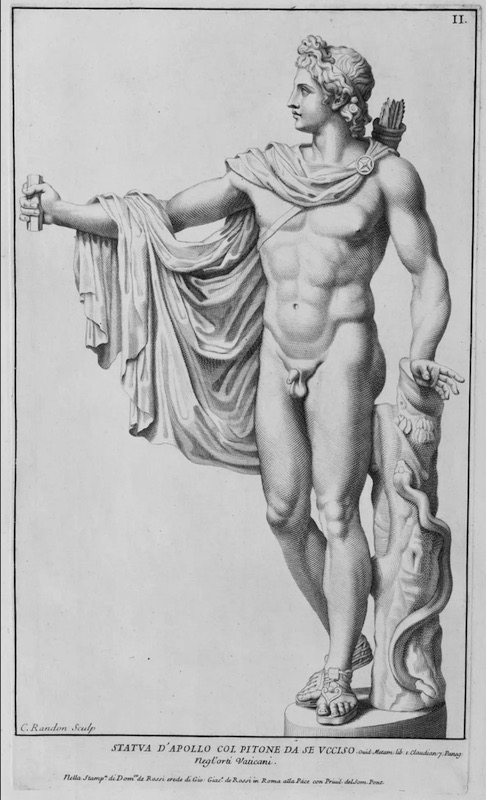
(#1) An engraving by the French artist Claude Randon (1674 – 1704), about whom I’ve not been able to find anything, beyond reproductions of his engravings on Classical subjects (I’ll show you his Belvedere Apollo in a little while)

This work probably appeared in my Pinterest mailing because of my 9/15/24 posting “Speeding into the 20th century”, about a J.C. Leyendecker homoerotic portrayal of Mercury (Greek Hermes) in a 1907 magazine cover.
Now to look at the actual sculpture.
The Hermes Ludovisi. From Wikipedia:
(#2) The model for #1The Hermes Ludovisi, also formerly known as Mercurio Oratore (“Mercury the Orator”), is a Hellenistic sculpture of the god Hermes in his form of Hermes Psychopompus. It is made of Italic marble and is a somewhat slick 1st-century AD Roman copy after an inferred bronze original of the 5th century BC which is traditionally attributed to the young Phidias, ca 440 BC … Its model is among the earliest sculptural representations of Hermes as beardless and youthful. It was acquired by Cardinal Ludovico Ludovisi for the Ludovisi collection and is now on show at the Palazzo Altemps.
A variant on a somewhat reduced scale, found in Anzio, is conserved in the Museo Nazionale Romano, Palazzo Massimo alle Terme. As in other free Roman-era copies, there are variations in the shaping of the soft-brimmed petasos Hermes wears and the angle of the kerykeion [Latin caduceus] in his left hand.

The Apollo Belvedere. First, the Randon engraving:
(#3) Apollo of the Belvedere: another heroic male nude; note the quiver of arrows on the god’s back
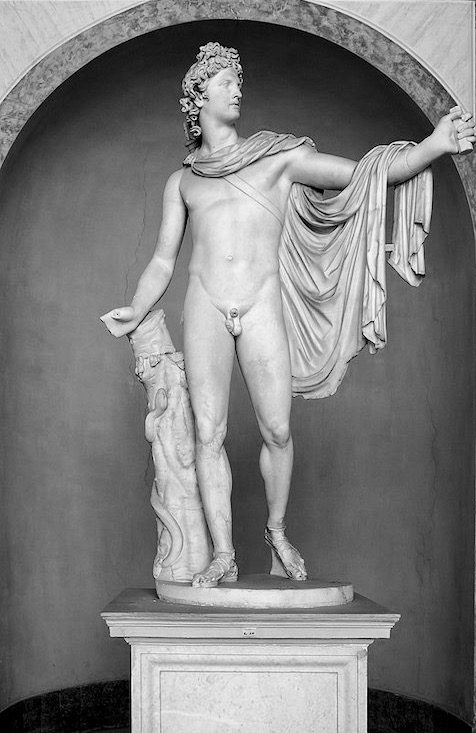
Now the statue, from Wikipedia, with the sad story of the work’s reception by (British) art critics:
(#4) Apollo in the VaticanThe Apollo Belvedere (also called the Belvedere Apollo, Apollo of the Belvedere, or Pythian Apollo) is a celebrated marble sculpture from classical antiquity./
The work has been dated to mid-way through the 2nd century A.D. and is considered to be a Roman copy of an original bronze statue created between 330 and 320 B.C. by the Greek sculptor Leochares. It was rediscovered in central Italy in the late 15th century during the Italian Renaissance and was placed on semi-public display in the Vatican Palace in 1511, where it remains. It is now in the Cortile del Belvedere of the Pio-Clementine Museum of the Vatican Museums complex.
From the mid-18th century it was considered the greatest ancient sculpture by ardent neoclassicists, and for centuries it epitomized the ideals of aesthetic perfection for Europeans and westernized parts of the world.
… The Romantic movement was not so kind to the Apollo’s critical reputation. [The critic] William Hazlitt (1778–1830) … was not impressed and dismissed it as “positively bad”. The eminent art critic John Ruskin (1819–1900) wrote of his disappointment with it.
Finally, starting something of a trend among some later commentators, the art critic Walter Pater (1839–1894) adverted to the work’s homoerotic appeal by way of explaining why it had been so long lionized. The opinion was not widely accepted. Nevertheless, the work retained much popular appeal and casts of it were abundant in European and American public places (especially schools) throughout the 19th century.
The critical reputation of the Apollo continued to decline in the 20th century, to the point of complete neglect.
Now, I’m not trained in art history or criticism, but I have plenty of experience judging homoerotic appeal. I can tell you that J.C. Leyendecker’s Mercury is definitely hot:
(#5) Mercury and his (phallic) caduceus (plus his delightful flying shoes); we don’t see much of his handsome face, but his muscular body is prominently on display, thanks to the pose JCL has put him in

In contrast, Apolllo’s body in #4 is pretty much the standard heroic male nude body of Classical statuary. What makes him stand out is his delicately beautiful face (and neck). In fact, the head of the Belvedere Apollo became a notable art object in its own right:
(#6) Close-up of the head (also letting us see the quiver more clearly)
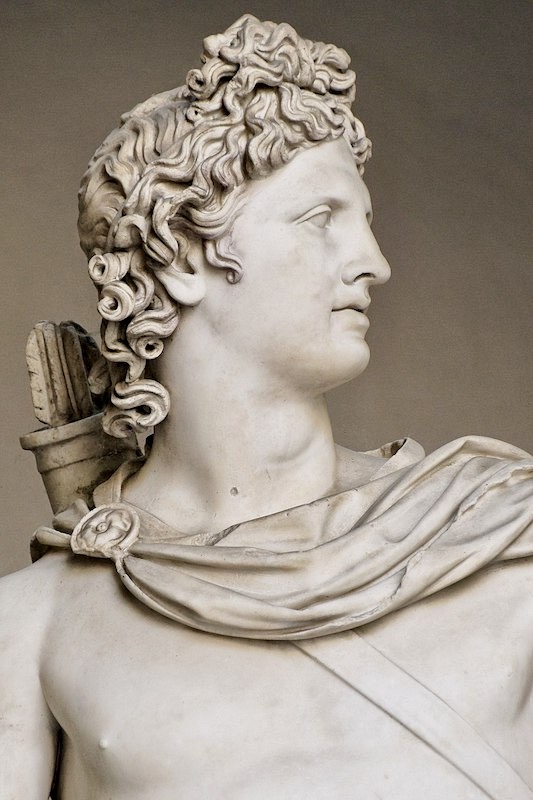
#6 (minus the quiver) has been the source, over centuries, of innumerable reproductions and variations for sale (ranging from the faithful to the downright tacky). Beautiful Apollo lives on in the popular imagination.
Leave a Reply